


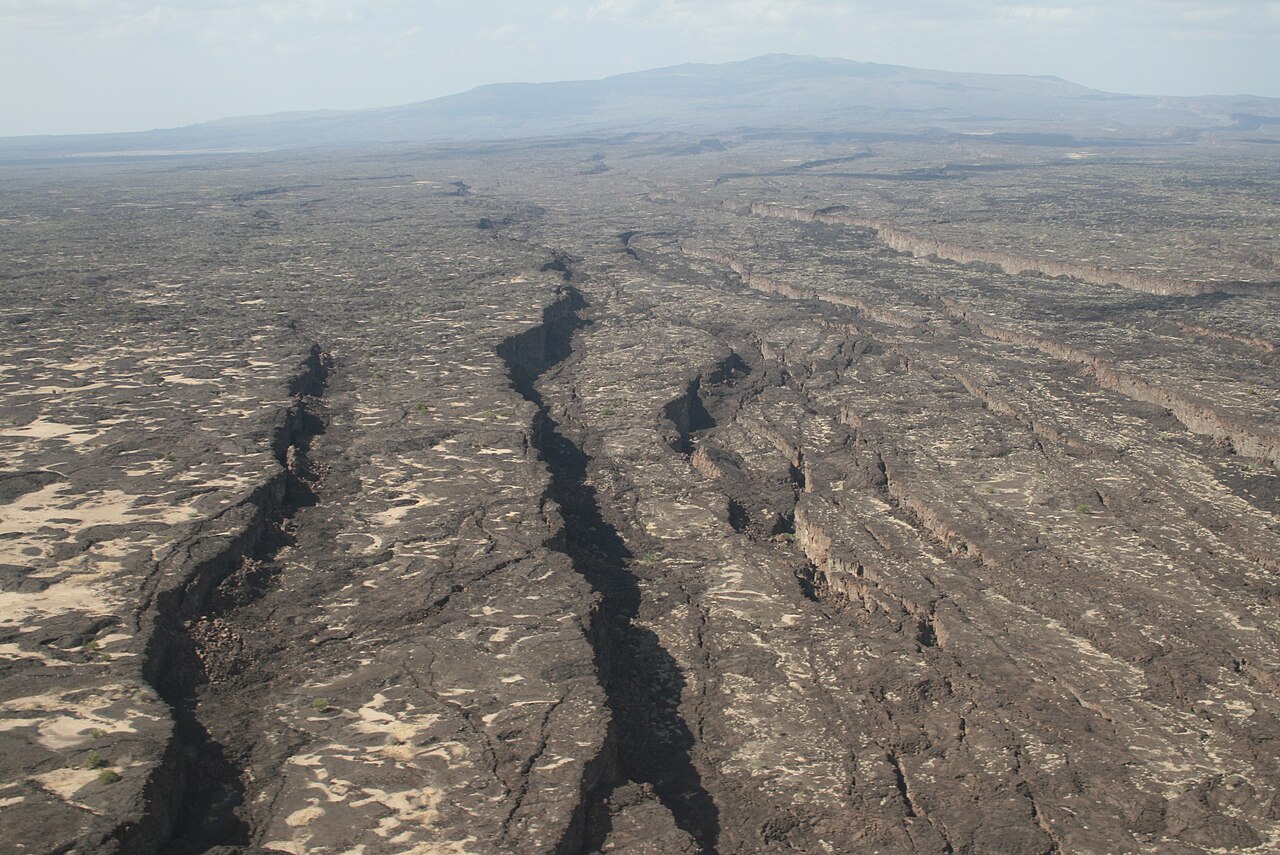
The African continent is divided by tectonic plates in the heart of Ethiopia. Recent investigations by geophysicists have significantly enhanced our understanding of tectonic plate separation. Research indicates that continents initiated their break-up when the crust and upper mantle, known as the lithosphere, began to exhibit cracks and misalignments. Magma from deep within the Earth’s interior ascends through these fractures, resulting in volcanic formations. While scientists are aware that volcanoes emerge in continental rift areas, the pace of their formation remains uncertain, complicating assessments of volcanic hazards in these zones.
Researchers, spearheaded by Kevin Wong, sought to address this mystery by examining minerals formed during magma cooling, specifically focusing on olivine. They analyzed 72 olivine crystals sourced from the Bok and Jiwei volcanoes within Africa’s Main Ethiopian Rift (MER) zone, with sizes ranging from 1 to 4 millimeters (0.04 to 0.16 inches). The research revealed that the lithosphere in this region remains approximately 35-40 kilometers (21-25 miles) thick, suggesting that the MER is at an intermediate stage in continental separation. This provides a unique platform for studying the transition between tectonic deformation and magmatic fractures during the separation process.
Wong and his team analyzed olivine due to its position as one of the earliest minerals to crystallize from magma, continuing to grow as the magma rises and cools. As the magma ascends, its composition shifts, generating distinct chemical “zones” within the crystals, akin to tree rings. Variations in temperature and magma composition cause different elements, such as magnesium and iron, to diffuse into and out of the crystals at varying rates. This allows scientists to model chemical zones in olivine crystals and determine the magma’s ascent rate from the upper mantle to the surface.
Wong and his team studied olivine crystals from the MER volcanic field using high-magnification imaging and chemical analysis via an electronic microprobe. They conducted mappings at 10 to 15 points, spaced 5 to 15 microns apart (approximately 10% the thickness of a human hair) along a cross-section from the inner core to the outer edge of each crystal.
They identified two distinct populations of olivine crystals. The first featured a normal zone crystal with a magnesium-rich inner core, while the second showcased a reverse zone crystal with a magnesium-poor core. The researchers clarified that freshly formed magma deep within the Earth typically contains a higher concentration of magnesium compared to iron. The magnesium-rich zone presents a distinct boundary with the magnesium-poor zone, yet this boundary can become indistinct due to diffusion. Given that diffusion smoothes these boundaries over time at a known rate, researchers leveraged this “fuzziness” to ascertain the rate at which the crystals equilibrated with the surrounding magma.
Employing a numerical model, the researchers estimated the diffusion rates of magnesium and iron across chemical boundaries at varying temperatures and magma chemistries. They compared thousands of simulated diffusion profiles with their measured olivine diffusion profiles. Through this iterative process, they projected that during the Bok and Jiwei eruptions, the crystals ascended from deep within the Earth and integrated into the surrounding magma for an average of 40 and 17 days, respectively. They additionally validated these figures using a growth-diffusion model that replicates natural crystal behavior, yielding an average ascent time of about 27 days and better aligning with the observed crystal band pattern.
From these models, researchers concluded that intermediate-stage rifting events occur on surprisingly short time scales. On average, magma ascends up to 40 kilometers (25 miles) from the Earth’s depths to the surface within approximately one calendar month. This timeframe aligns more closely with human perceptions than geological ones. They proposed that this rapid ascent is likely due to a sophisticated magmatic plumbing system present within the lithosphere before significant thinning occurs. However, the research also indicated that the timescale of magma ascension lies within a broader range than ideal for disaster prediction and mitigation.
Post views:
1,432
Source: sciworthy.com