


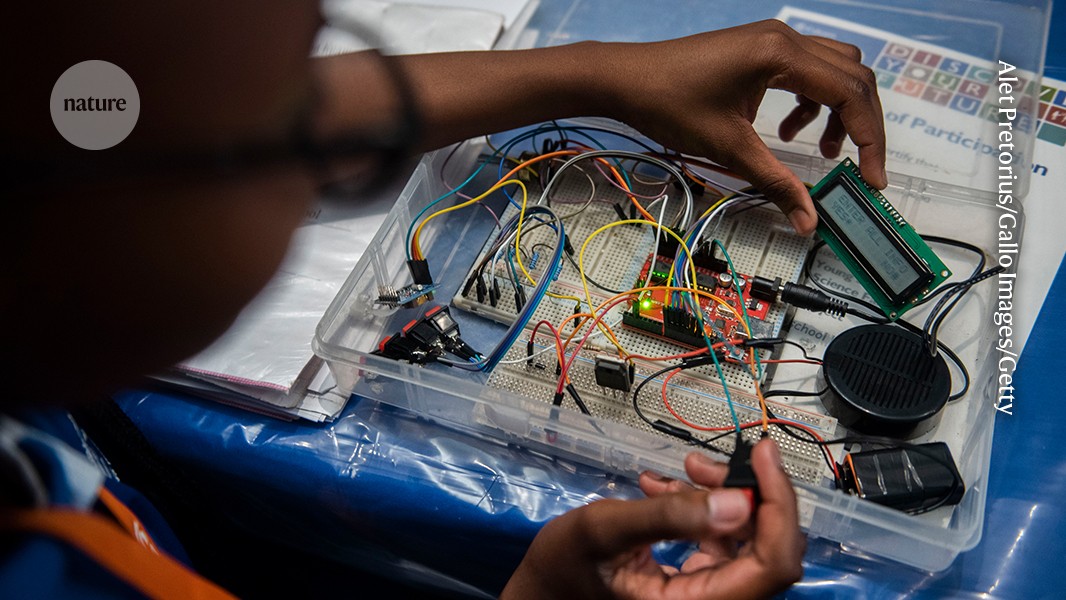
South Africa’s proposed scientist-registration law could affect the future of the country’s young researchers.Credit: Alet Pretorius/Gallo Images/Getty
Engineers, environmental health specialists and medical professionals share an important responsibility: in many countries, they can only practise legally after registering with the relevant professional body. Registration usually involves passing a qualifying examination and complying with regulations that include penalties for professional misconduct. The goal is to protect quality, ethics, public safety and the environment.
South African scientists could face prison for failing to register with public bodies
Scientists are not generally classified as regulated professionals in most countries. Although many belong to scientific societies that establish professional standards and disciplinary procedures, membership is usually voluntary. South Africa is taking a different approach. The government plans to introduce stricter rules that would require “practising natural scientists” to register with the South African Council of Natural Scientific Professions (SACNASP).
Legislation published in March defines scientific practice as “the rendering of services or advice in a specialized field of natural science,” whether the work is paid or unpaid. The proposed rules would exempt people who teach at accredited educational institutions or develop government policy related to the natural sciences. However, the wording leaves some uncertainty about whether registration would be required when those individuals also carry out scientific practice.
If approved, South Africa could become one of the first countries to make professional registration a legal requirement for scientists as a group. Individuals who fail to comply could face a prison sentence of up to one year.
The principle behind the proposed South African scientist-registration law is understandable. Scientific work can affect public health, safety and the environment, and stronger accountability may be justified in high-risk areas. However, the legislation has several serious weaknesses. The first is the government’s limited communication. Although the draft was available for public comment from March to May, many scientists — including people in senior positions — only became aware of it last week. nature News article (nature 656804–805. 2026).
The government should also have consulted scientists and other affected stakeholders before drafting the bill. Broad consultation would have improved public awareness and helped make the registration requirements clearer. As written, the legislation is difficult to interpret. For example, it excludes researchers who teach at universities or develop government policy, but it does not clearly explain whether registration is necessary when those researchers are also considered to be practising natural scientists.
The proposed penalties are another concern. A prison sentence for failing to register, when no harm has occurred, appears disproportionate. Governments have several other options for encouraging compliance, including fines, workplace sanctions, loss of employment and deregistration. Healthcare professionals and members of other tightly regulated occupations can face a range of consequences for breaching professional rules without being immediately threatened with imprisonment.
The independence of SACNASP also requires closer examination. The council is a government agency, and the bill states that the government will appoint a director nominated by an independent body. Regulatory institutions are generally more credible when they operate independently from political authorities. Professional standards should be developed by qualified experts, based on the best available evidence and free from undue government influence. Public trust is also more likely when regulations are seen as independent and professionally developed.
The South African Government is right to consider stronger standards and accountability for scientific activities that affect people’s well-being and the natural environment. Other countries are exploring similar proposals, although no comparable system has yet been implemented. Before the bill advances, South Africa should clarify its language, review the proposed penalties and establish firm safeguards for the independence of scientific regulation.
The best way to improve the legislation would be through meaningful consultation with the scientists who will be regulated, the public the rules are intended to protect and researchers with relevant legal and professional expertise. The government still has time: no date has been set for the bill to be debated and voted on in South Africa’s parliament. If the country creates a clear, proportionate and independent framework, the law could strengthen research integrity, protect the public and offer other nations a model for distinguishing reliable scientific advice from misinformation.
Source: www.nature.com