


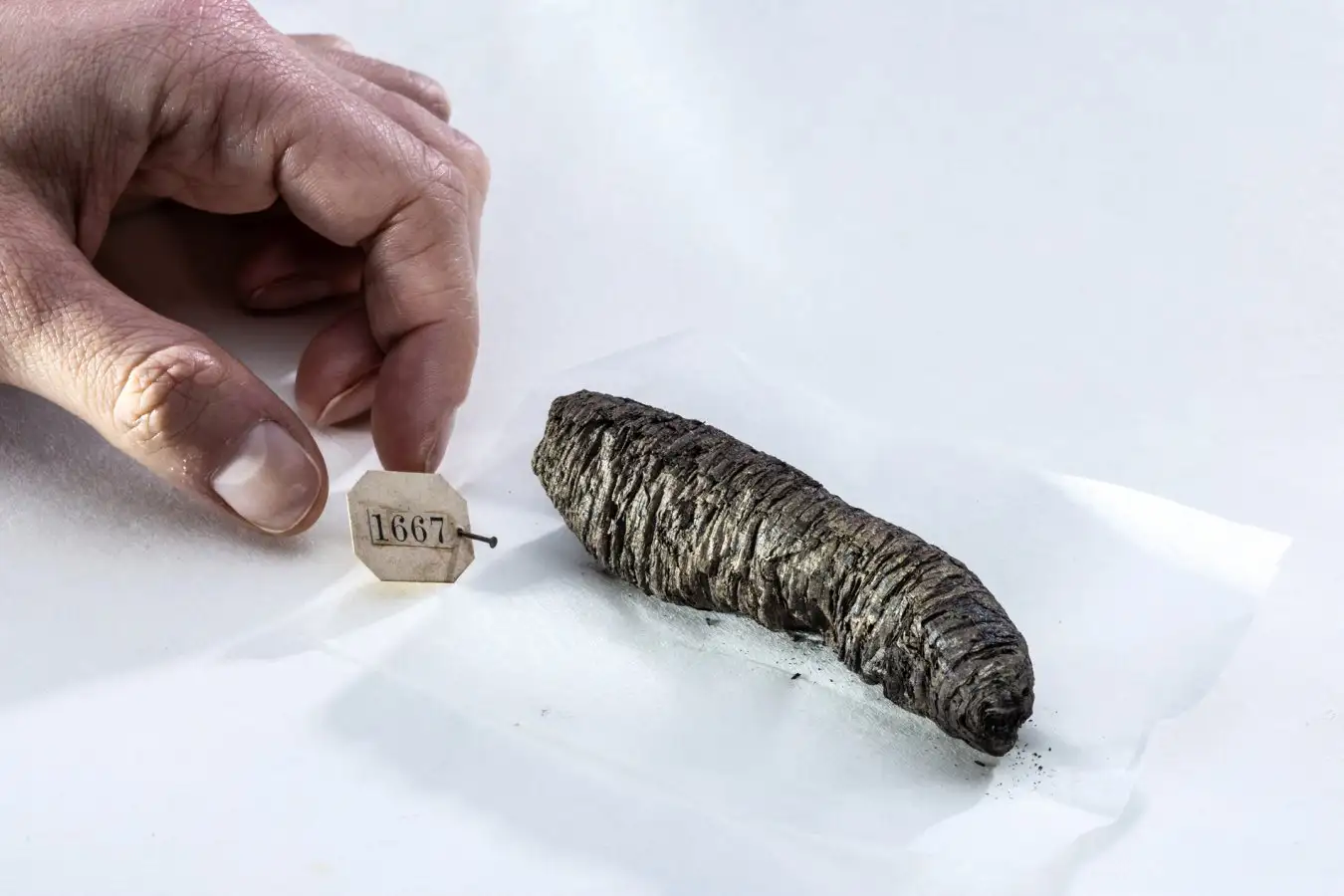
Carbonized scroll of Herculaneum, now readable through advanced imaging technology.
Paolo Verzone/National Geographic
A groundbreaking discovery has emerged as researchers have unveiled a long-lost ancient philosophical work hidden within a carbonized papyrus scroll, previously deemed unreadable after the catastrophic eruption of Mount Vesuvius in 79 AD. Utilizing cutting-edge AI technology, researchers have successfully extracted the entire text from an ultra-high-resolution 3D scan without needing to physically unfold the delicate scroll.
These ancient scrolls were salvaged from the library of Herculaneum, buried alongside Pompeii nearly 2,000 years ago. Since the library’s discovery in 1752, scholars have grappled with the charred remnants that appear like lumps of charcoal. Opening the scrolls risks irreversible damage, as the ink is often indistinguishable from the charred papyrus to the naked eye.
<p>However, starting from 2023, the <a href="https://scrollprize.org/">Vesuvius Challenge</a> has implemented a revolutionary project. By using a particle accelerator, numerous scrolls were scanned and the results were shared with an online community. This collaborative effort has led to the development of AI software that can virtually "open" the scrolls and detect ink, enabling researchers to read book titles, authors, and significant passages with greater clarity.</p>
<p>This time, the research team uncovered a remarkable 1.5-meter long text written in 22 columns on a 2-centimeter wide core. The outer layer had been meticulously removed over centuries by scholars seeking to access the content.</p>
<p>“I found a record that I attempted to open multiple times…but could not read,” remarked <a href="https://www.docenti.unina.it/teacher/46454445524943414e49434f4c415244494e434c46524339304c34354638333942/profile/references">Federica Nicolaardi</a> from Federico II, University of Naples, Italy. "Fragments from previous attempts to physically open the scroll revealed only a few visible letters. Through virtual opening, we have indeed transformed the narrative surrounding this ancient papyrus."</p>
<section>
</section>
<p>Scrolls are co-founders of the Vesuvius Challenge, with <a href="https://www2.cs.uky.edu/dri/w-brent-seales/">Brent Shields</a> from the University of Kentucky dubbing one of them the "Impossible Scroll." This particular scroll represents one of many surviving texts from early papyrus scholars who often bypassed complex scrolls in favor of simpler ones.</p>
<p>Shields explains that combining high-resolution imaging techniques down to 2 micrometers with abundant scanning data has enabled the AI algorithms to read lengthy sections of scrolls that were once deemed inaccessible.</p>
<p>At present, the AI models adjust to individual scrolls based on variations such as the ink types used. Shields remains optimistic that as the AI examines more scrolls, it will successfully detect ink in previously unreadable texts. "This is why we’re employing large-scale language models," he notes. "Training these models across vast datasets from the internet is essential, although we are not there yet with scrolls."</p>
<p>The unsealed texts delve into themes of ethics, art, and humanity, frequently referencing Stoic doctrines typical of the second-century B.C. period, suggesting Chrysippus, the renowned Greek Stoic philosopher, is likely the author.</p>

<p>Chrysippus is venerated as one of the foundational architects of Stoicism; however, the majority of his compositions have been lost to history. As classical scholars like <a href="https://research-information.bris.ac.uk/en/persons/thomas-r-p-coward/?_gl=1*1llqwes*_gcl_au*MTQyNzg0ODI1Ni4xNzgwMzE3ODg4*_ga*MTQ4NTc2NDEwNS4xNzgwMzE3ODg5*_ga_6R8SPL3HLT*czE3ODE3ODM4MDEkbzMkZzEkdDE3ODE3ODM4MzMkajI4JGwwJGgw">Thomas Coward</a> from the University of Bristol have noted, we primarily know of his work from the critiques of others.</p>
<p>“Accessing the original texts—rather than relying on quotes or summaries subject to interpretation by other authors—holds significant importance,” he states, comparing this find to unearthing the lost writings of iconic figures like Isaac Newton or Albert Einstein, whose works are primarily known through secondary sources.</p>
<p>
    <figure class="ArticleImage">
        <div class="Image__Wrapper">
            <img class="Image" alt="Text by the philosopher Philodemus from a Herculaneum scroll" width="1350" height="900" src="https://images.newscientist.com/wp-content/uploads/2026/06/24125718/SEI_302685264.jpg" srcset="https://images.newscientist.com/wp-content/uploads/2026/06/24125718/SEI_302685264.jpg?width=300 300w, https://images.newscientist.com/wp-content/uploads/2026/06/24125718/SEI_302685264.jpg?width=400 400w, https://images.newscientist.com/wp-content/uploads/2026/06/24125718/SEI_302685264.jpg?width=500 500w, https://images.newscientist.com/wp-content/uploads/2026/06/24125718/SEI_302685264.jpg?width=600 600w, https://images.newscientist.com/wp-content/uploads/2026/06/24125718/SEI_302685264.jpg?width=700 700w, https://images.newscientist.com/wp-content/uploads/2026/06/24125718/SEI_302685264.jpg?width=800 800w, https://images.newscientist.com/wp-content/uploads/2026/06/24125718/SEI_302685264.jpg?width=837 837w, https://images.newscientist.com/wp-content/uploads/2026/06/24125718/SEI_302685264.jpg?width=900 900w, https://images.newscientist.com/wp-content/uploads/2026/06/24125718/SEI_302685264.jpg?width=1003 1003w, https://images.newscientist.com/wp-content/uploads/2026/06/24125718/SEI_302685264.jpg?width=1100 1100w, https://images.newscientist.com/wp-content/uploads/2026/06/24125718/SEI_302685264.jpg?width=1200 1200w, https://images.newscientist.com/wp-content/uploads/2026/06/24125718/SEI_302685264.jpg?width=1300 1300w, https://images.newscientist.com/wp-content/uploads/2026/06/24125718/SEI_302685264.jpg?width=1400 1400w, https://images.newscientist.com/wp-content/uploads/2026/06/24125718/SEI_302685264.jpg?width=1500 1500w, https://images.newscientist.com/wp-content/uploads/2026/06/24125718/SEI_302685264.jpg?width=1600 1600w, https://images.newscientist.com/wp-content/uploads/2026/06/24125718/SEI_302685264.jpg?width=1674 1674w, https://images.newscientist.com/wp-content/uploads/2026/06/24125718/SEI_302685264.jpg?width=1700 1700w, https://images.newscientist.com/wp-content/uploads/2026/06/24125718/SEI_302685264.jpg?width=1800 1800w, https://images.newscientist.com/wp-content/uploads/2026/06/24125718/SEI_302685264.jpg?width=1900 1900w, https://images.newscientist.com/wp-content/uploads/2026/06/24125718/SEI_302685264.jpg?width=2006 2006w" sizes="(min-width: 1288px) 837px, (min-width: 1024px) calc(57.5vw + 55px), (min-width: 415px) calc(100vw - 40px), calc(70vw + 74px)" loading="lazy" data-image-context="Article" data-image-id="2531726" data-caption="Text by the philosopher Philodemus from a Herculaneum scroll" data-credit="Vesuvius Challenge"/>
        </div>
        <figcaption class="ArticleImageCaption">
            <div class="ArticleImageCaption__CaptionWrapper">
                <p class="ArticleImageCaption__Title">Text of philosopher Philodemus from the Herculaneum scrolls</p>
                <p class="ArticleImageCaption__Credit">Vesuvius Challenge</p>
            </div>
        </figcaption>
    </figure>
</p>
<p>Included among the discoveries is a previously illegible scroll identified as <em>About God, Volume 8</em>, an expanded edition of the known work <em>About God, Volume 1</em>, part of an eight-book series by Philodemus.</p>

<p>This remarkable find signifies an extraordinary leap in computational imaging techniques for digital unwrapping. Professor <a href="https://www.ncl.ac.uk/hca/people/profile/nickfreer.html">Nicholas Freer</a> from Newcastle University, UK, believes that this innovative technology could fundamentally reshape our understanding of the ancient world.</p>
<p>"The significance of these advancements lies in the hundreds of unopened scrolls that still exist," he asserts. "What we are witnessing is not merely a singular breakthrough; we are entering a long-term recovery process that could unfold over decades."</p>
<p>For Shields, who has dedicated decades to digital opening technology, this discovery signifies a shift from focusing on technological functionality to allowing the scrolls to express their true historical narratives.</p>
<p>"People will increasingly want to know the identities of the authors, the age of the scrolls, and their philosophical implications," he emphasizes. "While we strive to make manual jobs redundant, our priority is to restore the voices that history has silenced."</p>
<p>If there’s one regret, it’s the loss of scrolls before they could be read, he reflects. "What was extracted from the ground—the original scrolls from 1752—may soon yield their secrets," he adds, noting their relative legibility.</p>

<section class="ArticleTopics" data-component-name="article-topics">
    <p class="ArticleTopics__Heading">Topics:</p>
</section>
Source: www.newscientist.com