


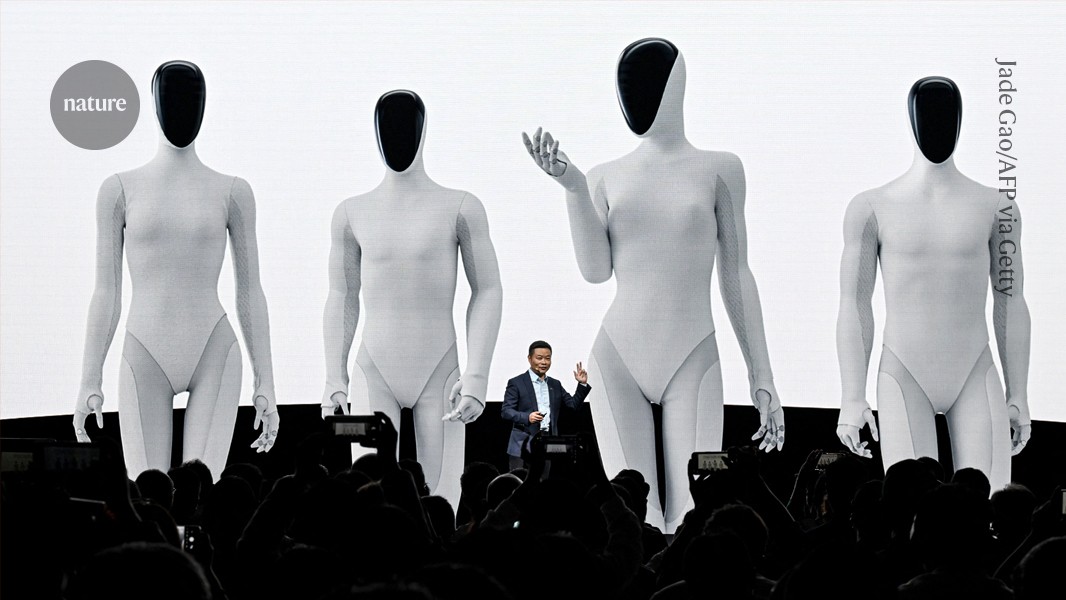
Artificial intelligence can seem daunting, but researchers say curiosity and a basic understanding of AI tools are essential starting points. Credit: Jade Gao/AFP via Getty
Artificial intelligence and machine learning are becoming essential skills for scientists. Employers and research funders increasingly expect candidates to understand how AI can support scientific discovery, even as the overall number of science jobs declines. Data compiled by job site Indeed shows that listings requiring AI skills are rising rapidly in the United States, while total science-related hiring has fallen (see “Demand for AI”).
At the Quadram Institute, which specializes in food science and gut biology in Norwich, UK, researchers are expected to demonstrate at least some knowledge of AI and machine learning, says chief executive Daniel Feigaze.
“They should definitely be familiar with it,” he said. Much of the institute’s work involves machine learning, high-throughput screening and the analysis of large datasets with AI tools. “It depends on the position, but if they lack all those skills, that would be a red flag.”

Source: Indeed
Researchers do not need to become AI specialists to benefit from these tools. Rather than worrying that artificial intelligence will replace scientific jobs, they can learn to use AI to interpret data, test ideas and deepen their understanding of complex problems.
Regina Barzilay, a computer scientist who teaches a specialist course for scientists at the Massachusetts Institute of Technology (MIT) in Cambridge, compares learning AI with learning to cook. “You don’t need to learn every recipe on the planet to feel comfortable in the kitchen,” she says. “But you do need this very basic understanding.” In other words, scientists do not have to become computer scientists before they can use computers effectively.
nature spoke to nine recruiters and researchers about the most important artificial-intelligence skills for scientists working in every field.
Be curious about AI
Recruiters repeatedly told nature that curiosity and a willingness to learn are often more valuable than a long list of specific AI skills. Candidates can demonstrate this interest on their CVs by describing courses, personal projects, workshops or practical experiments with AI tools.
“Whether it’s informal training or just spending a few hours with open-source educational content, it’s the willingness to roll up your sleeves and get started,” says Vijay Shah, director of research at the Mayo Clinic in Rochester, Minnesota. The clinic had about 30 research positions open in May.
A willingness to learn matters because AI is changing so quickly. Requiring candidates to have experience with particular tools, such as OpenClaw or AlphaGenome, could soon become outdated, Shah says.
Christopher Walsh, chief executive of TileBio, a Glasgow, UK, start-up that uses AI to analyze medical images, shares this view. “These days, it’s very easy to teach yourself new information using large language models if you check the sources, so I encourage you to approach it with curiosity,” he says. “Be open to learning new things. I think that’s the first step.”
Universities and professional organizations increasingly offer artificial-intelligence training alongside science courses. Online resources are also available from institutions such as MIT and the Royal Society of Chemistry in London. Researchers do not have to rely exclusively on formal education, Feigaze says; self-directed learning and hands-on experimentation can also build useful skills.
Understand how AI works
One of the biggest risks of using AI in research is accepting its output without critically examining the data, methods or assumptions behind it. “A lot of times we get the results that users want based on what they say,” Walsh says. “It’s a people pleaser.”
AI-generated probabilities can also differ from what happens in the real world and therefore need to be tested carefully. If an AI model says there is an 80% chance that a radiology image contains cancer cells, Barzilay suggests asking a simple question: “Can I trust this 80%?”
Link Should you use AI to write applications for science jobs?
This process is known as calibration. It involves checking whether a model’s probability estimates reliably match the observed outcomes in the data being analyzed.
For example, cancer-screening models are often evaluated using historical cases. When they are applied to new populations, however, the risk thresholds used by the models might no longer reflect reality. In an unpublished study, MIT AI expert Aziz Ayed and colleagues found that the AI model MIRAI misclassified breast-cancer risk in women, potentially preventing some patients from being identified for additional screening.
Engineer Sydney Pham completed a machine-learning course taught by Barzilay in 2024. She now works at pharmaceutical company Moderna in Cambridge, Massachusetts, where she uses AI to improve manufacturing processes. Her work includes identifying promising experimental parameters and highlighting areas that require further investigation.
“Models can sometimes make sense of unexpected observations, which can inform further research iterations,” Pham says. She adds that AI recommendations should always be evaluated alongside other measurements and scientific evidence. “It’s helpful to understand how a model produces results.”
“Understanding the functionality of the model is very important,” says Dominique Lukesh, a consultant at the AI Competency Center at the University of Oxford, UK. Researchers should develop a practical understanding of what happens when a model runs on a machine or interacts with a dataset.
Lukesh says it is worth investing time in learning how AI systems work. Researchers can otherwise receive unreliable answers from large language models and mistakenly assume that the technology is indispensable. Effective AI use requires practice: learning how to frame questions, assess responses, verify sources and revise workflows.
Know the limits of your AI expertise
In the age of AI, many scientific research proposals include ambitious plans to use the technology. But recruiters and funders say that applicants often fail to demonstrate that their teams have the experience needed to deliver those plans. Simply writing “we will use AI to achieve our goals” is not convincing without technical details, evidence and relevant expertise.
Many proposals submitted to Cancer Research UK (CRUK) in London now include AI, says Talicia Cuaro, the charity’s director of prevention and early-detection research. Funding committees need applicants to explain which AI methods they will use, how the algorithms work, how they will be validated and what their limitations are.

Developing effective humanoid robots is one goal of researchers working on embodied intelligence.Credit: VCG (via Getty)
One CRUK success story is Ke Yuan’s research group, AI for Cancer Research. The team previously included Walsh, who studied computer science as an undergraduate before completing a doctorate focused on cancer.
“I was one of the members who brought computer-science knowledge,” Walsh says. Each member of the team had a distinct role in the grant. His responsibility was to translate knowledge of pathology and cell biology into computer code.
Cuaro says that publishing research involving AI is one of the clearest ways for scientists to demonstrate their expertise to grant reviewers. Research teams can also strengthen proposals by including members with relevant AI, statistics or data-science experience. Although every researcher does not need to be an AI specialist, the team should be able to explain its methods, validate its results and acknowledge the technology’s limitations.
Source: www.nature.com