


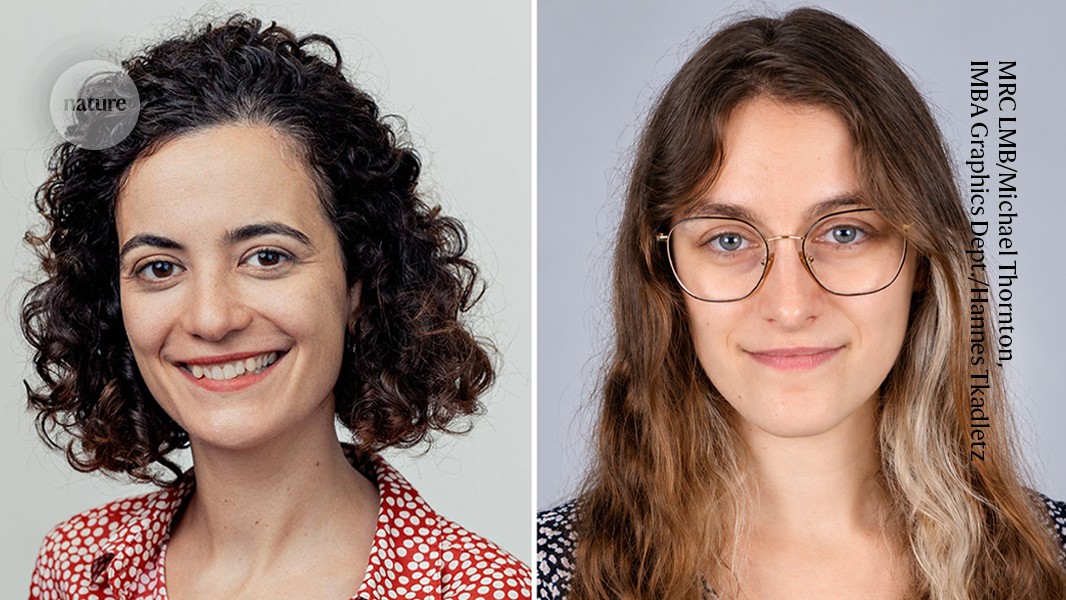
Scientists are mourning the deaths of developmental biologists Marta Shabaj Alonso and Tamara González Costa, who were killed in a high-speed train collision in Spain on October 28. The accident near Urda, in central Spain, killed 69 people and injured more than 100, making it one of the worst railway accidents in modern European history.
Shabaj Alonso, 41, was a stem-cell and developmental biologist at the MRC Laboratory of Molecular Biology (LMB) in Cambridge, UK. González Costa, 31, was a postdoctoral researcher at the Vienna Institute of Molecular Biotechnology (IMBA). Both scientists were from Spain and were travelling to the 19th meeting of the Spanish Society for Developmental Biology (SEBD) in El Rompido.
Shabaj Alonso was due to receive an award at the conference for her contributions to the study of human embryonic development.
Eva Ortega Paino, secretary general for research at Spain’s Ministry of Science and Innovation, wrote in Spanish on LinkedIn: “The sadness and emptiness I feel is immeasurable and nothing compares to the pain their families are suffering today.”
A breakthrough in embryo research
Researchers describe Shabaj Alonso as an outstanding scientist who made pioneering contributions to extending the time that human embryo models can grow in laboratory culture, a notoriously difficult task.
She joined the laboratory of stem-cell scientist and developmental biologist Magdalena Żernicka-Goetz at the University of Cambridge in 2014 as a postdoctoral researcher. “One of the things I’ll never forget and will always stay with me is her enthusiasm,” says Jernica Goetz, who runs a laboratory at the California Institute of Technology in Pasadena. “She loved science for science’s sake.”
In 2016, Shabaj Alonso worked with Żernicka-Goetz’s team on a method that allowed human embryos to be grown in the laboratory for up to 14 days after fertilization, compared with seven days in earlier efforts.1 The work enabled scientists to study a critical stage of human development in unprecedented detail and provided an alternative to mouse models.
“For the first time, we can identify the characteristics of the life of a human fetus at the time of so many failed pregnancies, allowing us to understand what has to happen for the fetus to survive,” says Żernicka-Goetz.
Vincent Pasque, a stem-cell and developmental biologist at the Catholic University of Leuven in Belgium who knew Shabaj Alonso, describes the work as “a real breakthrough”.
Research by Shabaj Alonso and Żernicka-Goetz also identified “molecular checkpoints” that regulate cell development and tissue formation in early embryos.2
“Marta was more than just an extraordinary scientist and a rising star in her field. She was a vibrant member of our laboratory family and part of LMB’s future,” LMB director Jan Löwe said in a November 2 press statement. “We are devastated by her death and our hearts go out to her family, her children and everyone who had the privilege of working with her at LMB and elsewhere.”
A role model for scientists and parents
Colleagues also remembered Shabaj Alonso, a mother of two, for the way she balanced a demanding scientific career with raising her children. “She was the perfect scientist and the perfect mother,” says her friend and collaborator Roser Vento-Tormo, a geneticist at the Wellcome Sanger Institute in Cambridge.
Vento-Tormo described Shabaj Alonso as a passionate scientist who was loved and generous towards her students and colleagues. “When I was pregnant and needed to know everything about being a mother, she really taught me everything, from food recipes to local schools,” she said.
In 2020, Shabaj Alonso established her own research group at the LMB to continue studying embryonic development. “She was a role model to many people around the world, including me,” Pasque says. “The way she combined motherhood and science was really amazing.”
“I actually use Marta as a model for my students,” says Żernicka-Goetz. “She encouraged them to focus on science.”
Vento-Tormo said that Shabaj Alonso’s latest research made a significant contribution to understanding aneuploidy, a condition in which embryonic cells have extra or missing chromosomes. Aneuploidy is associated with miscarriage and implantation failure. Parts of this research “will become clearer in the coming months”.
“She was preparing the tenure file,” Pasque said. “This is truly a tragedy for our community.”
Source: www.nature.com