


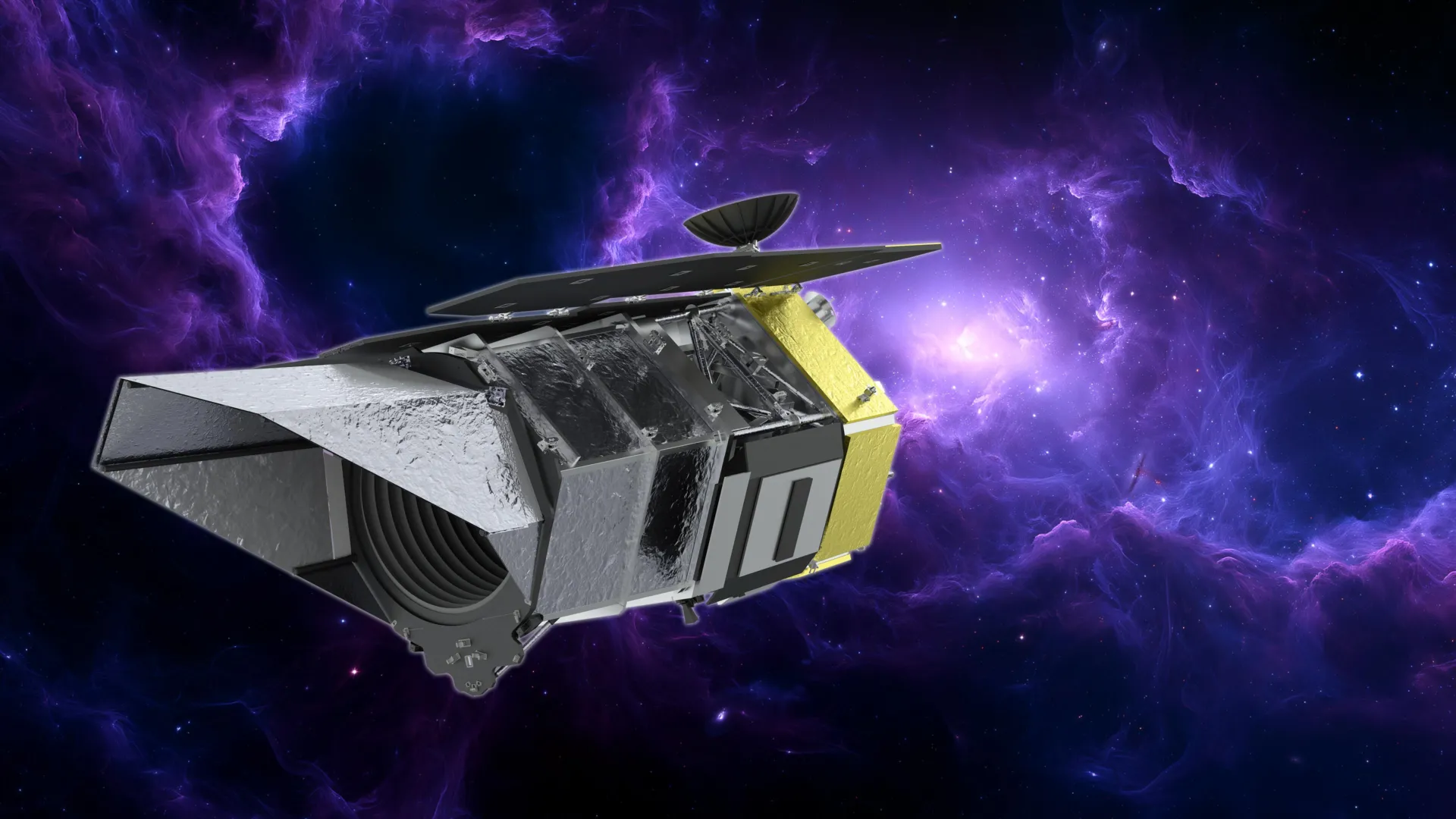
NASA’s Nancy Grace Roman Space Telescope is just two days from launch, ushering in NASA’s next flagship astrophysics mission after the James Webb Space Telescope. University of Arizona faculty and students will watch from Cape Canaveral as the Roman Space Telescope begins its journey toward scientific operations, scheduled to start in January 2027.
Unlike the James Webb Space Telescope, which studies relatively small regions of space in extraordinary detail, Roman is designed to survey enormous areas of the sky quickly. Both observatories detect infrared light, enabling astronomers to compare and combine their observations. Together, the NASA Roman Space Telescope and Webb could reveal more about the universe than either mission could discover alone.
Hubble-sized mirror with a wider field of view
Roman features a 7.9-foot primary mirror, matching the diameter of the Hubble Space Telescope, along with two major scientific instruments. Its coronagraph instrument will block and filter starlight, allowing astronomers to study exoplanets and the disks of material surrounding them. Roman’s wide-field instrument is designed to offer sensitivity comparable to Hubble’s camera while imaging 100 times more of the sky.
During more than 30 years of observations, Hubble has examined approximately 0.1% of the night sky. By comparison, Roman could survey the entire sky at a similar resolution.
Roman’s expansive field of view will help scientists find rare celestial objects both near Earth and across the distant universe. Researchers hope to identify dying stars, newly discovered planets, galaxy clusters and many other astronomical targets. University of Arizona researchers will contribute to several major areas of Roman science.
Exploring dark matter and dark energy
One of the Nancy Grace Roman Space Telescope’s primary science goals is to study dark matter and dark energy, two mysterious components that account for nearly all of the universe. Dark matter exerts gravity but does not emit light, while dark energy is believed to drive the accelerated expansion of the universe.
NASA selected the University of Arizona’s Arizona Institute for Cosmology, which includes a broad science team and a project infrastructure team, to support two initiatives focused on understanding these phenomena.
Elizabeth Krauss, professor of astronomy and physics, leads the wide-field science team “Kinematic Lensing with the Roman Space Telescope.” The group received $2 million to develop a cosmological measurement technique known as a kinematic lens.
By combining Roman images with spectroscopic measurements, researchers hope to study dark matter and dark energy with greater precision than ever before.
A group of universities will also play a leading role in the infrastructure team for the multi-institutional project “Maximizing Space Science Through Roman High-Latitude Imaging Surveys.” Tim Eifler, professor of astronomy and physics, leads the working group responsible for interpreting Roman’s cosmological observations.
Turning galaxy surveys into cosmic maps
Roman will identify galaxies across a broad range of distances, determine their locations and measure their properties. Astronomers will use this information to create massive catalogs and apply physical models that reveal how the universe formed and evolved.
These analyses require significant computing power. The NASA Roman Project awarded Eifler’s lab $800,000 for computing resources that will become part of a new university-wide high-performance computing system scheduled for installation this fall. The institute will also receive an additional $2.4 million over five years to support its research.
“This infrastructure takes us from cataloging to cosmological interpretation,” Eifler said. “We will be able to measure how much dark energy and dark matter there is in the universe.”
Eifler also co-chairs the Cosmology Group, which includes more than 1,000 scientists from around the world.
“It’s great to bring the community together and organize us around this scientific event,” he said. “This is truly a dream job.”
Directly photographing distant planets
Roman’s coronagraph instrument uses masks, prisms, detectors, filters and deformable mirrors to demonstrate advanced starlight-suppression technology. By reducing the intense glare of a host star, astronomers will be able to directly image nearby planets and circumstellar disks that would otherwise be difficult to observe.
Direct imaging represents a major advance in exoplanet research. Most known exoplanets have been discovered indirectly, such as by measuring the slight dip in a star’s brightness when a planet passes in front of it.
Roman’s coronagraph will instead search for planets by blocking the light of their host stars. The instrument is expected to detect planets up to 100 million times fainter than their stars, with performance 100 to 1,000 times better than existing space-based coronagraphs.
“This is an important path forward for future habitable-world observatories,” said Skyler Wolff, an associate research professor of astronomy who leads the coronagraph instrument observation planning working group. The telescope is specifically designed to support future searches for signs of life beyond our solar system.
Preparing for Roman’s exoplanet observations
Mark Murray, director of the Lunar and Planetary Institute; Euan S. Douglas, associate professor of astronomy; Ramya Anche, assistant professor at Steward Observatory; and Justin Hom, a postdoctoral fellow in astronomy, also contributed to the development of the coronagraph instrument. They will participate in future science planning through the Observation Planning Working Group.
Marley, along with LPL Associate Professor Ty Robinson and LPL Postdoctoral Researcher Zara Brown, will use coronagraph data to study the atmospheres of planets beyond our solar system.
Brown has modeled the climates and spectra of self-luminous giant planets. These worlds are often young and hot enough to emit their own thermal infrared radiation.
The models predict atmospheric temperature, composition and cloud properties, as well as the infrared spectrum produced by each object. These predictions are especially valuable because many of these planets have never been observed at these wavelengths.
“That predicted spectrum is very important for planning,” Brown said. “Roman’s coronagraph targets extremely dark, high-contrast objects, so teams must schedule enough observation time to detect candidates without unnecessarily using the mission’s limited observing time.”
Anche’s team is investigating structures beyond our solar system, while Hom is leading efforts to identify the best stars for calibrating Roman’s coronagraph instruments. Hom also leads a program to observe potential targets with ground-based telescopes. This work is essential for confirming which targets should be selected for future Roman science programs.
Roman science operations begin in January 2027
When the Roman Space Telescope begins scientific operations in January 2027, its data will be available to researchers across the global scientific community.
The University of Arizona will lead nine NASA-approved studies using Roman data and receive more than $2 million in funding. Researchers plan to use Roman’s observations to investigate supermassive black holes, gravitational lensing, galaxy formation, cosmic reionization, cosmic dust and other fundamental questions about the universe.
Source: www.sciencedaily.com