


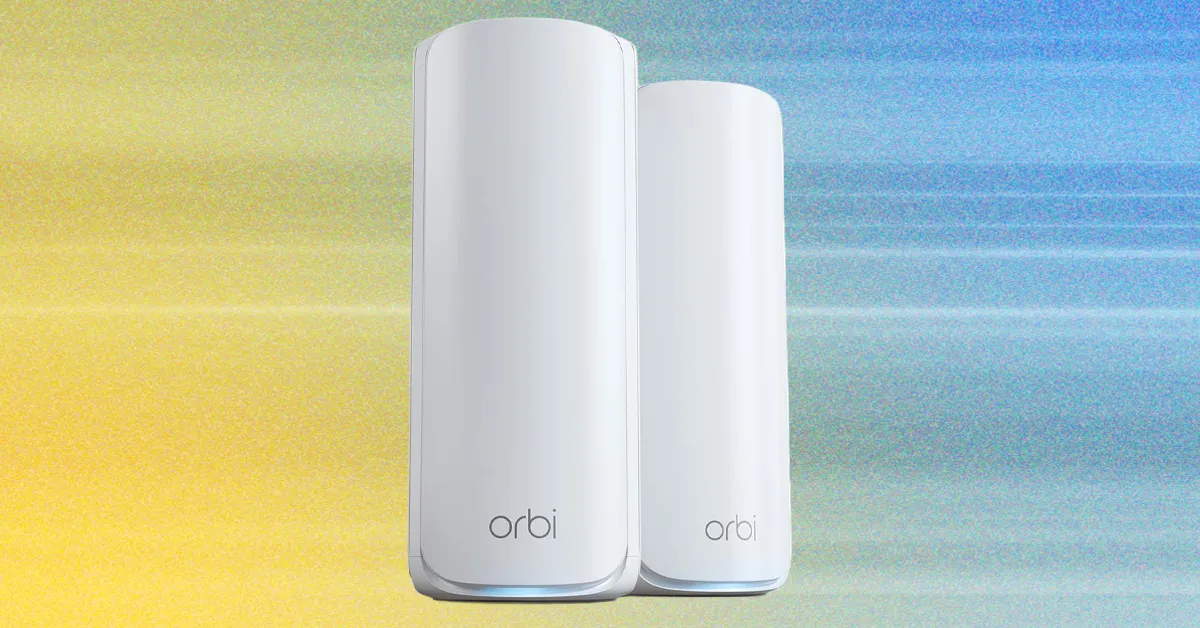
The Netgear Orbi 770 is a large Wi-Fi 7 mesh system with a design similar to the company’s premium Orbi 970 series, but at a lower price. The main router includes four 2.5 Gbps Ethernet ports, while each satellite has two 2.5 Gbps ports. There is no USB port. Setup is fast and straightforward through the Netgear Orbi mobile app.
This tri-band mesh Wi-Fi system supports the 2.4-GHz, 5-GHz, and 6-GHz bands. By default, all three bands share a single network name, or SSID, and support Wi-Fi 7 Multi-Link Operation (MLO). This feature allows compatible devices to use multiple wireless bands at the same time for improved speed, reliability, and latency.
However, MLO and Wi-Fi 7 have stricter security requirements, including WPA2 or newer encryption. Some older devices may not connect to the primary network, although a guest network or dedicated IoT network can often solve the problem. Older hardware, such as an iPhone 5, is unlikely to work with the main Wi-Fi 7 network.
Wi-Fi 7 also introduces support for channels up to 320 MHz wide, doubling the previous 160-MHz maximum, along with several other performance improvements. In testing, the Orbi 770 delivered fast, dependable Wi-Fi and excellent coverage. Netgear claims that a three-pack can cover up to 8,000 square feet, although real-world coverage depends on your home’s layout, building materials, and wireless interference.
The Orbi 770 is fast, stable, and capable of covering a typical home without difficulty. It was slower than some other Wi-Fi mesh systems tested, but most people are unlikely to notice the difference during everyday activities such as web browsing, video calls, streaming, and online gaming. The performance gap becomes more apparent when transferring large files across the network.
With enough bandwidth for several household members to stream 4K video, work remotely, and play games simultaneously, the Orbi 770 is a strong choice for busy homes. Wi-Fi 7 devices connected directly to the main router can achieve consistent, low-latency multi-gigabit speeds. However, wireless backhaul through the satellites occasionally introduced delays. Connecting the satellites to the router with Ethernet can eliminate those latency issues.
The Orbi app has a clean, uncomplicated interface. It lets you see connected devices, run an internet speed test, and manage basic network settings. Netgear also includes 30-day trials of its Armor security service, powered by Bitdefender, and its Smart Parental Controls. After the trial, Armor costs $40 for the first year and $100 annually thereafter. Parental controls cost $8 per month and include user profiles, age-based filters, schedules, and time limits. Neither subscription is required to use the Orbi 770.
Unless you have a large home and an internet plan faster than 2.5 Gbps, the Netgear Orbi 770 may perform similarly to more expensive Wi-Fi 7 mesh systems, including the TP-Link Deco BE85 ($1,200), Eero Max 7 ($1,700), and the Netgear Orbi 970 series ($2,000).
In a previous modern home, the performance gains from the Orbi 970 were difficult to notice despite its significantly higher price. For most households, a two-pack of the Orbi 770 should be sufficient. If you have an internet connection faster than 2.5 Gbps, consider stepping up to the Netgear Orbi 870 three-pack for around $1,300. Prices for these systems frequently drop during sales.
Best Subscription-Free Mesh Wi-Fi System
The Asus ZenWiFi BT10 was one of the best-performing Wi-Fi 7 mesh systems in testing, delivering excellent wireless coverage and strong throughput. Its tri-band design supports the 2.4-GHz, 5-GHz, and 6-GHz bands, while Multi-Link Operation helps create a reliable wireless backhaul between the main router and mesh nodes.
The two-pack was initially tested in a 1,600-square-foot modern home, but the BT10 also handled a difficult Victorian property with thick stone walls and rubble-filled floors. Each unit includes two 10 Gbps Ethernet ports, one Gigabit Ethernet port, and a USB 3.0 port, making it a versatile choice for demanding home networks. Unlike many competing systems, the BT10 includes security software and parental controls without requiring an ongoing subscription.
Source: www.wired.com