


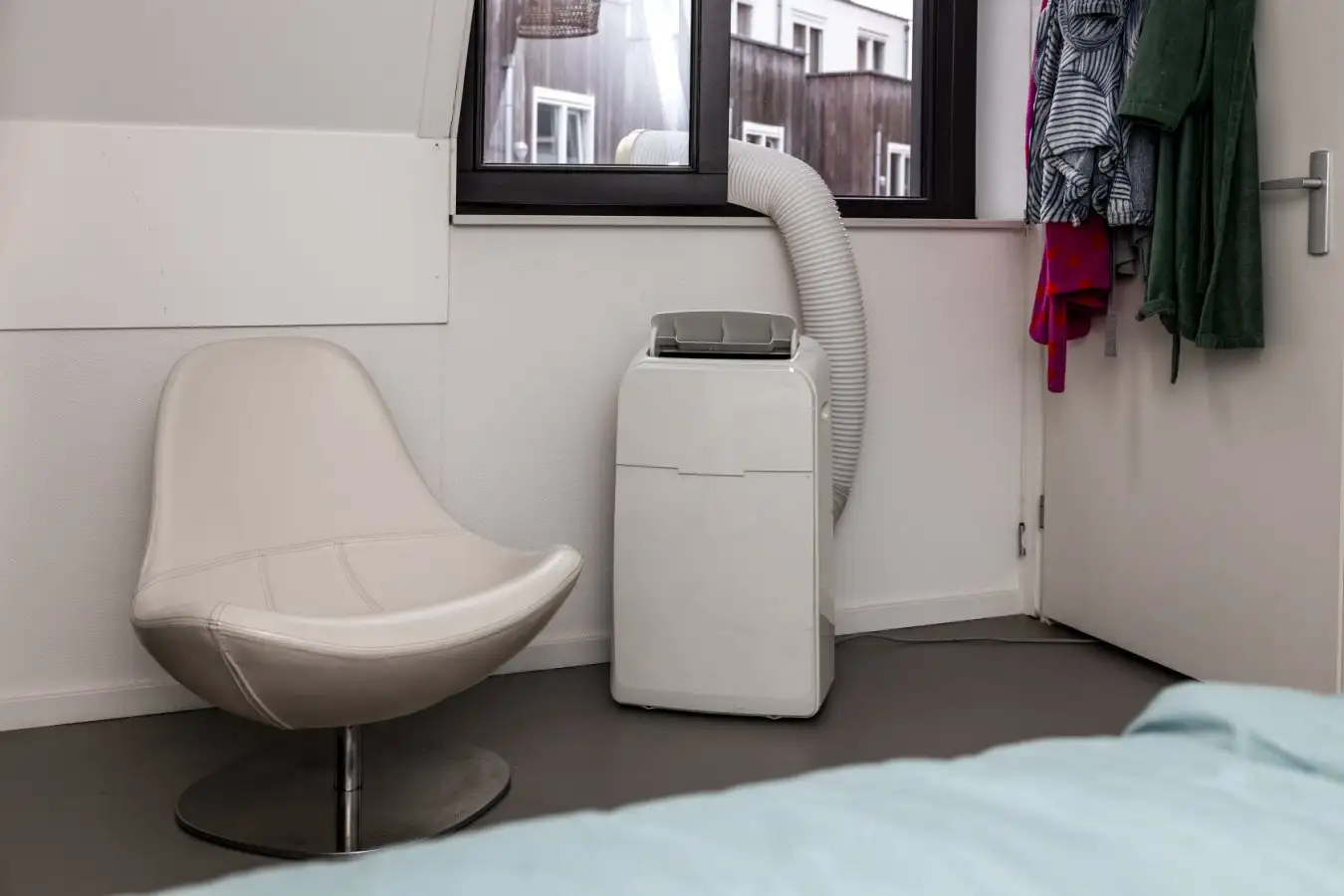
Single-hose air conditioners draw in hot air from outside.
Ton Hazewinkel/Getty Images
Are you contemplating the purchase of a portable air conditioner amidst increasingly frequent heatwaves? It’s crucial to know that a significant number of portable air conditioners possess inherent design flaws, and many lack informative labeling for consumers.
When I bought a portable air conditioner, I was completely unaware of this. The most surprising realization is that there’s a straightforward solution. Legal amendments should be made to prohibit the sale of portable air conditioners without proper labeling.
Let’s confront the prevalent notion in the UK that purchasing an air conditioner may be a misguided choice. If you don’t require one, that’s understandable. However, countless individuals reside in homes that become uncomfortably hot during heat waves, despite adopting measures like closing blinds and windows during the day. Excessive heat not only poses health risks but can also impact productivity and concentration. If it’s acceptable to utilize energy for heating, why not for cooling?
As global temperatures rise, reliance on air conditioning is increasing. Hence, minimizing energy consumption by these additional units is vital for curbing carbon dioxide emissions that exacerbate climate change and intensify the need for refrigeration systems.
Understanding the design flaws requires a grasp of air conditioning mechanics. The most efficient models feature split systems, consisting of an outdoor unit that compresses refrigerant into a liquid and heats it before cooling it through a heat exchanger that utilizes outside air.
This refrigerant is transmitted indoors through a narrow pipe, where it is transformed into gas and cooled. Indoor air circulates through another heat exchanger, cooling the air by transferring heat to the refrigerant.
Consequently, indoor air remains within the space while only heat is expelled. Additionally, split systems typically operate more quietly since the compressor resides in an exterior unit. However, they tend to be pricey and often lack the feasibility for outdoor installation in upper-level rooms, with few portable split systems available on the market.
Some portable air conditioners, on the other hand, draw outside air into the room and feature a wide intake hose that brings in outside air while expelling heated air through a similar outlet. These dual-hose models are less efficient than split systems, as the exhaust hose may inadvertently introduce heat back into the room. Wrapping the hose can mitigate some heat exchange, but spatial considerations can also impact performance.
Unfortunately, single-hose portable air conditioners lack air intake options. Instead, they utilize indoor air to cool hot refrigerant, which is then expelled through a single hose. This process continually introduces hot outside air into the room.
With an open window, hot air readily flows inside, while closed windows allow heat to infiltrate through various areas of your home—raising indoor temperatures. Consequently, these air conditioners must work harder to cool the incoming hot air, leading to increased energy consumption. It’s tantamount to adding unwanted contaminants to laundry detergent.
Moreover, single-hose units quickly lose efficiency when outside temperatures soar, failing to maintain cool indoor conditions as effectively as dual-hose counterparts.
This fundamental design flaw remains unaddressed, as European labels do not highlight these issues. While cooling capacity is noted in British thermal units (BTUs), this merely reflects the machine’s heat transfer efficiency, overlooking the fact that continuous hot air inflow necessitates greater cooling output.
Seasonal Energy Efficiency Ratio (SEER) figures also fall short by only presenting cooling capacity against power consumption, leaving consumers unaware of the performance discrepancies between dual and single-hose models.
As industry expert Chris Michael from Meaco identifies, consumers often prefer single-hose units for their simplicity, while dual-hose alternatives are scarce in the UK market.
In the US, labeling is more straightforward, with measures such as Seasonally Adjusted Cooling Capacity (SACC) taking external heat influx into account—often resulting in a significant reduction in effective capacity by over a third.
Furthermore, the overall energy efficiency ratio (CEER) provides insight into dual-hose unit efficiencies. However, I feel these metrics still fail to present a comprehensive picture. These values assume outdoor temperatures hover around 28°C (82.4°F) for 80% of the operational time—ignoring conditions under which air conditioning is genuinely necessary.
Interestingly, many single-hose air conditioners are effectively dual-hose units with only one hose. Rectifying this issue often requires just an additional hose and attachment. At least one manufacturer, GE, offers conversion kits for select single-hose models, claiming a threefold increase in cooling capacity.
Many consumers have reported success with DIY conversions, using materials from duct tape to 3D printed components, which can significantly improve cooling efficiency—as I personally experienced during a recent heatwave in the UK.
Thus, in my perspective, portable air conditioner labels within the UK and EU should be revised to reflect real performance during extreme heat events. It is misleading for a single-hose unit to carry an “A” efficiency rating.
Ideally, a complete ban on single-hose air conditioners should be instituted. All portable units ought to be marketed as dual hoses, providing the option for single-hose operation only when necessary. In essence, single-hose units should not be marketed without a conversion kit. According to Michael, Meaco is mulling over introducing such options in 2027.
In my quest to find regulatory clarity regarding portable air conditioners in the UK, I encountered significant gaps in response from relevant authorities. Despite attempts to reach out to the Department of Energy Security and the Department of Net Zero, I received no feedback. Even the Energy Saving Trust has yet to respond. However, I remain hopeful that the concerned individuals will take notice. Achieving environmental victories is attainable.
Topics:
- Climate Change/
- Extreme Weather
Source: www.newscientist.com