


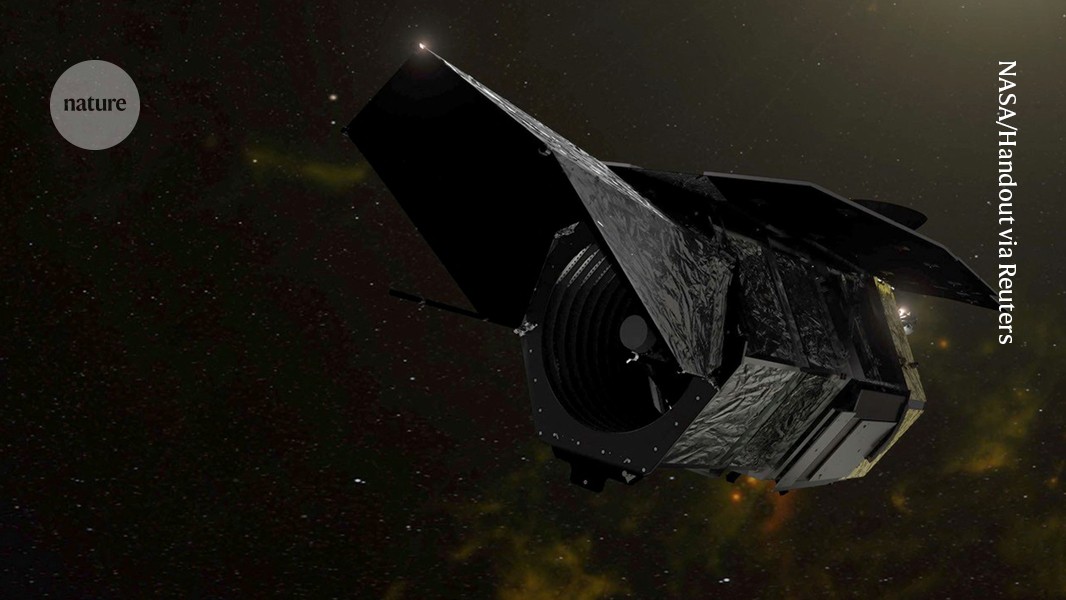
The Nancy Grace Roman Space Telescope’s field of view, shown in this artist’s illustration, is approximately 100 times larger than that of the Hubble Space Telescope.
Credit: Handout via NASA/Reuters
NASA’s newest flagship observatory is safely in orbit after the successful launch of the Nancy Grace Roman Space Telescope. The $4.3 billion infrared space telescope, equipped with the largest digital camera ever built for space, lifted off aboard a SpaceX rocket from NASA’s Kennedy Space Center in Florida at 7:35 a.m. local time. It will now travel to its final operating position.
The Roman Space Telescope is expected to transform astronomy by investigating dark energy—the mysterious force accelerating the expansion of the universe—while also surveying millions of stars in the Milky Way and searching for planets orbiting them. The mission is named after Nancy Grace Roman (1925–2018), NASA’s first chief astronomer and a key leader in the development of several of the agency’s major scientific programs, including the Hubble Space Telescope.
Roman is the final member of a trio of complementary sky-mapping observatories. It will work alongside the US-led Vera C. Rubin Observatory in Chile, which began operations in 2025, and the European Space Agency’s Euclid space telescope, launched in 2023. Together, these missions will collect vast quantities of data and produce highly detailed maps and images that could reshape our understanding of the cosmos.
During its three planned survey programs, Roman will use a 300-megapixel camera to repeatedly capture deep, wide-field images in infrared light. Infrared wavelengths are slightly longer than the wavelengths visible to the human eye, allowing the telescope to study distant objects and large areas of the sky efficiently. “It would be revolutionary,” says Tony Tyson, a physicist at the University of California, Davis.
Why Roman’s infrared vision matters
Roman’s infrared capabilities are central to its mission. As the universe expands, light from the most distant galaxies is stretched into longer, redder wavelengths over billions of years. Much of this infrared radiation is absorbed by Earth’s atmosphere, making space-based observatories ideal for studying the distant universe.
Rachel Mandelbaum, an astrophysicist at Carnegie Mellon University in Pittsburgh, Pennsylvania, says Roman’s sensitivity to infrared light will allow it to look deep into cosmic history and detect red, distant galaxies that are difficult for the Rubin Observatory or Euclid to observe. By creating three-dimensional maps of galaxies, Roman will help cosmologists reconstruct how the universe has expanded over time.

The telescope is also expected to discover thousands of distant supernovae. These stellar explosions act as cosmic markers, allowing researchers to measure how the expansion rate of the universe has changed over billions of years. Such observations could reveal whether dark energy is constant or varies across time and space.
Roman will also survey the Milky Way and examine an estimated 20 billion stars, including those within and beyond the galaxy’s dusty central region. Interstellar dust blocks visible light more effectively than infrared radiation. Roman’s infrared imaging could therefore provide the most complete view yet of the entire galaxy. “We were able to see the entire galaxy unlike any other mission before,” says Dominic Benford, an astrophysicist at NASA in Washington, D.C., and Roman program scientist.
NASA’s James Webb Space Telescope (JWST), launched in late 2021, is also designed primarily for infrared astronomy. However, Roman’s main instrument will have a field of view large enough to cover an area comparable to the full Moon, while JWST’s field of view is about 100 times smaller. Roman will often identify transient objects such as supernovae first, after which astronomers can study them in greater detail with JWST and other observatories.
The long road to the Roman Space Telescope’s L2 orbit
The origins of the Roman mission can be traced to the surprising discovery in the 1990s that dark energy was accelerating, rather than slowing, the expansion of the universe. Saul Perlmutter of Lawrence Berkeley National Laboratory in California helped lead that discovery by analyzing dozens of supernovae that exploded as far back as 7 billion years ago. Perlmutter and fellow Berkeley Lab physicist Michael Levi later proposed the Supernova Accelerator Probe, or SNAP, to study even more distant supernovae and measure dark energy’s influence with greater precision.
Renamed WFIRST, the mission gained important momentum in 2012 when the secretive US National Reconnaissance Office offered NASA two partially assembled space telescopes at no cost. Each featured a 2.4-meter primary mirror, roughly the same size as Hubble’s. Although the mirrors were originally designed for Earth-observation satellites, NASA selected one after recognizing that its wide-field design was ideally suited to a space mission focused on dark energy and the evolution of the universe.
Source: www.nature.com