



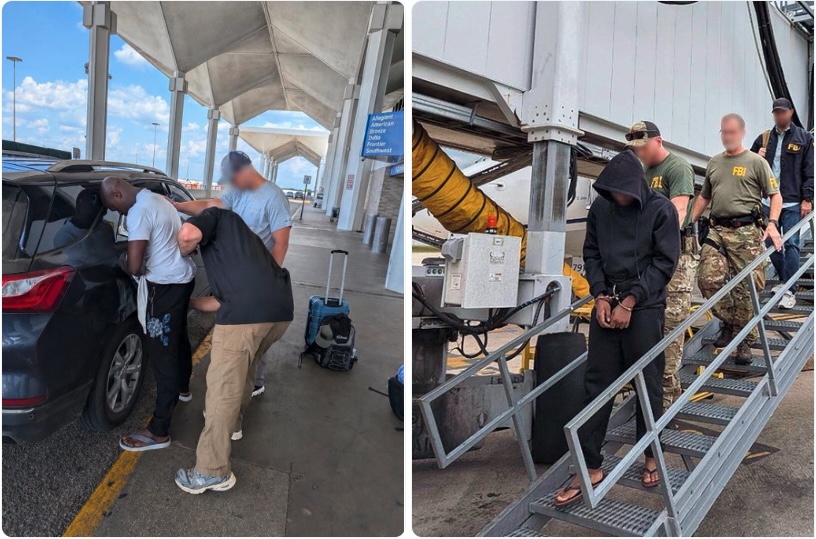
Two Nigerian men have been extradited to the United States to face federal sextortion charges linked to the deaths of two underage victims in Mississippi and North Carolina.
Sextortion is a form of online extortion in which criminals threaten to release nude images or videos unless victims provide money, additional sexually explicit content, or other demands. The material may be stolen through hacking, obtained through coercion, or shared by victims after being manipulated online.
Cybercriminals may also sell stolen content on underground marketplaces or distribute victims’ personal information—including their names, dates of birth, email addresses, phone numbers, and social media usernames—to other criminals. Those individuals can then use the information to continue pressuring victims for more private images and videos.

Adebola Festus Adekunle, 26, and Mudasir Afeez Olawale, 24, were arrested in Nigeria in August 2023 during Operation Artemis. The joint international law enforcement operation targeted sextortion networks in Nigeria that allegedly preyed on minors in the United States.
The two defendants face severe penalties, including possible life imprisonment and a minimum sentence of 30 years in prison on at least two capital murder charges involving child exploitation.
“Adekunle is charged with sexual exploitation of a minor, production of child abuse material resulting in death, coercion and seduction of a minor, and interstate intimidation for the purpose of extortion, while Olawale is charged with sexual exploitation of a minor, coercion and seduction of a minor, and distribution of child pornography,” FBI Director Kash Patel said.
“They had been overseas for three years when the FBI and our Justice Department partners went to capture them. Sextortion is a heinous crime that targets innocent people, often young children, and this FBI will stop at nothing to pursue any individual who harms vulnerable Americans.”
Earlier this month, the FBI warned that cybercriminals are increasingly targeting the social media accounts of children and adults. Attackers use stolen account credentials to obtain sexually explicit images and videos, which can then be used to blackmail victims in sextortion schemes.
In September 2021, the FBI reported a significant increase in sextortion complaints and urged victims to contact law enforcement immediately. Authorities also advise victims to stop communicating with criminals, avoid sending additional images or money, and preserve evidence such as messages, usernames, payment details, and account information.
Sextortion convictions can result in decades behind bars. In May, a Canadian man was sentenced to 33 years in prison after targeting more than 145 children across the United States—including victims as young as six—in an eight-year sextortion operation.
More recently, members of the online cybercrime group The Com were sentenced to two years in prison after pleading guilty to intimidation and multiple counts of child sexual abuse involving approximately 120 victims worldwide.

Overall prevention scores can conceal what happens after an attacker gains initial access. When criminals use valid credentials, an organization’s defenses can weaken significantly.
Blue Report 2026 evaluates defensive techniques across technologies using 338 million simulations conducted in customer production environments.
Source: www.bleepingcomputer.com