


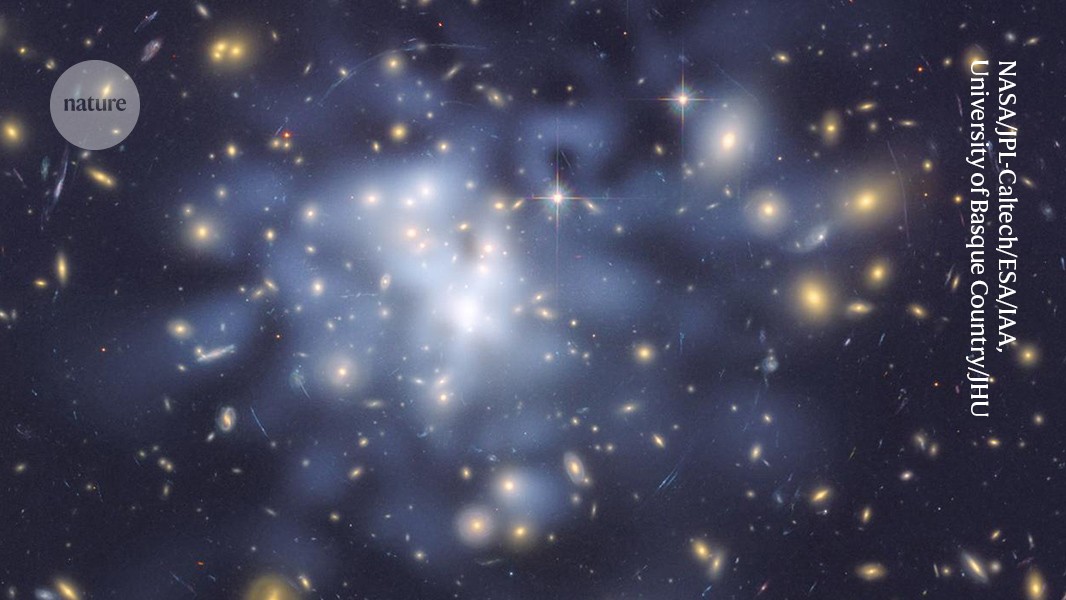
Images captured by the Hubble Space Telescope show dark matter concentrated at the centers of massive galaxy clusters.
Credit: NASA/JPL-Caltech/ESA/IAA, University of the Basque Country/JHU
A single unusual event recorded by a 10-tonne detector filled with ultra-pure liquid xenon could offer a tantalizing clue in the decades-long search for dark matter. Sometime between 2023 and 2024, the LUX-ZEPLIN (LZ) experiment detected a high-energy signal consistent with the possible collision of an atomic nucleus and a massive dark matter particle.
The finding is based on just one event and is not evidence of dark matter discovery. However, if additional data support the result, it could provide important evidence that dark matter consists of heavy particles known as weakly interacting massive particles, or WIMPs. These hypothetical particles have been proposed for decades but have never been directly detected.
Researchers from the LZ collaboration, based at the Sanford Underground Research Facility in Lead, South Dakota, presented the findings at the TeV Particle Astrophysics Conference in Tendo, Japan, on September 1. The results were also described in a preprint published on the experiment’s website.1
Scientists stress that previous dark matter experiments have produced similarly encouraging signals that were later traced to background noise or other sources. Even so, the LZ event is “interesting and will definitely excite the field,” says Jianglai Liu, a physicist at Shanghai Jiao Tong University in China.
LZ experiment detects an unusually energetic event
For decades, physicists have suggested that WIMPs could account for much of the dark matter in the Universe. Numerous experiments have attempted to detect these particles as they pass through Earth or to create them by colliding particles at facilities such as the Large Hadron Collider near Geneva, Switzerland. So far, those searches have not produced conclusive evidence, prompting many researchers to investigate alternative candidates, including extremely light particles.
Launched in late 2021, LZ is a larger and more sensitive successor to an earlier xenon-based experiment designed for the direct detection of dark matter. In the latest analysis, LZ researcher Samuel Eriksen and colleagues examined 220 days of data collected between March 2023 and April 2024.
The critical moment for my theory on dark matter
The researchers searched for rare flashes of light produced when energetic particles collide with xenon nuclei, causing the nuclei to recoil. Most direct-detection searches focus on low-energy events, in which the xenon nucleus receives less than 50 kiloelectronvolts (keV) of energy. The new analysis expanded the search range to 270 keV.

The LZ central detector at the Sanford Underground Research Facility in Lead, South Dakota.
Credit: Matthew Kapust/Sanford Underground Laboratory
The LZ experiment and two other major xenon-based dark matter searches—XENON at Italy’s Gran Sasso National Laboratory and PandaX at China’s Jinping Underground Laboratory—have previously explored this high-energy range. Those earlier studies used smaller data sets and older detectors, however, and found no signals beyond the expected background, including high-energy neutrons generated by natural radiation.
To reduce the risk of unconscious bias, the LZ collaboration “salts” its data by adding randomly generated events that imitate potential dark matter interactions. Researchers analyze the data without knowing which events are real and remove the artificial signals only after completing the analysis.
“After desalting, there was only one event left,” says Richard Gaitskell, a physicist at Brown University and an LZ spokesperson. “Obviously, it was very exciting.”
The remaining event involved a nuclear recoil that deposited 248 keV of energy in the detector. LZ researchers estimate that a dark matter particle capable of producing this signal would have a mass of at least 200 gigaelectronvolts (GeV), and possibly close to 1,000 GeV. For comparison, 1 GeV is approximately equivalent to the mass of a proton.
“What we’re looking at is just one high-energy event,” Eriksen says. “We’re not claiming that this is dark matter at all.”
Scientists urge caution over possible dark matter signal
“One thing is for sure: this event is very shocking,” says Caterina Doglioni, an experimental particle physicist at the University of Manchester in the United Kingdom who works on the ATLAS experiment at CERN, Europe’s particle-physics laboratory.
Because the analysis examines a relatively unexplored range of nuclear-recoil energies, researchers say that potential background sources must be investigated carefully. PandaX spokesperson Jianglai Liu cautions that conventional explanations need to be thoroughly tested before the event can be linked to WIMPs or any other dark matter candidate.
Source: www.nature.com