


Close Menu
HitechubHitechub
    What's Hot
    Technology

    What will you do if the world remains without internet?

    Science

    AI Startups Transforming Mathematics: The Race to Revolutionize Learning and Innovation

    Technology

    What has Tesla’s Optimus robot learned so far?

    Important Pages:
    • About Us
    • Privacy Policy
    • Terms & Conditions
    Facebook X (Twitter) Instagram Pinterest
    Facebook X (Twitter) Instagram
    HitechubHitechub
    Thursday, June 25
    • Technology
      1. AI
      2. Gadgets
      3. View All

      This is the most popular CEO in the world

      Sectors in which “Chat-GPT” is most often used

      AI Pioneer Expresses Concern About Potential for AI to Surpass Humanity

      Artificial intelligence has begun to “swallow” professions

      What’s new in Android 14

      Europeans have about 700 million old mobile phones in their drawers

      Here’s how you can tell if your phone is being tapped

      “Sneaker X” – computer case in the shape of a sneaker

      Russian Gamers Unite to Prevent Nuclear War: Join the Fight Online

      Challenges of Space Travel: Why Journeying to Space is So Difficult

      NASA Astronaut Casts Historic Vote from Space

      Discover the Future of Comfort: What If You Could Wear a Chair?

    • Science
      1. Space
      2. Wheels
      3. View All

      Galaxies in the universe are growing more slowly than they should

      “Espace” presented the new lander “Apex 1.0”

      The largest asteroid sample ever collected has arrived on Earth

      (VIDEO) Incredible flight of the Parker Solar Probe

      Toyota wants to make a new generation battery with a range of up to 1,200 km

      Meet Toyota’s lunar “baby” that could make exploring the Moon easier

      Microlino – Is this the perfect city car?

      Alfa Romeo 4C gets an electric successor

      Breakthrough in Cancer Research: Antarctic Creature Holds Promise for New Treatments

      How Daily Bright Light Exposure Can Help Prevent Dementia

      Instant Stress Relief Techniques: Quick Tips for Finding Peace Instantly

      Discover the Top 17 Must-Read Science Books of 2026

    HitechubHitechub
    Home » How Daily Bright Light Exposure Can Help Prevent Dementia
    Science

    How Daily Bright Light Exposure Can Help Prevent Dementia

    Share Facebook Twitter Pinterest WhatsApp
    Share
    Facebook Twitter LinkedIn Pinterest WhatsApp

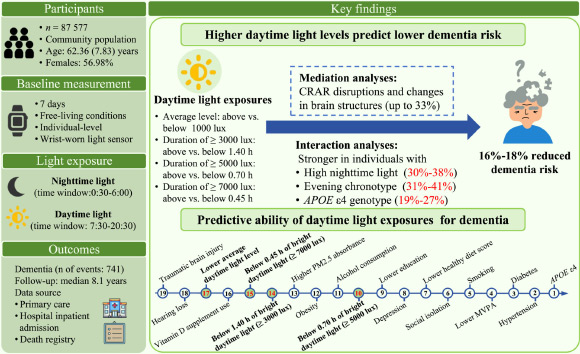
    Research from Guangzhou Medical University reveals a compelling link between exposure to daytime light and reduced rates of dementia among nearly 88,000 adults tracked over eight years.


    Zheng et al. highlight the association between ample daytime light exposure and decreased dementia risk. Image credit: Zheng et al., doi: 10.1002/gps3.70039.

    “Dementia, the leading neurodegenerative disease globally, is marked by progressive cognitive decline and diminishing capability in daily activities,” stated Dr. Hongliang Feng, co-senior author of the study.

    “As our global population ages, the incidence of dementia is escalating sharply, while effective treatments remain scarce, presenting increasing health and socio-economic challenges.”

    “Therefore, identifying protective factors and forming effective prevention strategies is of paramount importance.”

    “The natural light-dark cycle, marked by darkness at night and bright light during the day, serves as a fundamental environmental cue that regulates endogenous circadian rhythms.”

    “These circadian rhythms govern physiology, behavior, and cognitive functions.”

    “Conversely, disruptions in circadian rhythms are frequently observed in individuals with dementia and are linked to a heightened dementia risk in the broader population.”

    In this comprehensive study, researchers monitored 87,577 adults from the UK Biobank over a median follow-up period of 8.1 years.

    The findings indicated that individuals exposed to light levels of 1,000 lux or higher (akin to the brightness of indirect outdoor light) experienced a roughly 16% lower risk of developing dementia compared to those in dim settings.

    Benefits increased with light intensity; participants who spent at least 42 minutes daily in environments with 5,000 lux or above saw their risk diminish by about 17%.

    Significantly, light exposure was measured using a wrist-worn sensor continuously for seven days, providing real-world data instead of relying on self-reported surveys.

    “These findings establish daytime light exposure as a novel, robust, and quantifiable indicator of dementia risk,” stated the researchers.

    When compared to 15 established dementia risk factors using a machine learning model, insufficient daytime light exposure was found to outpace influences such as obesity, alcohol consumption, air pollution, and traumatic brain injuries.

    Subgroups with significant nighttime light exposure, such as night owls and those with the Apoe ε4 genetic mutation—recognized as the most significant genetic risk factor for Alzheimer’s—saw a reduction in dementia risk by up to 41%.

    Researchers propose that daytime light may contribute to dementia risk reduction by stabilizing circadian rhythms and sustaining specific brain structures.

    In contrast, exposure to light at night showed no significant impact on dementia risk.

    “The results of this research may guide future studies and public health strategies focusing on light-based interventions that encourage increased daytime light exposure as an economical approach to bolster brain health, particularly in high-risk groups,” concluded the scientists.

    For more insights, refer to their paper published in the journal General Psychiatry.

    _____

    Nana Jen et al. 2026. Association between daytime and nighttime light exposure measured by wearable devices and dementia risk: a prospective cohort study. General Psychiatry 39 (3): e70039; doi: 10.1002/gps3.70039

    Source: www.sci.news

    Share. Facebook Twitter Pinterest LinkedIn WhatsApp
    Previous ArticleInstant Stress Relief Techniques: Quick Tips for Finding Peace Instantly
    Next Article Breakthrough in Cancer Research: Antarctic Creature Holds Promise for New Treatments

    Related Posts

    Science

    Breakthrough in Cancer Research: Antarctic Creature Holds Promise for New Treatments

    Science

    Instant Stress Relief Techniques: Quick Tips for Finding Peace Instantly

    Science

    Discover the Top 17 Must-Read Science Books of 2026

    Science

    Ancient Philosophers’ Lost Writings Rediscovered from Unreadable Scrolls

    Science

    How Phages Could Enhance Vaccine Immunity While Targeting Cancer Cells

    Science

    Record-Breaking IBM Chip Achieves 100 Billion Transistors Using Innovative Technology

    Science

    Revolutionary Method for Detecting Volcanic Eruptions | Sciworthy Insights

    Science

    Study Finds Modified Mediterranean Diet Boosts Healthy Lifespan in Mice

    Add A Comment
    Leave A Reply Cancel Reply

    Stay In Touch
    • Facebook
    • Twitter
    • Instagram
    • Pinterest
    Top Picks
    Science

    How Human Error Transformed into a Weapon Against Large-Scale Language Models

    Typos indicate human involvement in writing…for now. Marc de Simone/Alamy In a recent conversation over…

    Exploring Two Distinct Autism Subtypes Identified by Unique Brain Activity Patterns

    No Young Woman Has Died from Cervical Cancer in the UK for Years: A Positive Trend

    How Quantum Computers Enhance the Spookiness of Horror Video Games

    Sherp vehicle – still the best truck in the world

    Most Popular
    Science

    Award-Winning Dramatic Photo Captures Ibis on Its Journey to Winter Home

    Science

    Newly Discovered Microraptorin Dinosaur Species Unveiled in China

    Categories
    • AI (13)
    • Gadgets (10)
    • Science (360)
    • Space (9)
    • Technology (37)
    • Wheels (9)
    Our Picks
    Science

    The 6 Most Common Poop Problems and Expert Solutions from a Harvard Doctor

    Technology

    How Cell Phones and Screens Disrupt Your Child’s Sleep: Tips for Better Rest

    © 2026 Hitechub.
    • Home
    • About Us
    • Privacy Policy
    • Terms & Conditions

    Type above and press Enter to search. Press Esc to cancel.

    We are using cookies to give you the best experience on our website.

    You can find out more about which cookies we are using or switch them off in .

    Ad Blocker Enabled!
    Ad Blocker Enabled!
    Our website is made possible by displaying online advertisements to our visitors. Please support us by disabling your Ad Blocker.
    Go to mobile version
    Hitechub
    Powered by  GDPR Cookie Compliance
    Privacy Overview

    This website uses cookies so that we can provide you with the best user experience possible. Cookie information is stored in your browser and performs functions such as recognising you when you return to our website and helping our team to understand which sections of the website you find most interesting and useful.

    Strictly Necessary Cookies

    Strictly Necessary Cookie should be enabled at all times so that we can save your preferences for cookie settings.