


Close Menu
HitechubHitechub
    What's Hot
    Technology

    How Elizabeth Holmes Fooled WIRED and the World

    Technology

    Best Gifts for Engineers in 2026: Top Gift Ideas for Every Engineer

    Science

    Doctors Remove Mysterious Gut Mass From Woman—Live Bug-Like Creature Jumps Out During Surgery

    Important Pages:
    • About Us
    • Privacy Policy
    • Terms & Conditions
    Facebook X (Twitter) Instagram Pinterest
    Facebook X (Twitter) Instagram
    HitechubHitechub
    Friday, November 27
    • Shop
      • Fashion
        • Mens
        • Womens
        • Accessories
          • Handbags
          • Keychain
          • Masks
          • Money clicps
          • Neck Pillow
          • Rings
          • Towels
          • Wallets
        • Jewelry
        • Watches
        • T-shirts
        • Hawaiian shirts
        • Vests
        • Swim trunks
        • Swimsuits
      • Fun
        • Magic cubes
        • Magnifiers
        • Misc
        • Photo books
        • Puzzles
        • Toys
      • Home
        • Cleaning/Care
        • Mailbox covers
        • Mugs
        • Pot Holders
        • Spoon
      • Office and Electronics
        • Chairs
        • Office Supplies
        • IPad cases
        • Laptop stickers
        • Mouse pads
        • Notebooks
        • Pencil bags
        • Pens
        • Phone cases
      • Personalized
      • Pets
      • Sports
        • Cycling
          • Balaclava Mask
          • Bike Bell
          • Bike Computer
          • Bike Fender
          • Bike Grips
          • Bike Kickstand
          • Bike Light
          • Bike Locks
          • Bike Mitts
          • Bike Pumps
          • Bike Repair Stand
          • Bike Seat
          • Bike Trainer
          • Bike Wheels
          • BIKES
            • Folding Bikes
            • Road Bikes
          • Carbon Fiber Bike Products
          • Cycling Mask
          • Kid’ Bike Helmets
          • Inner Tube
          • Motorcycle Bag
          • Nylon Pedals
          • Adult Helmets
          • Photochromic Sunglasses
          • Soft Coolers
          • Suction Cup Bike Rack
          • Tool accessories
          • Winter Cloth
          • Heart Rate Monitor
        • Outdoors/Camping
          • Outdoor Bags
        • Sweatband
    • Technology
      1. AI
      2. Gadgets
      3. View All

      This is the most popular CEO in the world

      Sectors in which “Chat-GPT” is most often used

      Artificial intelligence has begun to “swallow” professions

      The unusual robot conductor of a concert in Seoul

      Here’s how you can tell if your phone is being tapped

      PlayStation 5 becomes a completely silent console and gets more space

      This is the first phone that can be used to park a car

      Best Gaming Laptops 2023: Powerful Portables for PC Games

      Intel Faces Pressure to Give Trump 10% Stake or Risk Consequences

      How AI May Transform the Role of Theoretical Physicists

      SAP Confirms Security Incident Following Suspicious GitHub Activity

      Iranian Hacker Group Discovers New Tactics to Launch Widespread Cyberattacks

    • Science
      1. Space
      2. Wheels
      3. View All

      Space Perspective: A Journey to the Edge of Space

      5 Fascinating Facts About Space

      Space Exploration: Unveiling the Wonders of the Universe

      Toyota wants to make a new generation battery with a range of up to 1,200 km

      Meet Toyota’s lunar “baby” that could make exploring the Moon easier

      What does a night drive look like with one of the most beautiful cars in the world: the Rolls-Royce Ghost

      Postcard from the Grave: Exploring Nature’s Haunting Beauty

      Why the Next U.S. Congress Should Ban Self-Improving AI Development

      Natural Floating Island Installed in Glasgow Park as a Lasting Games Legacy Project

      Extremophile Transgene Enhances Drought Resistance and Yield in Cereal Crops

    HitechubHitechub
    Home » Hurricane Polo Rapidly Intensifies in Explosive Strengthening
    Science

    Hurricane Polo Rapidly Intensifies in Explosive Strengthening

    Share Facebook Twitter Pinterest WhatsApp
    Share
    Facebook Twitter LinkedIn Pinterest WhatsApp

    Hurricane Polo Exploded Into a Category 5 Storm Over Record-Warm Pacific Waters

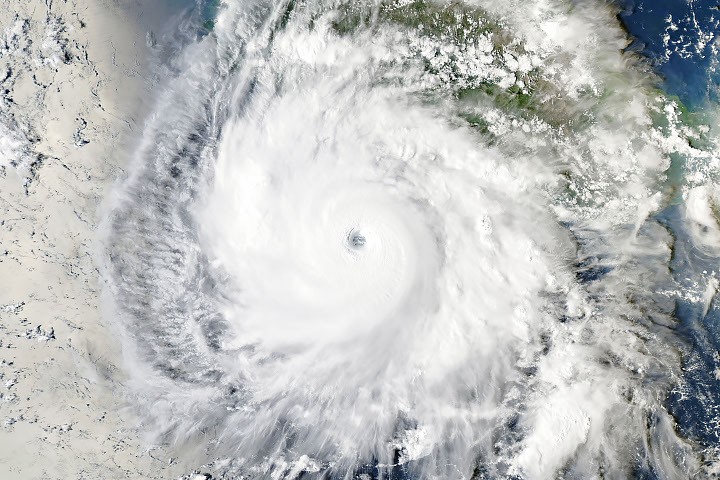
    Hurricane Polo underwent an extraordinary period of rapid intensification in September 2026, strengthening from a tropical cyclone into a Category 5 storm in less than a day. NASA satellite imagery revealed the storm’s clear eye as it churned off the coast of Mexico.

    Hurricane Polo’s explosive intensification

    In mid-September 2026, Hurricane Polo began as a tropical disturbance off Mexico’s Pacific coast. By September 20, it had organized enough to be classified as a tropical storm. It strengthened further the next day.

    Polo then entered a period of exceptionally rapid intensification. Meteorologists used words such as “surprising”, “amazing” and “absolute madness” to describe the storm’s transformation.

    “Polo went through what can only be described as an explosive, rapid intensification period,” atmospheric scientist Gary Partica of NASA’s Global Modeling and Assimilation Office at Goddard Space Flight Center said by email. “This was rapid, rapid escalation.”

    Partica said Polo encountered “almost perfect” conditions for strengthening: low wind shear, high humidity, warm ocean temperatures and substantial atmospheric instability.

    How quickly did Hurricane Polo strengthen?

    Several observers described Polo’s development as extreme rapid intensification. The technical classification refers to a tropical cyclone whose maximum sustained winds increase by at least 60 knots—111 kilometers per hour, or 69 miles per hour—in 24 hours.

    By September 22, Polo’s maximum sustained winds had reached 90 knots. Within 24 hours, the storm reached Category 5 intensity. The National Hurricane Center described the rate of strengthening as “truly remarkable” in its forecast discussion.

    When NOAA hurricane hunter aircraft flew over Polo on September 22, researchers estimated maximum sustained winds near 285 kilometers per hour—about 180 miles per hour.

    That intensity made Polo the third-strongest storm on record in the eastern Pacific based on maximum sustained wind speed. Some analysts also identified it as the fastest storm on record to progress from a tropical cyclone to a Category 5 hurricane.

    NASA satellite images show Polo’s powerful structure

    NASA’s MODIS instrument captured Hurricane Polo south of Acapulco on September 23, 2026.

    On the afternoon of September 23, the Moderate Resolution Imaging Spectroradiometer, or MODIS, aboard NASA’s Aqua satellite captured an image of Polo south of Acapulco, off the coast of Guerrero.

    At the time, Polo had maximum sustained winds of 230 kilometers per hour, or 145 miles per hour, making it a Category 4 hurricane. An eyewall replacement cycle had weakened the storm slightly.

    “The Polo satellite images are very impressive, with the storm’s large, clear eye and extensive outflow pattern,” said Kristen Corbosiero, an atmospheric scientist at the State University of New York at Albany. She is working on a NASA project that uses satellite data to study ventilation in tropical cyclones.

    Corbosiero said weak winds above the storm and strong upper-level outflow also helped Polo intensify rapidly.

    Why did Hurricane Polo intensify so rapidly?

    As Polo developed, it moved across areas where sea surface temperatures reached 32 degrees Celsius, or 90 degrees Fahrenheit. On September 23, those waters were 2 to 3 degrees Celsius warmer than normal.

    Most of the region’s surface waters were warmer than 27.8 degrees Celsius, or 82 degrees Fahrenheit—the temperature typically needed to maintain and intensify a hurricane.
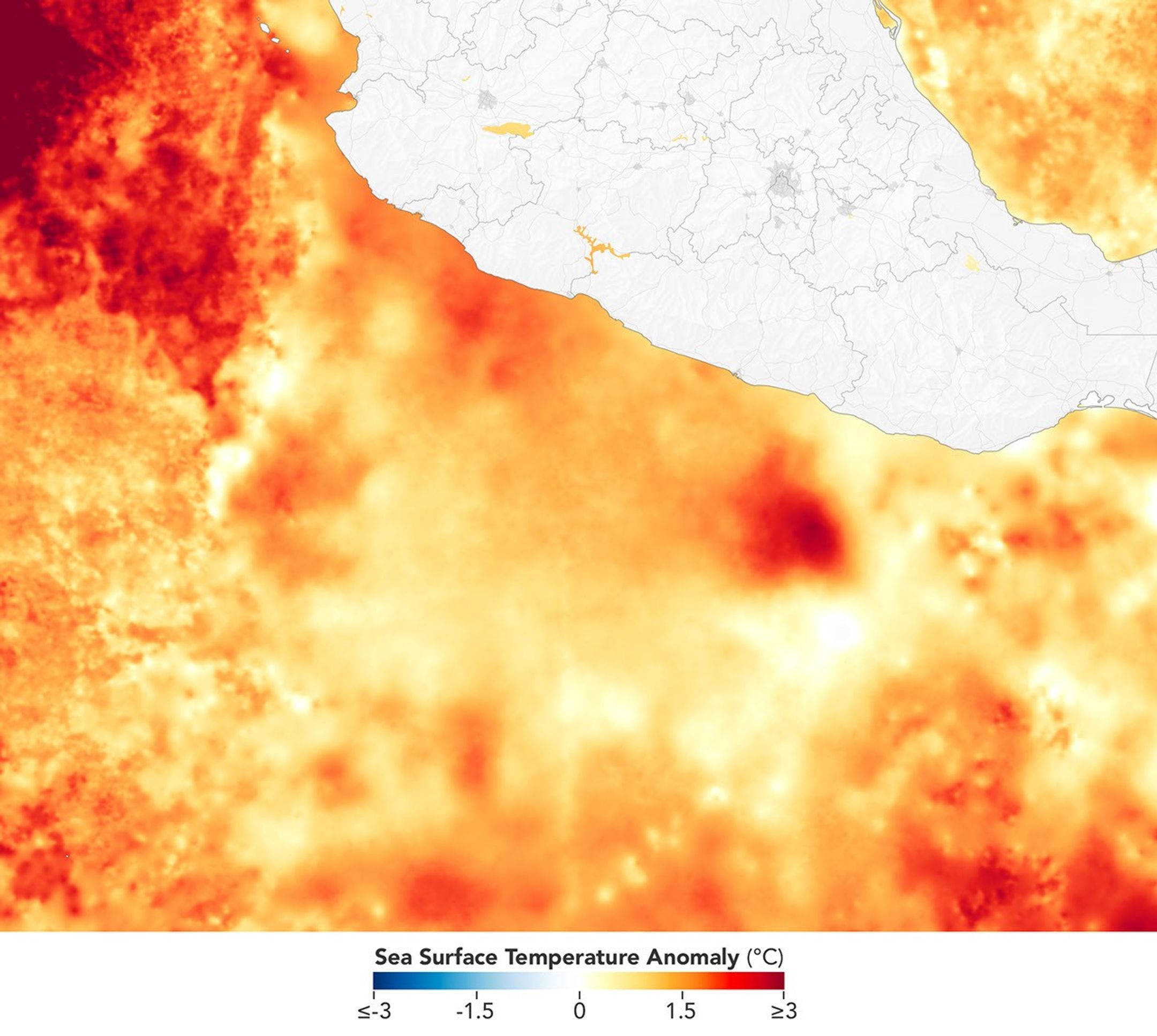
    Sea surface temperature anomalies off the Pacific coast of Mexico on September 23, 2026, with areas up to 3 degrees Celsius above normal
    NASA’s MUR sea surface temperature data showed unusually warm water along Polo’s path.

    The map uses data from NASA’s Multiscale Ultra-high Resolution Sea Surface Temperature project. The MUR SST project combines satellite measurements from NASA, NOAA and international missions with observations from ships and buoys.

    Rather than showing absolute temperatures, the map displays temperature anomalies: how much warmer or cooler the ocean surface was on September 23, 2026, compared with the project’s 2003–2014 average for that date.

    Corbosiero said that warmer water deeper in the ocean likely helped the storm persist. Hurricanes can churn up cold water from below the surface, which may slow intensification. In Polo’s case, the supply of cold water behind the storm appeared limited.

    Measurements and model data showed that ocean heat content remained high at considerable depth.

    Is El Niño responsible for Polo’s rapid intensification?

    Partica and Corbosiero cautioned against directly attributing Polo’s rapid intensification to El Niño’s unusually warm surface temperatures in the central and eastern Pacific.

    Hurricanes in the region have also strengthened rapidly during La Niña events. Corbosiero pointed to neutral conditions during Hurricane Otis in 2023 and Hurricane Patricia in 2015. Both storms reached Category 5 intensity.

    However, changes in large-scale ocean and atmospheric circulation patterns typically increase overall tropical cyclone activity in the eastern Pacific during El Niño periods. That pattern has been evident so far in 2026.

    As of September 24, accumulated cyclone energy in the region was nearly twice the normal level, according to Colorado State University data.

    What happens next to Hurricane Polo?

    Researchers and forecasters can track sea surface temperature anomalies and other storm characteristics using NASA’s Worldview browser, the SPoRT near-real-time data viewer and GMAO tools.

    Forecasters expected Polo to remain over the Pacific Ocean until the following week before curving northeast toward Baja California.

    Images by Michala Garrison using sea surface temperature data from NASA’s MUR project, MODIS data from NASA’s LANCE and GIBS/Worldview, and NOAA storm-tracking data from the National Hurricane Center. Story by Adam Voiland.

    Sources

    • Colorado State University. Real-time Northeast Pacific statistics by storm for 2026. Accessed September 24, 2026.
    • Joint Atmospheric Research Institute. Hurricane Polo. Accessed September 24, 2026.
    • Michael Lowry. Polo puts on a show in the Eastern Pacific. Accessed September 24, 2026.
    • Forbes. Explosive Hurricane Polo could remain Category 5 for several days. Accessed September 24, 2026.
    • NASA Earthdata. Tropical cyclones. Accessed September 25, 2026.
    • National Hurricane Center. Hurricane Polo advisory archive. Accessed September 24, 2026.
    • Stern, D., et al. Distinguishing between ultra-rapid development and normal rapid development of tropical cyclones. Monthly Weather Review, 154(10), 2133–2149.
    • The Washington Post. Hurricane Polo intensifies to Category 5 in less than a day. Accessed September 24, 2026.
    • Yale Climate Connections. Tropical Pacific erupts as powerful Hurricane Polo threatens Mexico with heavy rains. Accessed September 24, 2026.

    Source: science.nasa.gov

    Share. Facebook Twitter Pinterest LinkedIn WhatsApp
    Previous ArticleApple M5 Ultra Mac Studio Review: How It Turned Me Into a Vibecorder
    Next Article AI Bots Are Flooding Researchers With Requests for Money, Time, and Resources

    Related Posts

    Science

    Postcard from the Grave: Exploring Nature’s Haunting Beauty

    Science

    Why the Next U.S. Congress Should Ban Self-Improving AI Development

    Science

    Natural Floating Island Installed in Glasgow Park as a Lasting Games Legacy Project

    Science

    Extremophile Transgene Enhances Drought Resistance and Yield in Cereal Crops

    Science

    Black Friday 2026 Telescope Deals: Smart Telescopes and Binoculars

    Science

    NASA Science: Imbued with Sivrich

    Science

    Why Certainty Can Be a Failure in Science

    Science

    Chromosomal Glue May Improve Fertility by Stabilizing Aging Eggs

    Add A Comment
    Leave A Reply Cancel Reply

    Stay In Touch
    • Facebook
    • Twitter
    • Instagram
    • Pinterest
    Top Picks
    Science

    Tiny Patch of Amazon Rainforest May Harbor 40,000 Insect Species, Many New to Science

    A juvenile female of the mantid species Choeradodis rhomboidea was collected during a major effort…

    Postcard from the Grave: Exploring Nature’s Haunting Beauty

    How Research Funding Took Me from the Lab to Leadership Roles

    MCP for Agent-to-Agent Communication: The Dangerous Protocol You May Never Have Heard Of

    Scientists Discover How Pancreatic Cancer Rewrites DNA to Resist Treatment

    Most Popular
    Science

    Duck-Billed Dinosaur Beaks Were as Complex as Modern Bird Beaks

    Science

    NASA Curiosity Rover on Mars, Sols 4968–4974: Rock Climbing Toward the Discontinuity

    Categories
    • AI (9)
    • Gadgets (6)
    • Science (3,613)
    • Space (3)
    • Technology (3,044)
    • Wheels (3)
    Our Picks
    Science

    Aspen Trees Help Protect Against Wildfires as Fire Season Intensifies, Study Finds

    Technology

    Nobel Prize-Winning Protein Designer Uses AI to Create Molecules That Don’t Exist in Nature

    © 2026 Hitechub.
    • Home
    • About Us
    • Privacy Policy
    • Terms & Conditions

    Type above and press Enter to search. Press Esc to cancel.

    GDPR Cookie Banner

    We are using cookies to give you the best experience on our website.

    You can find out more about which cookies we are using or switch them off in .

    Ad Blocker Enabled!
    Ad Blocker Enabled!
    Our website is made possible by displaying online advertisements to our visitors. Please support us by disabling your Ad Blocker.