


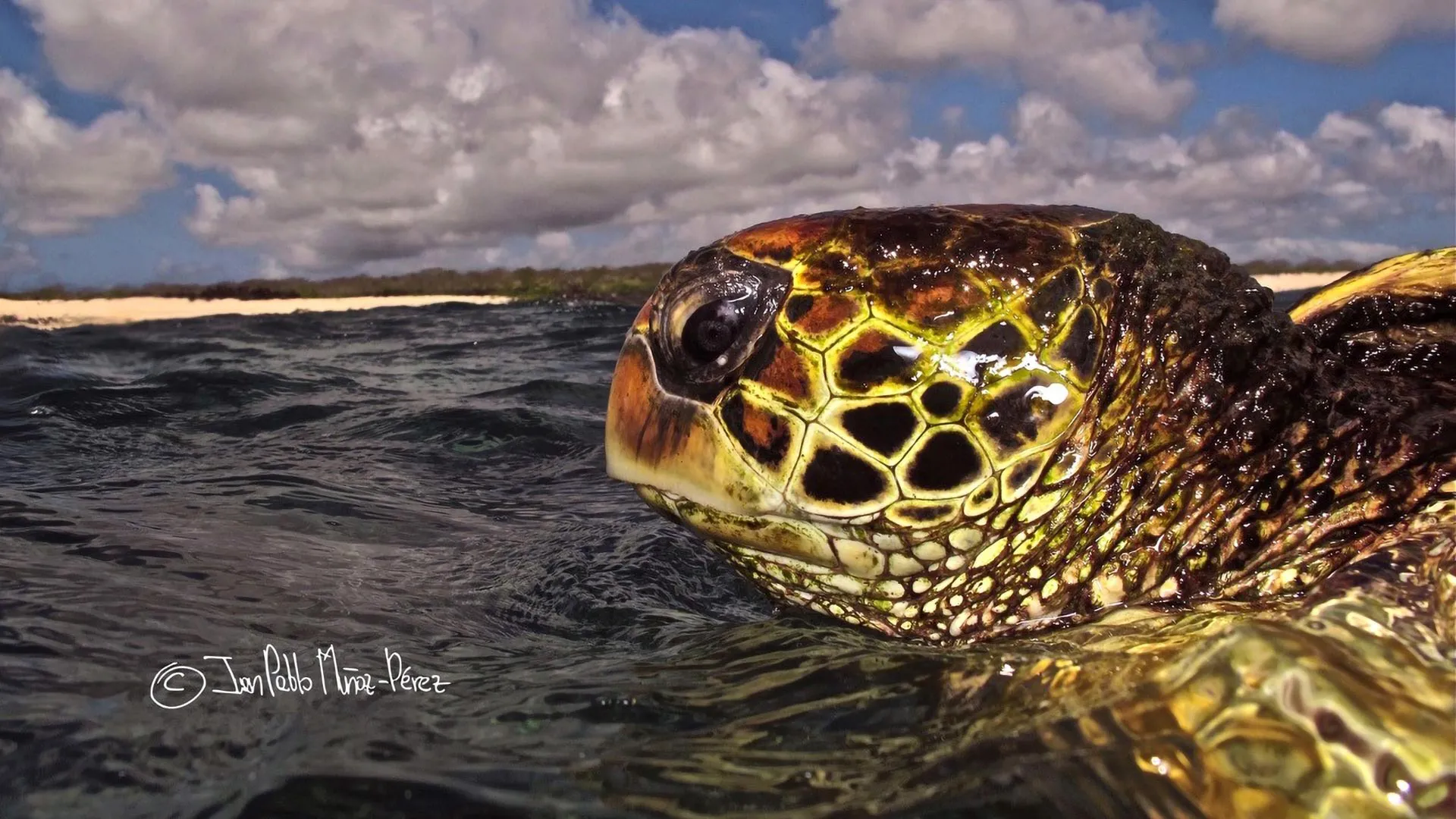
Why Galápagos Green Sea Turtles Rarely Leave the Marine Reserve
Sea turtles are famous for their long ocean journeys. They use the Earth’s magnetic field, the sun and ocean currents to navigate across vast distances, often returning to their birthplace to reproduce. But new tracking research suggests that some green sea turtles in the Galápagos Islands may spend most of their lives close to home.
Two genetically distinct forms of green sea turtle
Researchers found that the yellow morph of the green sea turtle occupies distinct feeding areas around one or more Galápagos Islands. During the three-year study, not one satellite-tagged turtle left the 198,000-square-kilometer Galápagos Marine Reserve.
“Here we show that the ‘yellow morph’ green turtle, one of two genetically distinct forms, occupies distinct foraging areas across one or more islands in the Galápagos,” said Dr. John W. Rowe, a professor at Alma College in the United States and a co-author of the study published in Frontiers in Amphibian and Reptile Science.
Green sea turtles differ from the other six living sea turtle species because adults are primarily vegetarian. Young turtles eat both plants and animals, but their diet gradually shifts toward seaweed and algae as they mature.
Scientists recognize two genetically distinct forms involved in the study. The yellow morph generally lives in tropical and subtropical regions of the western Pacific, while the black morph occurs in the eastern Pacific, west of the Americas and south of Southern California.
The Galápagos is the only known location where both forms share the same ocean region. Yellow and black morphs intermingle there and feed on the same types of marine plants.
However, the two forms are not identical. Young yellow morphs tend to grow faster than young black morphs, suggesting that they may have physiological differences that scientists have not yet fully characterized.
Satellite tracking reveals where Galápagos turtles travel
Rowe and his colleagues wanted to learn where the turtles spend their time, how large their home ranges are and whether they move between islands within the Galápagos Marine Reserve.
In 2015, researchers captured nine adult turtles in shallow water near four islands. The group included seven males and two females. Each turtle was given a name and fitted with an electronic transmitter that sent location data to the Argos low-Earth-orbit satellite network.
The turtles were tracked for 418 days. Tracking ended when a tag detached or stopped transmitting signals.
The results showed a strong preference for shallow coastal habitats. Although the turtles sometimes traveled as far as 25 kilometers from the coast, most remained much closer to the islands.
Five of the nine turtles spent most of the study near a single island. Bernardo and Sara traveled between Isabela and San Cristóbal, while Leandro moved between Isabela and Española.
Ainoa made the longest series of movements. After being tagged near San Cristóbal, she traveled to Santa Cruz and then to Isabela.
The researchers also identified a seasonal pattern: movement between islands occurred only during the cooler months, from April through October.
On average, each turtle occupied a home range of approximately 1,498 square kilometers, although the size varied considerably between individuals.
Why the turtles may eventually leave the Galápagos
Overall, the tracking data suggest that yellow green sea turtles living around the Galápagos may regularly return to the same local feeding areas rather than roaming across the wider Pacific Ocean.
However, the researchers cautioned that the study captured only a limited period in each turtle’s life. Longer migrations could occur at other times and may not have been recorded.
This possibility is especially important for females. Female yellow green sea turtles are not known to lay eggs on Galápagos beaches, so they may eventually leave the region and return to nesting beaches in the western Pacific Ocean.
By contrast, some female black green sea turtles nest in the Galápagos. Some individuals may remain around the islands year-round, while others may migrate to nearby oceanic islands or feeding areas off the coasts of Central and South America.
“Individual turtles may depend on the surrounding waters of multiple islands, so the quality of the habitat available for foraging should be maintained intact on all islands and not allowed to degrade anywhere,” said co-author Dr. Pablo Muñoz Pérez, a professor at the University of San Francisco of Quito in Ecuador.
Protecting the Galápagos turtle habitat network
The findings have important conservation implications. Because some turtles travel between several islands, protecting just one preferred feeding site may not be enough.
The researchers emphasized the need to preserve coastal waters and the interisland routes turtles use as they move throughout the Galápagos archipelago. Protecting this connected habitat network could help support the turtles’ feeding, movement and long-term survival.
Source: www.sciencedaily.com