


Close Menu
HitechubHitechub
    What's Hot
    Science

    Revolutionizing Future Computers: Insights from a 200-Year-Old Physics Experiment

    Science

    Dogs Can Distinguish Fear From Sadness, Scientists Discover in Their Brains

    Science

    Bronze Ring Carved from Alexandria Lighthouse Discovered in Palace on Submerged Egyptian Island

    Important Pages:
    • About Us
    • Privacy Policy
    • Terms & Conditions
    Facebook X (Twitter) Instagram Pinterest
    Facebook X (Twitter) Instagram
    HitechubHitechub
    Thursday, November 26
    • Shop
      • Fashion
        • Mens
        • Womens
        • Accessories
          • Handbags
          • Keychain
          • Masks
          • Money clicps
          • Neck Pillow
          • Rings
          • Towels
          • Wallets
        • Jewelry
        • Watches
        • T-shirts
        • Hawaiian shirts
        • Vests
        • Swim trunks
        • Swimsuits
      • Fun
        • Magic cubes
        • Magnifiers
        • Misc
        • Photo books
        • Puzzles
        • Toys
      • Home
        • Cleaning/Care
        • Mailbox covers
        • Mugs
        • Pot Holders
        • Spoon
      • Office and Electronics
        • Chairs
        • Office Supplies
        • IPad cases
        • Laptop stickers
        • Mouse pads
        • Notebooks
        • Pencil bags
        • Pens
        • Phone cases
      • Personalized
      • Pets
      • Sports
        • Cycling
          • Balaclava Mask
          • Bike Bell
          • Bike Computer
          • Bike Fender
          • Bike Grips
          • Bike Kickstand
          • Bike Light
          • Bike Locks
          • Bike Mitts
          • Bike Pumps
          • Bike Repair Stand
          • Bike Seat
          • Bike Trainer
          • Bike Wheels
          • BIKES
            • Folding Bikes
            • Road Bikes
          • Carbon Fiber Bike Products
          • Cycling Mask
          • Kid’ Bike Helmets
          • Inner Tube
          • Motorcycle Bag
          • Nylon Pedals
          • Adult Helmets
          • Photochromic Sunglasses
          • Soft Coolers
          • Suction Cup Bike Rack
          • Tool accessories
          • Winter Cloth
          • Heart Rate Monitor
        • Outdoors/Camping
          • Outdoor Bags
        • Sweatband
    • Technology
      1. AI
      2. Gadgets
      3. View All

      This is the most popular CEO in the world

      Sectors in which “Chat-GPT” is most often used

      Artificial intelligence has begun to “swallow” professions

      The unusual robot conductor of a concert in Seoul

      Here’s how you can tell if your phone is being tapped

      PlayStation 5 becomes a completely silent console and gets more space

      This is the first phone that can be used to park a car

      Best Gaming Laptops 2023: Powerful Portables for PC Games

      Ladybird Browser’s First Downloadable Alpha Release Is Surprisingly Capable

      ShinyHunters Claims Return After FBI Arrest, Citing Old PGP Key as Evidence

      Radware Data Breach Exposes Customers’ Cloud Access Keys

      InfraTrust Warns That Network Equipment Supply Chain Vulnerabilities Have Been Exploited

    • Science
      1. Space
      2. Wheels
      3. View All

      Space Perspective: A Journey to the Edge of Space

      5 Fascinating Facts About Space

      Space Exploration: Unveiling the Wonders of the Universe

      Toyota wants to make a new generation battery with a range of up to 1,200 km

      Meet Toyota’s lunar “baby” that could make exploring the Moon easier

      What does a night drive look like with one of the most beautiful cars in the world: the Rolls-Royce Ghost

      Astronomers May Have Discovered a Black Hole Born Before the First Stars

      SpaceX Approves Plan to Launch 1 Million Data Satellites Into Space

      Heart Attack and Stroke Risk May Be Predicted Up to 30 Years in Advance, Research Suggests

      Scientists Discover Mysterious Lake More Than a Mile Beneath the Red Sea

    HitechubHitechub
    Home » Scientists Discover How Deep-Diving Pigs Navigate Turns More Efficiently
    Science

    Scientists Discover How Deep-Diving Pigs Navigate Turns More Efficiently

    Share Facebook Twitter Pinterest WhatsApp
    Share
    Facebook Twitter LinkedIn Pinterest WhatsApp

    Could Switching Breathing Gases Help Prevent Decompression Sickness?

    Deep-sea divers carefully control their ascent to avoid decompression sickness, also known as “the bends.” This potentially serious condition occurs when dissolved gases form bubbles in the blood and tissues as pressure decreases during a rapid ascent.

    Now, a new study involving pigs in custom diving suits suggests that changing the gas divers breathe underwater could reduce the risk of severe decompression sickness. The findings may eventually help commercial and military divers stay underwater longer, dive deeper and return to the surface more quickly.

    The research was published August 10 in Proceedings of the National Academy of Sciences.

    Study co-author Dr. Richard Moon, an anesthesiologist and professor of medicine at Duke University, has treated many people with decompression sickness. Moon has also experienced a mild case himself, which caused joint pain.

    Severe decompression sickness can be life-threatening. Gas bubbles may block blood flow and damage the heart, brain and other organs.

    from the latest videoslive science

    Why divers develop decompression sickness

    The risk begins with the gases divers breathe underwater. At depth, surrounding pressure increases, causing gases such as nitrogen and helium to dissolve into the body’s tissues.

    When a diver ascends, the pressure drops. If the ascent is too fast, dissolved gas can come out of solution and form bubbles, much like bubbles released when a carbonated drink is opened. These bubbles can cause joint pain, neurological symptoms, breathing problems and other complications.

    Breathing compressed air at great depth can also cause nitrogen narcosis, sometimes called “the rapture of the deep.” The condition can impair judgment and create an intoxicated feeling because of the effects of nitrogen under high pressure.

    you may like

    How nitrox and heliox reduce diving risks

    Many divers use nitrox, a breathing mixture containing more oxygen and less nitrogen than ordinary air. Reducing nitrogen exposure can lower the risk of nitrogen narcosis and decompression sickness when the gas is used within appropriate depth and time limits.

    Commercial and technical divers may use heliox, a mixture of helium and oxygen. Helium is less likely than nitrogen to cause narcosis, making heliox useful for deep diving. However, heliox is expensive and does not eliminate the risk of decompression sickness.

    High oxygen concentrations can also become toxic at depth. For that reason, divers must carefully manage gas mixtures, pressure, depth and exposure time.

    “The risk of injury while diving increases almost exponentially with increasing depth,” said Dr. Kay Tetzlaff, a clinician-researcher at the University of Tübingen who was not involved in the study.

    Divers prepare scuba tanks filled with heliox, a mixture of helium and oxygen.

    (Image credit: Vladimir_Timofeev, via Getty Images)

    Why researchers tested carbon tetrafluoride

    Moon and his colleagues have spent decades studying ways to make deep-sea diving safer. Their approach is based on a process called isobaric counterdiffusion, in which one inert gas leaves body tissues as another enters.

    The researchers initially considered neon because its larger molecules might move through tissues more slowly than helium or nitrogen. However, the cost of neon increased sharply, partly because of disruptions to global supplies. The team instead investigated carbon tetrafluoride, or CF4.

    Carbon tetrafluoride is an inert gas, meaning it does not readily react chemically with body tissues. It is also less soluble than helium, which could allow helium to leave the body faster than CF4 enters tissues.

    What to read next

    Pig study shows fewer signs of decompression sickness

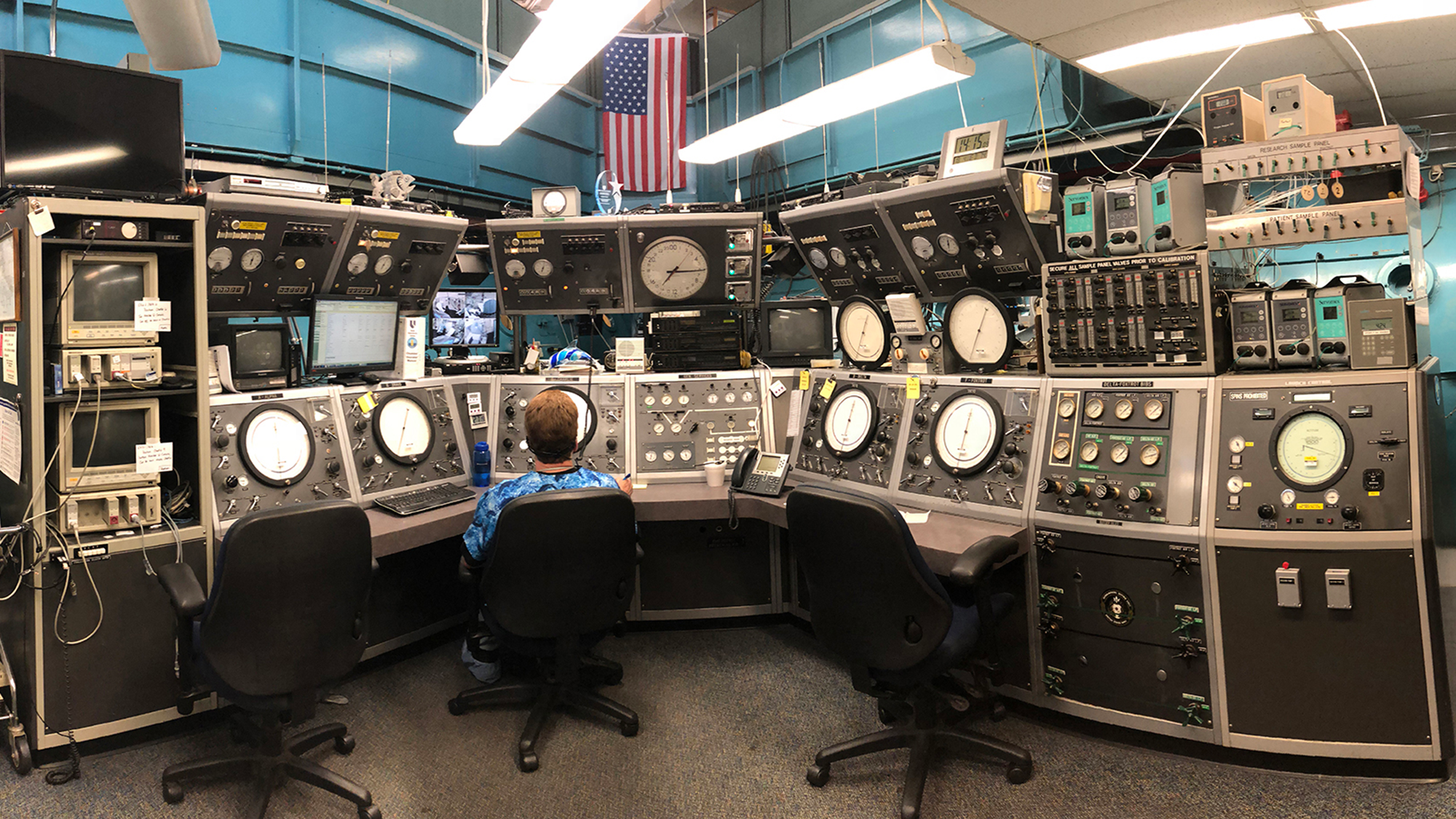
    The experiment took place at Duke University’s hyperbaric facility, where researchers used a large pressure chamber to simulate conditions roughly 61 meters, or 200 feet, below sea level.

    The team studied 40 sedated pigs, which are considered useful models for examining certain effects of diving because their cardiovascular and respiratory systems share important similarities with those of humans. The animals wore custom-made diving suits equipped with hoods and heaters.

    Each pig underwent a one-hour simulated dive. Half breathed heliox for the entire experiment. The remaining pigs breathed heliox initially and switched to a mixture of oxygen and CF4 during the final 10 minutes underwater.

    During the gas switch, helium began leaving the animals’ tissues while the less-soluble CF4 entered more slowly. As a result, the pigs in the experimental group had less inert gas remaining in their tissues when they returned to the surface.

    All of the animals underwent decompression at the same rate and were monitored for three hours afterward. Pigs that breathed only heliox showed more signs of decompression sickness, including difficulty walking and a higher incidence of gas bubbles, or embolisms, in the heart.

    More than 80% of the pigs that breathed heliox died within three hours of the simulated dive and decompression. None of the pigs that switched to the CF4-based mixture died during the monitoring period.

    Could the gas mixture be used by human divers?

    The findings are promising, but they do not immediately support changing human diving standards. The study was conducted in pigs under controlled laboratory conditions, and additional research is needed to evaluate the safety, effectiveness and long-term effects of breathing carbon tetrafluoride.

    Cost is another obstacle. CF4 is expensive, making it unlikely to become a practical option for most recreational divers. The gas may be more relevant to commercial, scientific or military diving, where the ability to work safely at extreme depths could justify the expense.

    “Due to the cost, it will be limited to commercial and military diving,” Moon said.

    Even if the technology is used by only a small number of divers, Tetzlaff said the research could still have an important impact.

    “Being able to dive safer is worth the effort, right?” he said. “Even if it only applies to a few people.”

    This article is for informational purposes only and does not provide medical or diving advice.

    Lance, R. M., Murkowski, M. S., Mahon, R. T., Everitt, J. I., Natoli, M. J., Wright, M. C., Howle, L. E., Bartlett, N. C., Patel, A., Morales, G., and Moon, R. E. (2026). Isobaric backdiffusion of carbon tetrafluoride breathing gas to prevent severe decompression sickness. Proceedings of the National Academy of Sciences, 123(33), e2600125123.

    Source: www.livescience.com

    Share. Facebook Twitter Pinterest LinkedIn WhatsApp
    Previous ArticleBest Wireless Charger 2026: My Top Pick After Testing Over 100 Chargers
    Next Article Download: New Rules for Flocking, the Future of Cloning, and Children’s Cells

    Related Posts

    Science

    Astronomers May Have Discovered a Black Hole Born Before the First Stars

    Science

    SpaceX Approves Plan to Launch 1 Million Data Satellites Into Space

    Science

    Heart Attack and Stroke Risk May Be Predicted Up to 30 Years in Advance, Research Suggests

    Science

    Scientists Discover Mysterious Lake More Than a Mile Beneath the Red Sea

    Science

    NASA Science: Moon Base Crop Production System for Lunar Agriculture

    Science

    Find Shelter on Resolution Island: Complete Guide for Visitors

    Science

    Coherent Fermion-Parity Oscillations in Coupled Minimal Kitaev Chains

    Science

    Iowa Explosion Lead Contamination Concerns Persist Despite Official Assurances

    Add A Comment
    Leave A Reply Cancel Reply

    Stay In Touch
    • Facebook
    • Twitter
    • Instagram
    • Pinterest
    Top Picks
    Science

    Mysterious Hole on the Moon May Lead to a Giant Lunar Cave

    NASA-Funded GIMLI Mission Will Search for Lava Tubes Beneath the Moon NASA has selected a…

    Beats 360 Review: Customizable, Stylish, and Fun Headphones

    New Chemical Eliminates 95% of Termites Without Harming Humans

    Atom-Based Quantum Computers: Accelerating Towards Practical Applications

    U.S. Schools Protest FCC Plan Threatening Children’s Internet Access

    Most Popular
    Technology

    Jumanji: Open World Trailer Teases Thrilling Body-Swapping Adventure

    Science

    Scientists May Have Captured Changing Light From Empty Space

    Categories
    • AI (9)
    • Gadgets (6)
    • Science (3,600)
    • Space (3)
    • Technology (3,243)
    • Wheels (3)
    Our Picks
    Technology

    Get 25% Off Adidas Promo Code – July 2026 Savings!

    Science

    Physicist Explains Why a Neutrino Laser Is Fundamentally Impossible

    © 2026 Hitechub.
    • Home
    • About Us
    • Privacy Policy
    • Terms & Conditions

    Type above and press Enter to search. Press Esc to cancel.

    GDPR Cookie Banner

    We are using cookies to give you the best experience on our website.

    You can find out more about which cookies we are using or switch them off in .

    Ad Blocker Enabled!
    Ad Blocker Enabled!
    Our website is made possible by displaying online advertisements to our visitors. Please support us by disabling your Ad Blocker.