


NASA Studies Reveal How the Sun Shaped Earth’s Climate and Early Habitability
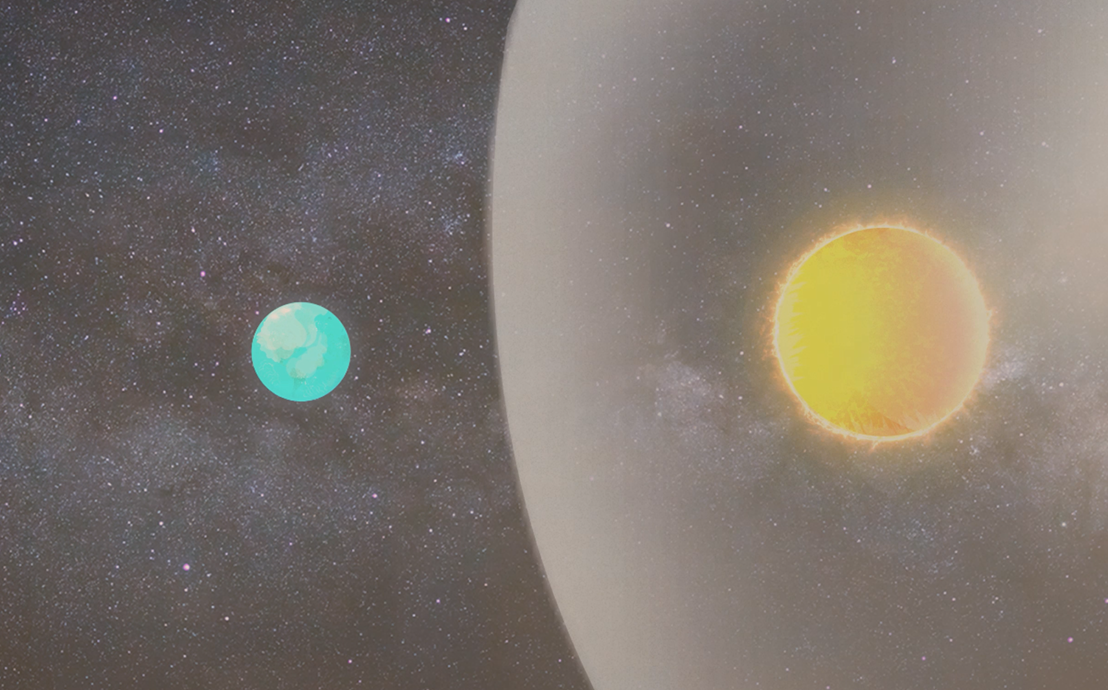
The Sun is the center of our solar system and exerts a powerful influence on every planet that orbits it. Two recent NASA-funded studies provide new insight into how the Sun’s ancient history helped shape Earth’s climate, influenced periods of long-term cooling and warming, and made it possible for life to develop on our planet.
One study from NASA’s SHIELD Center, part of the DRIVE Science Center program, examined the history of the heliosphere—the enormous bubble of solar wind that surrounds and protects the solar system. Researchers reconstructed how the heliosphere moved through the Milky Way and found that changes in the surrounding galactic environment may have affected Earth’s atmosphere and climate.
A second study investigated the “faint young Sun paradox,” the long-standing mystery of how early Earth maintained liquid water even though the young Sun was significantly dimmer than it is today. The researchers found that powerful solar flares may have triggered chemical reactions that produced greenhouse gases capable of warming the early planet.
Over the past tens of millions of years, Earth’s climate has undergone dramatic changes, including major ice ages that lowered global temperatures by several degrees Celsius. Scientists have traditionally explained these shifts through changes in Earth’s orbit, atmospheric greenhouse gas concentrations, ice coverage, and other processes originating on Earth.
However, new research suggests that the solar environment may also have played an important role in Earth’s ancient climate fluctuations. Just as Earth is surrounded by an atmosphere, the entire solar system is enclosed by the heliosphere—a protective region created by the continuous flow of charged particles known as the solar wind.
The heliosphere travels through the Milky Way as the Sun orbits the center of the galaxy. During the Sun’s 4.6-billion-year history, it has passed through a variety of interstellar environments. In a study published in the Annual Review of Astronomy and Astrophysics, NASA SHIELD researchers used computer models to retrace the heliosphere’s path through the galaxy and explore how those environments may have affected Earth.
SHIELD Principal Investigator Merav Opher and her team at Boston University simulated several encounters between the Sun and extremely cold, dense clouds of interstellar gas and dust. According to the models, these clouds may have compressed the heliosphere, shrinking it to a size smaller than Earth’s orbit and temporarily exposing our planet to the interstellar environment.
The simulations identified possible exposure events approximately 2 to 3 million years ago, 6 to 7 million years ago, and 13 to 14 million years ago. During these periods, Earth’s atmosphere would have encountered conditions very different from those produced by the solar wind. The findings also align with geological evidence, including the presence of interstellar dust components in deep-sea sediment cores, Antarctic snow, and lunar samples from similar time periods.
When Earth’s atmosphere was exposed to dense clouds of galactic hydrogen, the amount of water vapor in the atmosphere may have increased. This could have altered the upper atmosphere and changed conditions at Earth’s surface. The findings suggest that the heliosphere’s movement through colder regions of the galaxy may have contributed to some ancient climate changes and possibly influenced the development of ice ages.
NASA’s SHIELD Center is one of several research centers working to advance heliosphere science. As part of NASA’s DRIVE Science Center program, SHIELD brings together researchers from multiple disciplines to create detailed computer models, or “digital twins,” of the heliosphere. These models can help scientists understand how the solar system interacts with dense interstellar clouds and other galactic environments.
Learning more about the heliosphere could provide valuable information about Earth’s habitability, the evolution of life, and the conditions that allow other planetary systems to support life.
The second NASA-funded study focused on the early Sun and the origin of Earth’s warm climate. Approximately 3 billion years ago, the young Sun produced only about 70% of the energy it generates today. Based on the Sun’s brightness alone, early Earth should have been frozen. Geological evidence, however, shows that liquid water existed on the planet. This contradiction is known as the “faint young Sun paradox.”
Researchers found a possible solution by studying young, Sun-like stars elsewhere in the galaxy. Observations from NASA’s retired Kepler Space Telescope show that these young stars frequently produce powerful flares and release streams of energetic particles. If the young Sun behaved similarly, intense solar particle storms may have triggered chemical reactions in Earth’s early atmosphere.
Vladimir Airapetian of NASA’s Goddard Space Flight Center and his colleagues recreated conditions in Earth’s early atmosphere inside a laboratory chamber. Their mixture included molecular nitrogen, ammonia, carbon dioxide, and carbon monoxide. The researchers then bombarded the mixture with protons to simulate energetic particles released by powerful solar flares. The results were published in the Astrophysical Journal Letters.
The experiment produced nitrous oxide, a greenhouse gas that can be approximately 300 times more powerful than carbon dioxide at trapping heat. Although ultraviolet radiation from the young Sun would have destroyed some of the gas, computer simulations showed that even if just 10% remained, it could have warmed Earth’s equatorial regions to about 41 degrees Fahrenheit, or 5 degrees Celsius—above the freezing point of water.
The presence of small amounts of nitrous oxide may also have supported prebiotic chemistry. Temperatures just below freezing can be especially effective for forming complex chains of amino acids, which are important building blocks for life.
Together, these studies highlight the Sun’s far-reaching influence on Earth. The planet has never existed in isolation; it formed and evolved within a dynamic solar system that moves through the wider galactic environment. Understanding this connection could reveal new information about Earth’s climate history, the origins of life, and the conditions that make other planets potentially habitable.
By Desiree Apodaca and Miles Hatfield
NASA’s Goddard Space Flight Center, Greenbelt, Maryland
Source: science.nasa.gov