


Early Cretaceous Mammal Had Platypus-Like Feet and Replaced Its Teeth Multiple Times
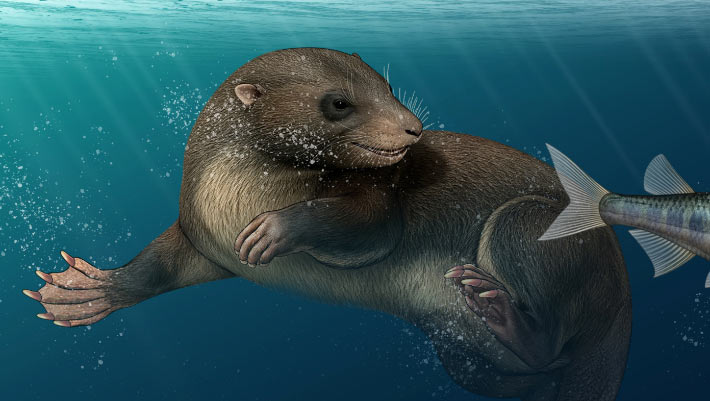
Dongoconodon platycauda, a small mammal that lived in northeastern China about 120 million years ago, may have paddled underwater with webbed, platypus-like limbs. CT scans also reveal an unusual dental pattern in which the animal replaced its teeth repeatedly.
The animal was approximately the size of a water vole and weighed an estimated 115 to 190 grams. It belonged to Eutriconodonta, an early mammalian group that lived during the Jurassic and Cretaceous periods.
“Mammals emerged by progressively acquiring important morphological and developmental innovations that underlie their evolutionary success across diverse ecological niches,” said paleontologist Shundong Bi of Yunnan University and his colleagues.
“Among them, didontia—the presence of two generations of teeth—and a completely separate middle ear are widely considered to be two important diagnostic features of modern mammals and represent fundamental transitions in mammalian evolution.”
A fossil with an unusual tooth-replacement pattern
Dongoconodon platycauda is represented by a nearly complete articulated skeleton, including a well-preserved skull and jaw. The fossil was collected in 2016 from the Changzigou area of the Jiufotang Formation in Liaoning Province, China.
CT scans showed teeth in several stages of eruption and development. In some positions, replacement teeth were visible beneath other replacement teeth.
According to the researchers, the animal appears to have had three generations of teeth in some positions across all four tooth types: incisors, canines, premolar-like teeth and molar-like teeth.
This condition, known as polydontia, differs from the two-generation tooth pattern typical of modern mammals. A closely related eutriconodontan, Gobiconodon voliciaki, has also been reported to have molars that were replaced multiple times.
The researchers propose that the return to frequent tooth replacement may have been associated with a carnivorous diet.
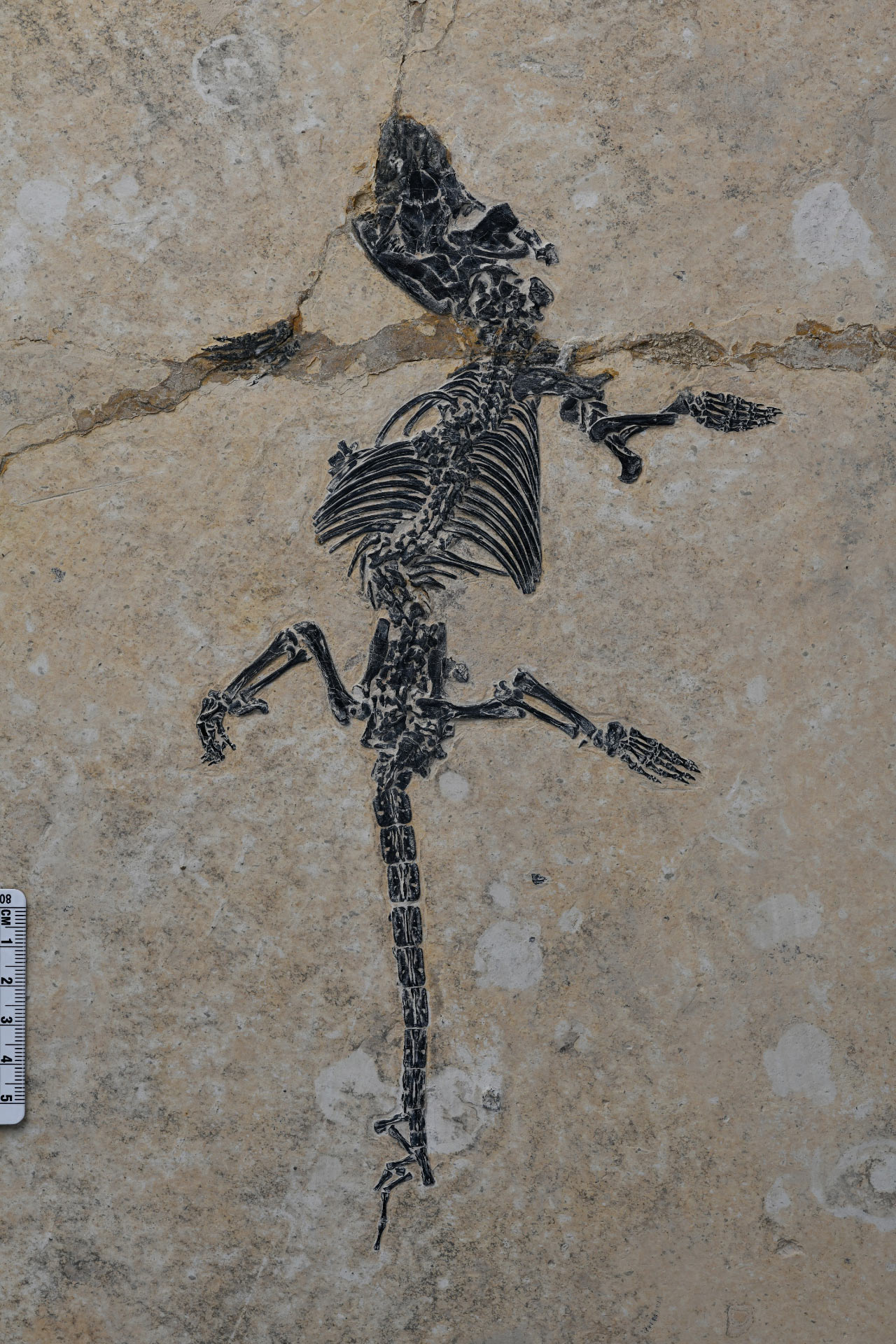
“Dongoconodon has 11 teeth in the upper jaw and 10 teeth in the lower jaw,” the researchers said. “The teeth are in different stages of eruption, and replacement teeth are in different states of formation.”
The right lower jaw was particularly important for interpreting the animal’s dental development. In front of the erupting canines were three unerupted teeth: the first incisor and its replacement, followed by the second incisor.
Behind the canine, the second and third molars were fully erupted. The researchers noted that this arrangement does not match the tooth-replacement pattern of any living or extinct mammal currently known.
Platypus-like limbs suggest a semi-aquatic lifestyle
The fossil also indicates that Dongoconodon platycauda may have been an efficient swimmer.
Its hands and feet contain flat, elongated bones resembling those of a platypus. A small flange on one finger bone corresponds to the area where webbing attaches in platypuses.
The animal’s caudal vertebrae were flat and box-shaped, similar to those of the nutria, a semi-aquatic South American rodent with a lightly haired tail.
Scientists suggest that the tail helped with steering and stability, while the forelimbs provided most of the propulsion.
To test the swimming interpretation, the researchers compared measurements from 13 limb bones of the fossil with those of 124 living species whose lifestyles are known. The fossil fell within the range of semi-aquatic animals.
“The new fossil indicates a semi-aquatic adaptation, with similar webbed, platypus-like limbs,” the authors concluded.
They added that the unusual dorsoventral flattening of the tail vertebrae resembles the condition seen in living nutria. The reappearance of polydontia and repeated molar replacement in Dongoconodon and related gobiconodontids may likewise reflect the animals’ ecological niche and carnivorous diet.
The discovery is described in a paper published in Nature Communications.
_____
S.B. et al. 2026. A polyphyodont semi-aquatic eutriconodontan mammal from the Early Cretaceous of China. Nature Communications 17, 10032; doi: 10.1038/s41467-026-77339-w.
Source: www.sci.news