


New Atomic Clock Is So Accurate It Could Redefine the Second
Scientists have developed the most accurate atomic clock ever made. The breakthrough could help change the official definition of a second.
Researchers have unveiled a record-breaking atomic clock that uses the vibrations of lutetium atoms to measure time with extraordinary precision. The device is accurate to 19 decimal places, representing a 41% improvement over the previous record holder.
The results were published in Nature on September 23.
How atomic clocks define a second
Atomic clocks have been used since the 1950s. The first models relied on radioactive isotopes of cesium, a silver-colored metal that soon became the standard for precision timekeeping.
In 1968, the International Bureau of Weights and Measures (BIPM) revised the definition of a second to be based on radiation emitted by cesium-133. Officially, 9.19 billion vibrations of a cesium-133 atom equal one second. Before that change, a second was defined as 1/31,556,925 of the length of the 1900 solar year.
Cesium clocks helped create a standardized definition of time for both science and everyday life. Since the 1960s, other elements, including ytterbium and strontium, have also been used to build atomic clocks. Today, these clocks support systems such as GPS, the internet and military technology.
Why the lutetium clock is more stable
Even the most precise atomic clocks are affected by changes in temperature, magnetic fields and gravity. The newly developed lutetium clock is designed to reduce the impact of those environmental factors.
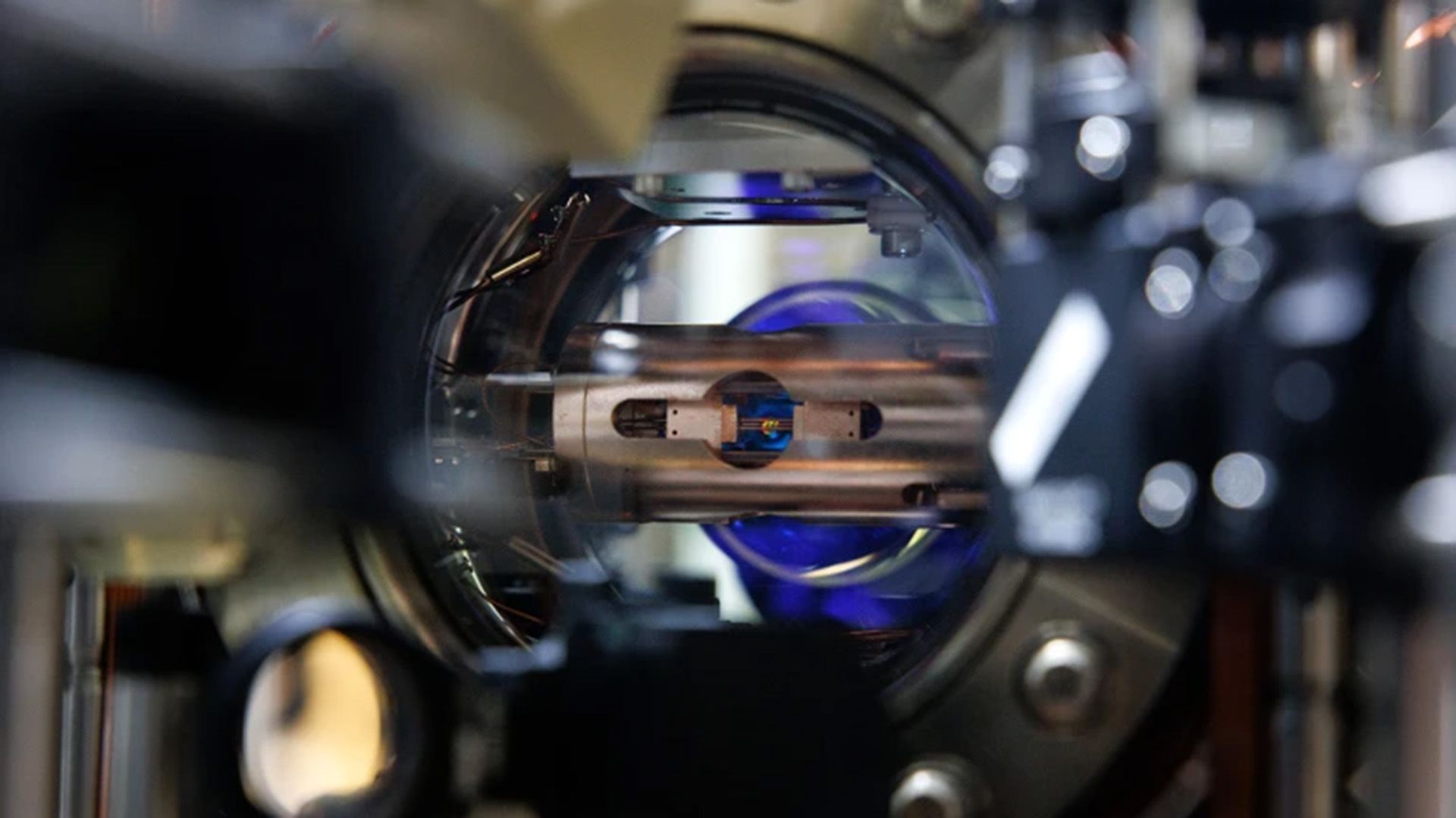
(Image source: Center for Quantum Technology, National University of Singapore)
To explain the challenge, study co-author Murray Barrett, a physicist at the National University of Singapore, compared precision timekeeping to an ultramarathon.
“Our job is to make sure runners can run long distances; after all, lutetium is a natural endurance athlete,” Barrett told Live Science via email.
Unlike previous atomic clocks, the team’s lutetium-176 clock is less sensitive to magnetic fields and temperature. Other elements may require the surrounding temperature to be controlled to within 1/1,000th of a degree. The lutetium-176 clock continues to operate even when the external temperature changes by 5 degrees.
Barrett’s laboratory also developed a technique called hyperfine averaging. The method reduces the influence of environmental factors, including gravity, leaving less variation in the clock’s timekeeping.
Could lutetium redefine the second?
These highly sensitive atomic clocks could become the next gold standard for the International System of Units, also known as the metric system, according to the researchers.
The BIPM is expected to redefine the second in 2030 based on the latest atomic-clock technology. For now, lutetium appears to be the leading candidate for improved accuracy.
What the clock could reveal about the universe
The new atomic clock could also help scientists investigate fundamental questions in physics, including whether constants such as the gravitational constant, G, are truly constant.
“There is some speculation that the fundamental constants may actually be changing,” Barrett said. “So ultra-high-precision clocks give us the tools to explore that.”
Source: Arnold, K. J., Li, M. D., Zhao, Q., Qin, Q., Zhang, Z., Jayjong, N., and Barrett, M. D. (2026). “The Lu+ optical frequency standard is verified for accuracy on the 19th digit.” Nature.
Source: www.livescience.com