


Elusive Ice Cloud Over Mars’ Mount Arsia Forms in a Matter of Hours
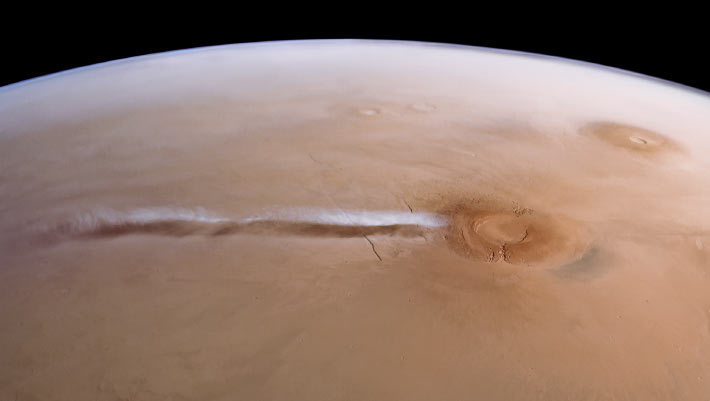
The Mount Arsia Elongated Cloud is a sliver of water ice that appears downwind of the 20-kilometer (12.4-mile) Mount Arsia volcano—the southernmost of three giant Martian shield volcanoes collectively known as the Tharsis Mountains—during spring and summer in Mars’ southern hemisphere.
This image from ESA’s Mars Express shows an elongated cloud over Mount Arsia. Image credit: ESA / DLR / FU Berlin / J. Cowart
A giant Martian cloud that appears every morning
The Arsia Mountain Elongated Cloud (AMEC) forms, stretches and dissipates within a day on Mars. It can grow up to 1,800 kilometers (1,118 miles) long before evaporating, and the cycle repeats every morning for several months.
ESA’s Mars Express spacecraft first photographed the cloud in 2018 and has been monitoring it ever since.
Planetary researchers have long identified AMEC as a type of orographic cloud, a phenomenon also found on Earth when winds flow over mountains and volcanoes. However, computer simulations based on that explanation could not reproduce what Mars Express observed.
Unexpected cloud formation on Mars
“We found that to create AMEC in our modeling, we needed to include some unusual physics, which, although included in textbooks, are treated as theoretical and usually thought to not occur in nature,” said first author Dr. Jorge Hernández-Bernal, a researcher at Sorbonne University and CNRS.
“I’ve certainly never seen it in action before.”
“Once we incorporated this physics into the simulation, AMEC emerged exactly as we had hoped.”
On Earth, clouds usually form through heterogeneous nucleation. In this process, water vapor condenses into small particles such as dust, salt, pollen and soot.
Scientists believe the same dust-based process occurs on Mars. However, the study suggests that the Mount Arsia cloud forms differently.
“For AMEC, cloud formation appears to be occurring without the need for ‘stuff’ like this,” Dr. Hernández-Bernal said.
“Water vapor converts directly into ice cloud particles without going through any intermediate steps.”
“This is similar to condensation droplets appearing in the center of the room instead of on the window.”
“We call this homogeneous nucleation, and we’ve never seen this in planetary atmospheres before. It’s completely unexpected.”
How Mount Arsia creates extreme conditions
Theorists have suggested that homogeneous nucleation could occur in the upper atmospheres of Earth and Venus, but the process has not been confirmed.
Homogeneous nucleation requires extreme supersaturation, with relative humidity more than 100,000 times higher than that normally experienced on Earth.
The team’s simulations suggest that Mount Arsia can produce the conditions required for this process. When wind encounters the volcano, its immense size generates powerful waves that push a moist air mass several kilometers upward within minutes.
The air cools rapidly, with temperatures falling by about 30 degrees in just 10 minutes while humidity rises sharply. The water vapor then naturally freezes into cloud ice particles.
“While conditions like this have never been seen on Mars before, this discovery strongly suggests that humidity on Mars can indeed reach such extreme levels,” said Dr. Hernández-Bernal.
The team’s study was published in Nature Geoscience.
_____
J. Hernández-Bernal et al. 2026. Homogeneous ice nucleation from water vapor suggested by Mars’ elongated clouds. Nature Geoscience 19, 1213–1217; doi: 10.1038/s41561-026-02089-9
Source: www.sci.news