


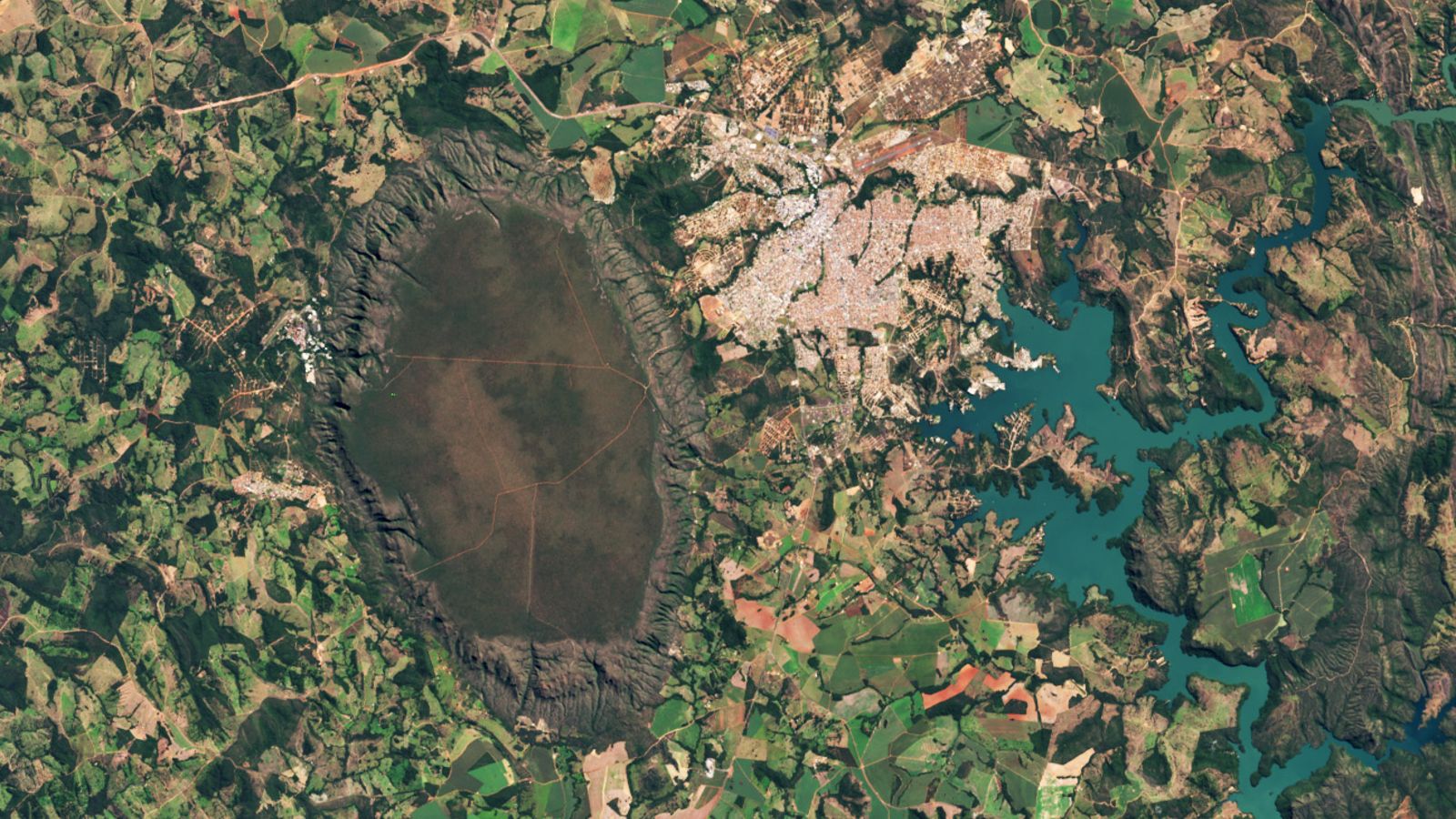
Satellite Image Reveals Brazil’s Giant “Sponge-Like” Dome That Feeds Its Famous Hot Springs
Simple facts
Where is it? Caldas Novas, Goiás, Brazil [map]
What is shown? A huge, sponge-like dome rising above the surrounding landscape.
Satellite: Landsat 9
Image date: May 19, 2025
A striking Landsat 9 satellite image shows the Caldas Novas Dome, a huge geological structure rising above central Brazil. The dome and the unusual Cerrado biome covering it help explain why the region is famous for its hot springs.
A 20-kilometer-long geological dome
The imposing oval structure is approximately 20 kilometers long and 7 miles (12 kilometers) wide. Known as the Caldas Novas Dome or the Caldas Mountains, it is located in the southeastern Brazilian state of Goiás and rises about 300 meters (1,000 feet) above the surrounding terrain.
An optical illusion known as relief inversion can make the elevated land appear to some viewers like a bowl-shaped depression, according to NASA Earth Observatory.
A 2004 survey suggested that the monolithic feature may be at least 600 million years old. It takes its name from the nearby town of Caldas Novas, which is visible in satellite imagery between the green dome and Lake Columba, an artificial reservoir formed by a nearby hydroelectric dam.
Caldas Novas has a population of about 100,000 and receives hundreds of thousands of tourists each year. Many visitors come to soak in the region’s famous hot springs.
Why the dome acts like a giant sponge
The dome is covered by the Cerrado, a tropical savanna that absorbs rainwater quickly. Water percolates through the rock’s internal structure, replenishing underground reservoirs and helping supply hot water to nearby springs during the dry season.
The Cerrado is often called Brazil’s “cradle of water” because it helps recharge groundwater and supply several of the country’s major rivers. Water also feeds waterfalls around the edge of the dome.
Image credit: Angeladepaula/Wikimedia
Hot springs heated deep underground
Unlike many hot springs, those around Caldas Novas are not heated by volcanic activity. Instead, water travels through deep cracks in the rock and is heated by naturally high temperatures within Earth before circulating back to the surface, according to Earth Observatory representatives.
Scientists once thought the dome formed through an ancient “magma intrusion,” in which lava forced its way through Earth’s crust. However, a 2021 survey largely disproved that theory and suggested that the structure most likely formed through other geological processes.

Image credit: Sueley Firmino Cavalcante
A protected Cerrado landscape
The dome and its surrounding area have been protected as part of Caldas Novas State Park since 1970. The park is home to the seriema (Cariama cristata), peki trees (Cariocal brasiliense) and wolf plants (Solanum lycocarpum), according to the Earth Observatory.
The park’s primary purpose is to protect the Cerrado covering the dome. Across South America, large areas of this biome have been cleared for farmland, just as deforestation has transformed parts of the Amazon rainforest.
Satellite images show the change clearly: land surrounding the dome is thought to have once been covered in Cerrado but is now a patchwork of farms and fields.
Source: www.livescience.com