


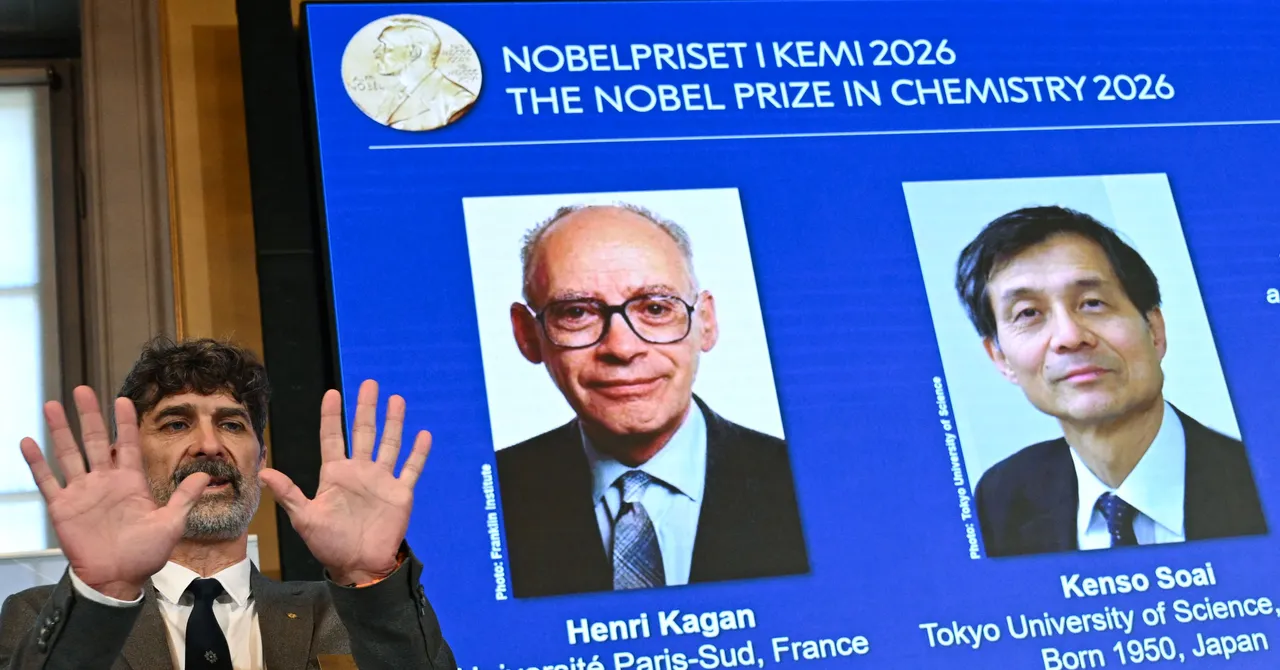
Nobel Prize in Chemistry 2026: Henri Kagan and Kenso Aiai Solve Nature’s Molecular Asymmetry Puzzle
Nobel Prize in Chemistry 2026 The Chemistry Prize was awarded to Henri Kagan and Kenso Aiai for discovering a solution to the puzzle of chemical asymmetries in nature. Their work opens new possibilities for engineering reactions used to produce medicines and other materials.
What is molecular chirality?
Some molecules are chiral, meaning they exist in two forms that are mirror images of each other but are not identical—much like a left hand and a right hand. One of the most mysterious chemical phenomena in biology is that living organisms contain almost exclusively one of these two forms. This phenomenon is known as homochirality.
The two versions of a molecule, known as enantiomers, have similar physical properties but can behave very differently. The Nobel Committee explained the difference with a simple analogy: Although a locksmith can create two mirror-image keys, “only one will fit the lock. If the customer attempts to open the lock with the other key, the lock may be damaged.”
Why chemical asymmetry matters for medicine
Homochirality creates challenges when developing medicines based on amino acids or sugar molecules. One enantiomer may produce the desired therapeutic effect, while the other can cause unwanted or even harmful side effects. Scientists cannot always easily control which version of a molecule is produced during synthesis.
From Pasteur’s discovery to the search for homochirality
The discovery of chiral molecules dates back to the work of Louis Pasteur. Pasteur identified two enantiomers that reacted very differently when exposed to bacteria. Since then, researchers have tried to reproduce homochirality in the laboratory to understand its spontaneous origins and apply that knowledge to controlled chemical reactions.
However, early experiments produced equal amounts of the two enantiomers and failed to replicate the selectivity observed in nature.
How asymmetric catalysts favor one molecular form
At the beginning of the last century, German chemist Willy Marquardt designed an asymmetric reaction that produced slightly more of one molecular form than the other. He achieved this using chiral catalysts—substances that accelerate chemical reactions and promote the formation of one enantiomer without being consumed.
Even so, the ratio between the two variants changed only slightly.
Charles Frank’s model explains how a small advantage can grow
In 1953, theoretical physicist Charles Frank proposed a mathematical model describing three conditions needed to reproduce homochirality. First, an asymmetric reaction must favor one of the two molecular forms. That initial imbalance must then be amplified. Finally, the reaction itself must produce a catalyst that drives the process forward.
This final property is called autocatalysis. It creates a positive feedback loop in which a small initial advantage allows one enantiomer to form more quickly until it dominates the reaction.
Henri Kagan’s research into asymmetric reactions
This framework formed the basis of Henri Kagan’s research. Beginning in the early 1980s, he focused on refining asymmetric reactions through detailed studies of catalysts.
At the time, scientists typically used catalysts made from metal atoms, which provided the driving force for a reaction, together with chiral substances that made the process asymmetric. They reasoned that using a mixture containing equal amounts of the two forms of a chiral molecule would produce a balanced mixture.
Source: www.wired.com