


Scientists have identified the first dinosaur fossil from the western Ingen-Ezhinaki Basin section of China’s Bayan Gobi Formation, expanding the known geographic distribution of Early Cretaceous dinosaur fossils in Inner Mongolia.
Dinosaur fossil 208GPV01 excavated from the Bayan Gobi Formation in the Ingen-Ezhinaki Basin, China. Image credit: Li et al., doi: 10.1016/j.hisbio.2026.100044.
The new specimen was discovered unexpectedly during a copper-mineral survey conducted by a team of Chinese geologists.
Cataloged as 208GPV01, the fossil was recovered from a drill core at a depth of approximately 473 meters (1,500 feet) near Guaizihu in the Ingen-Ezhinaki Basin of Inner Mongolia.
The Bayan Gobi Formation is an Early Cretaceous continental rock unit in northern China. It is primarily exposed in the Yingen-Ezhinaki Basin of western Inner Mongolia.
“The fauna of the Bayan Gobi Formation shares similarities with roughly contemporary fossil assemblages from western Liaoning Province,” said Tianyu Li of the China University of Geosciences and the Dinosaur Odyssey Science Museum and colleagues.
“Although differences exist, both assemblages may have formed part of the broader radiation of the Jehol biota.”
The dinosaur fossil dates to the Early Cretaceous, approximately 115 million years ago. It consists mainly of partial vertebrae from the sacral and tail regions, along with several associated skeletal elements.
“Specimen 208GPV01 consists of a sacral rib, four caudal vertebral centra, six caudal neural arches, several transverse processes, and an ossified tendon,” the researchers said.

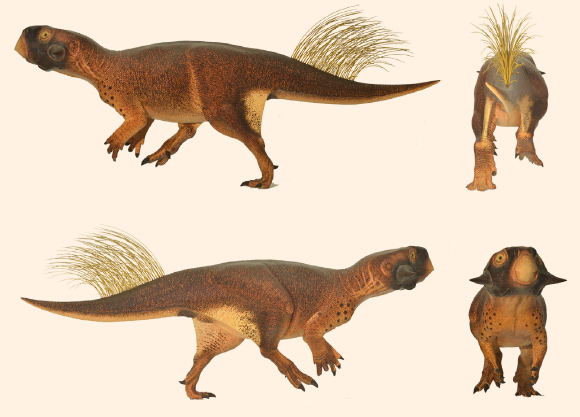
Reconstruction of Psittacosaurus, an early horned dinosaur. The model is based on the skin and pigmentation patterns of a specimen housed at the Senckenberg Museum in Germany. Image credit: Jakob Vinther et al.
The researchers identified the fossil as belonging to an ornithischian dinosaur. Ornithischians were a major group of primarily plant-eating, “bird-hipped” dinosaurs that included armored dinosaurs, duck-billed dinosaurs and horned dinosaurs.
To determine the specimen’s closest relatives, the scientists used geometric morphometric analysis to compare the proportions of its vertebrae with those of other ornithischian dinosaurs.
The results showed that 208GPV01 most closely resembles Psittacosaurus, an early horned dinosaur that was widespread across East Asia during the Cretaceous Period.
However, because the specimen is incomplete and its anatomical features are limited, the researchers could not assign it to a particular genus or species. For now, it is classified as an indeterminate ornithischian dinosaur.
The Bayan Gobi Formation has previously yielded several important dinosaur fossils, including the hadrosauroid Penelopognathus, ceratopsians such as Psittacosaurus sibiricus, and the alvarezsauroid Bannykus.
Nearly all of these discoveries came from the eastern part of the Ingen-Ezhinaki Basin.
“Specimen 208GPV01 represents the first published dinosaur record from the Bayan Gobi Formation in the western Ingen-Ezhinaki Basin,” the authors said. “It therefore expands the known geographic range of dinosaur fossils from this Early Cretaceous formation.”
The paper was published online on September 5, 2026, in the journal Historical Biology.
_____
Tianyu Li et al. The first dinosaur discovered from the Lower Cretaceous Bayan Gobi Formation in the western Ingen-Ezhinaki Basin, Inner Mongolia Autonomous Region, China. Historical Biology, published online September 5, 2026. doi: 10.1016/j.hisbio.2026.100044.
Source: www.sci.news