


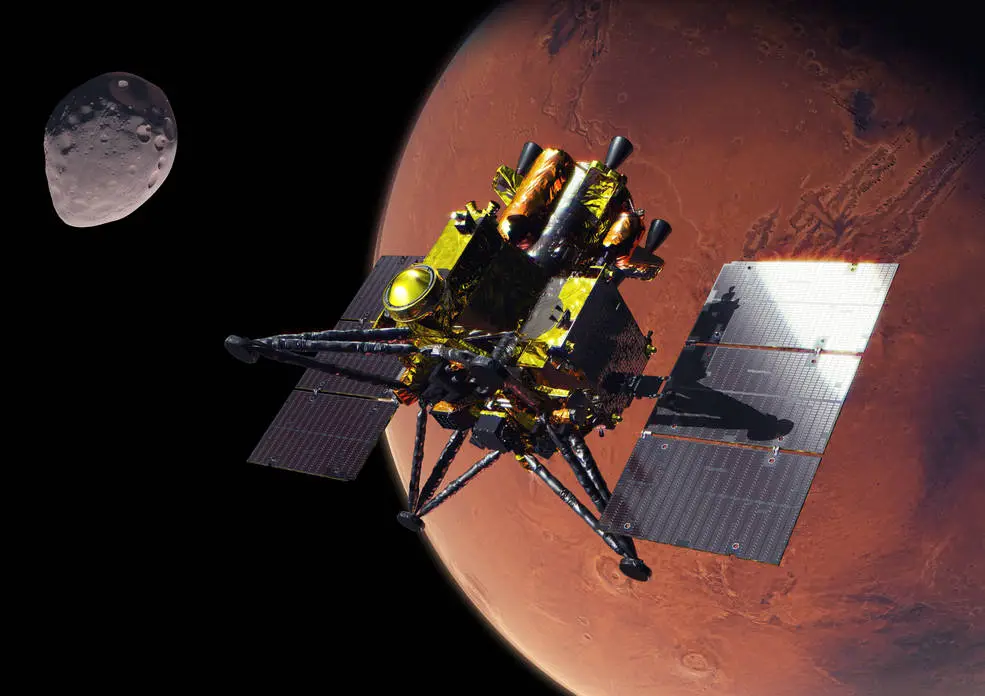
NASA to Preview JAXA’s Mars Moon Exploration Mission Ahead of October Launch
NASA will host a media conference call on Thursday, October 15, at 4:00 p.m. EDT to preview the agency’s contributions to JAXA’s Mars Moon Exploration (MMX) mission. The spacecraft is scheduled to launch from Japan’s JAXA Tanegashima Space Center on Monday, October 19, Eastern Daylight Time, which is Tuesday, October 20, in Japan.
NASA MMX Mission Media Briefing
Audio from the media conference call will be streamed on NASA’s website at:
Briefing participants will provide an overview of the MMX mission and discuss NASA’s contributions, including the spacecraft’s science instruments, sampling technology, communications and navigation support, and U.S. participation in the mission’s science team.
Media Conference Call Participants
- Lindsay Hayes, Acting Director, Planetary Science Division, NASA Headquarters, Washington
- Tom Statler, MMX Program Executive and Scientist, Planetary Science Division, NASA Headquarters
- David Lawrence, Principal Investigator, MEGANE (Mars Moon Exploration with Gamma Rays and Neutrons), Johns Hopkins University Applied Physics Laboratory
- Chris Szakny, Vice President of Honeybee Robotics, Blue Origin
Media interested in participating by phone should RSVP to Molly Wasser at [email protected] at least two hours before the call begins. NASA’s media accreditation policy is available online.
MMX Mission to Explore Phobos and Deimos
The MMX spacecraft will arrive at Mars in August 2027 and begin exploring the planet’s two moons, Phobos and Deimos. After studying Phobos in detail, the spacecraft is expected to collect samples from the moon’s surface by December 2028 and deliver them to Earth in 2031.
NASA’s contributions to the MMX mission include the MEGANE gamma-ray and neutron spectrometer, the spacecraft’s surface sampler mechanism, communications and navigation support from NASA’s Deep Space Network, and funding for U.S. scientists participating on the MMX science team.
NASA Technology Supporting the Mars Moon Mission
The MEGANE instrument was developed by the Johns Hopkins Applied Physics Laboratory. Blue Origin’s Honeybee Robotics developed the spacecraft’s pneumatic sampler mechanism.
NASA’s contribution to the MMX mission was funded by NASA’s Discovery Program, which provides frequent flight opportunities for high-value, focused planetary science investigations. The program is managed by NASA’s Marshall Space Flight Center in Huntsville, Alabama, for NASA’s Science Mission Directorate in Washington.
For more information on MMX missions, see below.
-end-
Karen Fox / Alana Johnson
Headquarters, Washington
240-285-5155 / 202-672-4780
[email protected] / [email protected]
Source: www.nasa.gov