


OAuth Grant Security: How to Find and Reduce Risky App Access
Every time an employee clicks Allow on an OAuth consent screen, a persistent trust relationship can be created between two applications. AI note-taking tools may gain access to calendars. Task management platforms may connect to Slack. Developer tools may receive access to code repositories.
Each decision takes only a few seconds. Reviewing those permissions properly can take much longer.
For IT and security teams, the question is no longer whether employees will connect applications to corporate data. They already have thousands of times. The challenge is identifying which OAuth grants are legitimate, which create significant risk, and which should be revoked—without spending an entire week on manual reviews.
That is exactly the problem Nudge Security is designed to address.
Why OAuth grant management is so difficult
OAuth permissions are different from traditional user access controls. A common misconception is that OAuth grants inherit the protections applied to a user’s identity. They do not.
OAuth is separate from authentication. Single sign-on (SSO) controls how users prove who they are, while multifactor authentication (MFA) adds another layer of verification. Neither SSO nor MFA automatically manages or removes OAuth permissions.
OAuth grants can also outlast the credentials of the person who created them. Disabling a user in Google Workspace or Microsoft 365 may suspend grants issued through that platform, but grants issued by third-party applications can continue to function.
Many grants remain dormant for months without generating an obvious activity log, yet they remain valid and could be used at any time.
Attackers understand this. In the recent Vercel breach, the root cause was a compromised OAuth token from Context.ai, a third-party AI tool that an employee had connected to the company’s Google Workspace account several months earlier. The attacker was able to gain access with a single approval.
The numbers show why OAuth sprawl is difficult to manage:
- 88 average OAuth grants created per employee, with 31 having data-level permissions (Nudge Security)
- 40 average applications per organization that can programmatically access sensitive corporate data (Nudge Security)
- 50% of SaaS breaches are expected to result from overprivileged OAuth tokens by 2027 (Gartner)
For a company with 1,000 employees, that could mean 88,000 access passes, including 31,000 connected directly to sensitive data.
OAuth grants can be more persistent than employee credentials, operate outside SSO, and move data through paths that are not visible to traditional network controls.
Learn why OAuth grants need their own lifecycle and access review process—and where to start.
Why manual OAuth reviews do not scale
A thorough review of one OAuth grant typically requires several steps:
- Review the application’s profile. Has the security team already vetted it? Does the vendor maintain a credible security and compliance program? Has it disclosed a breach within the past 12 months?
- Check the grantor’s role to determine whether administrative rights have been delegated to the application.
- Compare the requested scopes with what is typical for that type of integration and with the organization’s data-sharing policies.
- Contact the grantor to understand the business need and confirm MFA status.
Reviewing a single grant can easily take 45 minutes to reach a decision. That is not practical when an organization has tens of thousands of grants to examine.
No amount of expertise can eliminate the time required for repetitive manual work. Security teams need a way to cover the OAuth attack surface that already exists without relying solely on manual analysis.
Learn more about the risks of managing OAuth grants at scale.
Discover every OAuth grant with Nudge Security
You cannot evaluate an OAuth grant you do not know exists. Nudge Security provides complete OAuth visibility by building an inventory of grants and applications across the SaaS environment, including grants created before Nudge Security was deployed.
Discovery does not depend on activity logs. Dormant identity-only permissions, including “Sign in with Google” connections, appear alongside active permissions.
Nudge Security also identifies API keys, service accounts, and remote MCP server connections that power AI tools and agents, helping security teams understand programmatic access to corporate data.
For every grant, security teams can see:
- The applications and vendors being accessed
- The employee who created the grant
- The exact permissions and scopes granted
- The applications and company data the grant can reach
Assess OAuth risk with actionable security signals
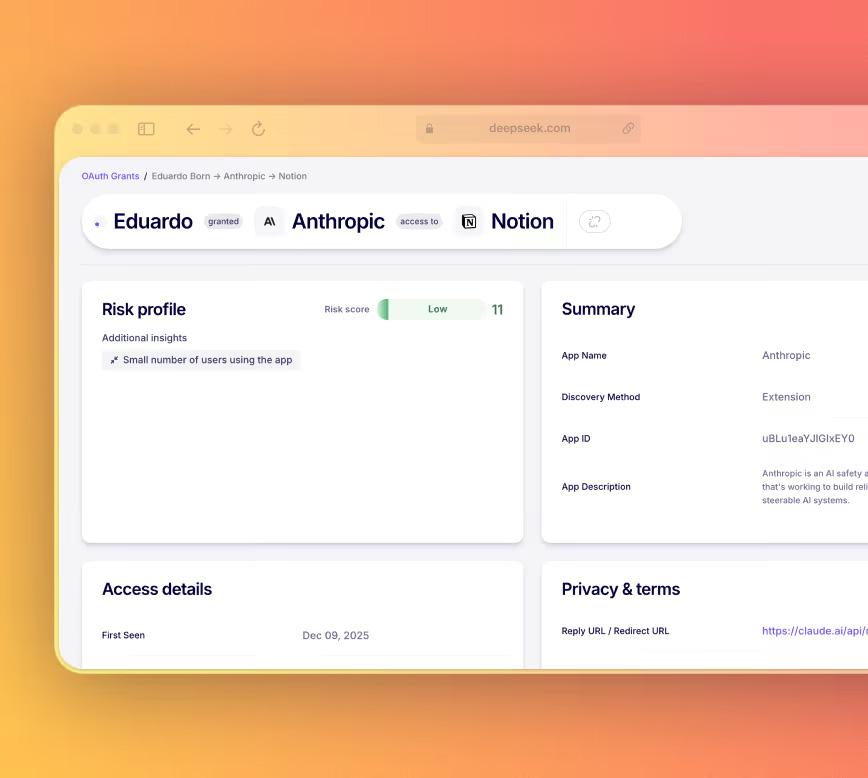
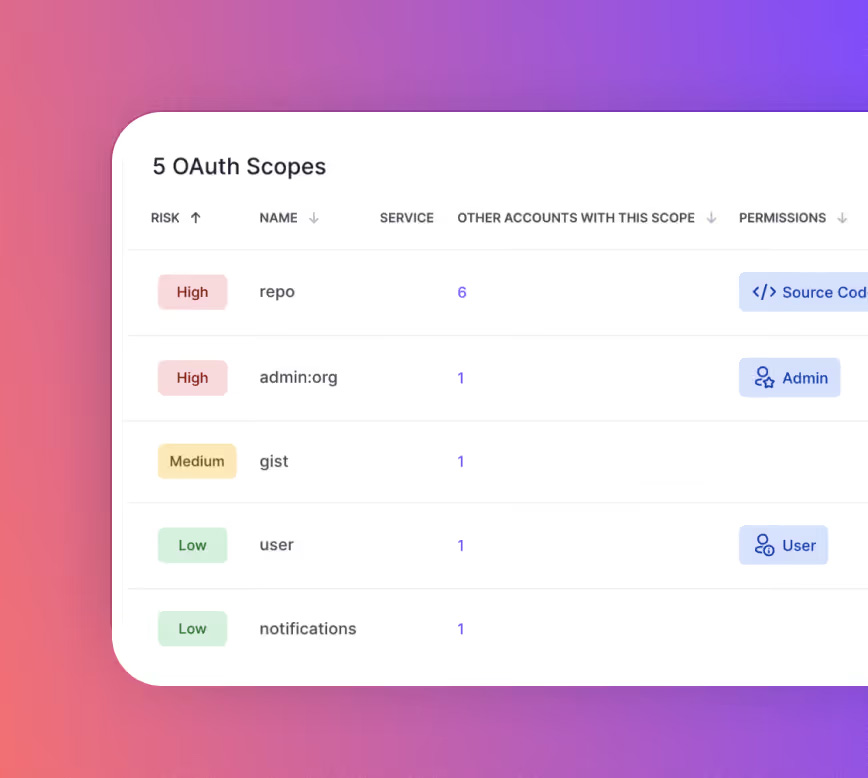
An inventory of OAuth grants is useful only if security teams can quickly identify which connections require attention. Nudge Security automatically classifies and risk-scores integrations based on privilege scope, vendor, grantor, organizational usage, and the sensitivity of the data accessed.
Risk insights can identify:
- Excessive or unnecessary privileges
- Suspicious domains
- Applications commonly used by threat actors to steal data
- “Data highways”—connections involving unusually broad and persistent access to sensitive data such as email, files, and code repositories
- MCP servers acting as intermediaries between AI tools and corporate data
Nudge Security also highlights positive signals, such as widely used applications and verified publishers, helping teams distinguish routine integrations from unusual or potentially risky connections.
Analyze every OAuth grant in seconds
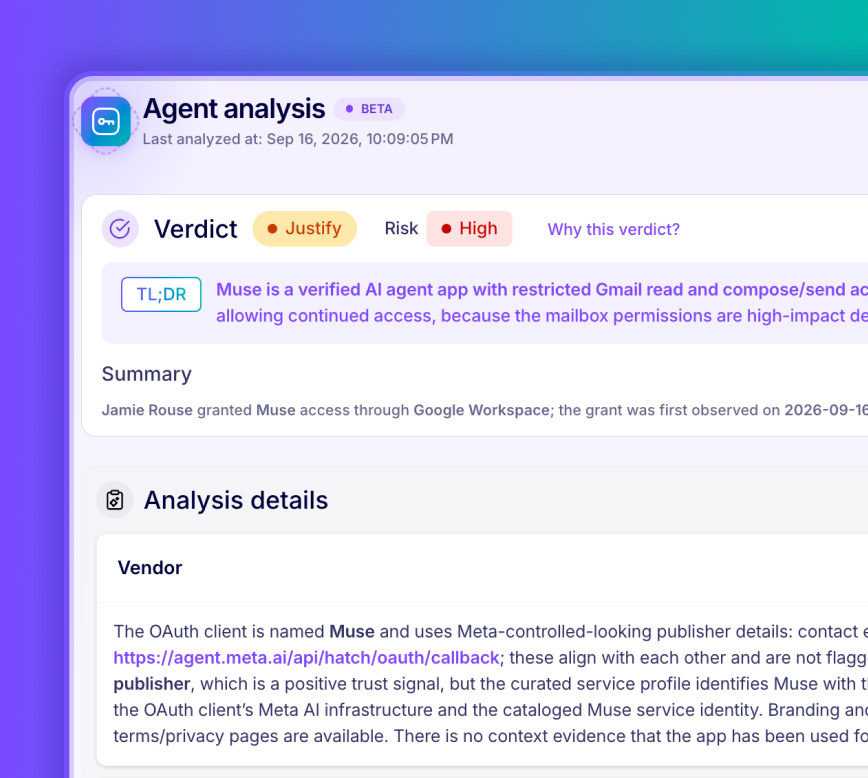
The risk score identifies where to look. The OAuth Grant Risk Analyst performs the detailed analysis.
The agent uses Nudge Security’s detection context across browsers, inboxes, identity providers, and connected applications, along with more than 240,000 pieces of risk intelligence, to review new OAuth permissions as they appear. It can also incorporate a vendor security profile.
The analysis evaluates the same factors an experienced security analyst would consider:
- Grantor: Metadata about the grant author, role, and users
- Vendor: Security posture, compliance program, and recent breach history
- Authority: The scopes granted and how they compare with common scopes
- Reach: What the application can do and how it is used across the organization
Because the agent examines who created the grant—not only what the grant allows—it can identify risks that a basic score may miss, such as a new hire creating a high-risk developer integration.
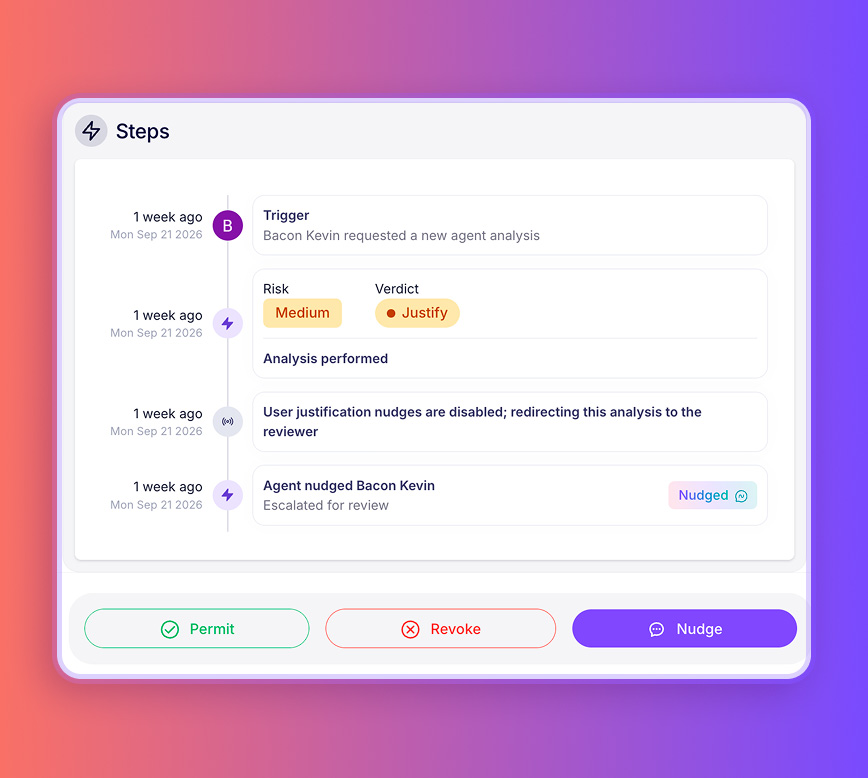
Each analysis returns a plain-language risk assessment, a summary, detailed reasoning, evidence gaps, and one of three verdicts:
- Allow: The grant is low risk and can remain active.
- Justify: Additional information is needed. Contact the grantor to confirm the business need.
- Revoke: The risks outweigh the business value, and the grant should be removed.
A review that could take 45 minutes manually can reach a verdict in approximately 15 seconds with the agent.
Govern OAuth access while keeping humans in control
Speed is valuable only when the results are reliable. OAuth Grant Risk Analyst gives security teams current information before any action is taken.
The agent recommends next steps, while the security team reviews the verdict and supporting evidence. Once the team approves an action, the agent can revoke the grant or ask the grantor to justify the access. All actions are auditable, so teams can see what was done, when it happened, and why.
Nudge Security also provides controls for reducing OAuth risk over time:
- Contact grantors directly: Request validation through Slack, Teams, email, or browser extensions, with responses captured automatically.
- Receive alerts: Get notified when new OAuth activity occurs.
- Revoke OAuth permissions: Automatically remove risky or unused access, including during employee offboarding.
The result is a managed OAuth workflow that turns 45-minute manual reviews into decisions your team can make in seconds—without giving up human oversight.
Conclusion: Take control of OAuth permissions
Employees connect applications because those tools help them get work done. That behavior is not going away—and it should not. The goal is to ensure every connection is visible, understood, and revoked when the risk outweighs the business value.
Nudge Security’s OAuth risk management capabilities are part of a broader solution for SaaS and AI security governance. Nudge provides an AI agent that inventories OAuth grants, adds the risk context needed to understand them, and supports clear decisions at scale while keeping security teams in control.
Ready to take control of risky OAuth permissions? Start your 14-day free trial.
Sponsored and written by Nudge Security.
Source: www.bleepingcomputer.com