



Daniel Ferris believes the best wearable exoskeletons are the ones users barely notice. When a biomechanical technician wears one, the device should feel like a gentle tug rather than a powerful machine. Yet after removing the exoskeleton, walking can suddenly feel as difficult as moving downhill.
How innovative technology helped spinal cord injury patients get back on their feet
Ferris has spent decades designing wearable exoskeletons and powered prosthetics. For years, he predicted that robotic assistance would eventually become part of everyday life. In 2009, he forecast that by 2024, people would be walking through streets, shopping centres and neighbourhoods while wearing robotic exoskeletons.1
Ferris now admits that he “jumped the gun”, but his vision of consumer exoskeletons is becoming increasingly realistic.
When Ferris made that prediction, exoskeletons were used mainly in clinical rehabilitation for people recovering from spinal cord injuries and strokes. “The exoskeleton was really targeted because it was losing function and needed to replace that function,” says Taylor Dick, a neuromuscular biomechanist at the University of Queensland in Brisbane, Australia.
Today, researchers and companies are focusing increasingly on augmentation rather than replacement. Instead of taking over movement, modern wearable robots provide some of the force needed to walk, climb stairs or run. Powered orthotics could reduce pressure on arthritic knees, while robotic shorts may make everyday walking easier for older adults. Other exoskeletons are being developed for healthy users who want to travel farther or move faster.
In October, Nike unveiled a prototype called the “Powered Footwear” system. The company’s Project Amplify is designed for everyday athletes and aims to help people walk or run longer with less effort. Similar wearable robotics could eventually support tourists exploring demanding terrain, including the foothills of the Great Wall of China.
For exoskeleton advocates, this shift towards physical augmentation cannot come soon enough. The World Health Organization says many countries, including Japan, China and Italy, are ageing rapidly. Globally, the number of people aged 60 and over is expected to reach 2.1 billion by 2050.
Before wearable exoskeletons can reach the mass market, however, researchers must overcome several technical and practical challenges. Devices need to become lighter, smarter, more affordable and adaptable to the wide range of people who may use them. Researchers must also determine the long-term effects of powered assistance. If machines make walking and running easier, will people become more active and healthier? Or could prolonged use lead to dependence on the technology and muscle weakening?
From movement replacement to wearable assistance
For modern exoskeleton designers, providing less assistance can produce better results. Earlier devices often resembled Iron Man-style suits that delivered substantial extra strength. Newer systems estimate how much force a wearer would naturally produce and add only a portion of what is needed.
This approach gives users greater control, reduces the amount of power required from the machine and limits the strain placed on the device when assistance is switched off.
Over the past few years, research teams have reported progress in developing exoskeletons that support more natural movement. A control system developed by researchers at the Georgia Institute of Technology in Atlanta uses artificial intelligence to estimate hip-joint motion in real time across different walking speeds, inclines and stair heights. The system reduced the effort required by test participants while walking.2
The same researchers and their colleagues later extended this approach to more flexible control systems. These systems allow users to switch unexpectedly between different types of movement, such as walking, climbing stairs and changing direction.3
Robert Gregg, a roboticist at the University of Michigan in Ann Arbor, is applying a similar strategy to the knee. He leads a $2 million project designed to adapt powered orthotics and reduce the forces transmitted through the joint. In a four-person pilot study, participants reported less pain while using the device for activities such as standing up from a chair and climbing stairs.
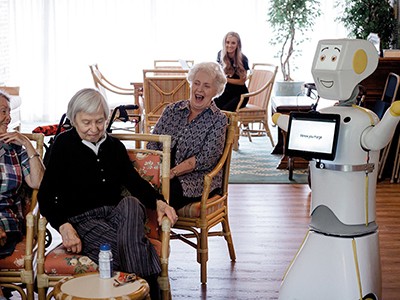
Robots take on the challenge of caring for the elderly
Many modern exoskeletons use what researchers call task-independent control. Older systems typically followed preset movement patterns for one specific activity. By contrast, task-independent systems estimate the effort produced by the wearer’s joints and adjust assistance in real time across different tasks.
Traditional exoskeletons often combine small, fast-spinning motors with large gear trains. Although this design can generate substantial force, it may also make the joints feel stiff. Newer actuators use larger, slower motors and lower gear ratios. This reduces friction and allows users to move more naturally with the device.
Gregg’s powered orthotic can provide approximately 25% to 30% of the force produced by a biological joint. According to Gregg, that level of support could compensate for some movement limitations associated with ageing, osteoarthritis and repetitive physical tasks.
Wearable sensors can monitor limb movement and shifts in body weight across the feet. Machine-learning systems then use this information to estimate how much assistance the wearer needs. Gregory Sawicki, a biomechanist at the Georgia Institute of Technology, compares the goal to creating a “large-scale movement model” trained on enough examples of human motion to support different users and activities.
The result, Sawicki says, is closer to a “wearable electric bike” than an Iron Man suit.
The comparison also resonates with designers outside academia. Nike’s Project Amplify, developed with Defi, a robotics company in Boxborough, Massachusetts, uses a motor, drive belt and rechargeable battery attached to the lower leg and foot. The system assists ankle movement and is still undergoing testing. Nike says it could eventually be sold to people who want to walk or run farther while using less effort.

Testers try out the WalkON robotic system while taking a walk with Enrica Tricomi, the researcher who helped develop the device.Credit: Uwe Anspach/Technical University of Munich
Advances in soft materials are also helping exoskeletons feel more like clothing. Researchers at the University of Heidelberg in Germany developed a system called WalkON, which consists of a shoulder strap, a belt and a band around the user’s thigh. The components fit over ordinary clothing.
In testing, WalkON reduced the metabolic cost of walking on level ground by 10% among 10 older adults. In a separate test, young adults used 18% less energy while walking uphill.4
WalkON weighs just under 3 kilograms, making it considerably lighter than many earlier exoskeletons. Dick recalls seeing a 23-kilogram unit designed for people recovering from strokes. “Nobody can wear this,” she told the engineer.
Japan’s experience with robots and assistive technology highlights why weight, cost and convenience matter. Tomohiro Shibata, a robotics engineer at Kyushu Institute of Technology in Kitakyushu, develops robots designed to provide human care, often in clinical environments.
Cost remains the biggest obstacle, Shibata says, but ease of use is also crucial. Some clinical exoskeletons take approximately 20 minutes to put on, which can consume valuable time during rehabilitation appointments.
Like Sawicki, Shibata compares the next generation of exoskeletons with electric bicycles. A wearable robot should be controllable “as if it were part of the body”, without professional assistance or constant maintenance, he says.
The size and weight of an exoskeleton could determine whether people are willing to use it. Shibata notes that bulky technology may carry a stigma similar to the reluctance some older adults feel about using canes or hearing aids. For wearable exoskeletons to become part of everyday life, they will need to be lightweight, discreet, affordable and easy to operate.
Source: www.nature.com