


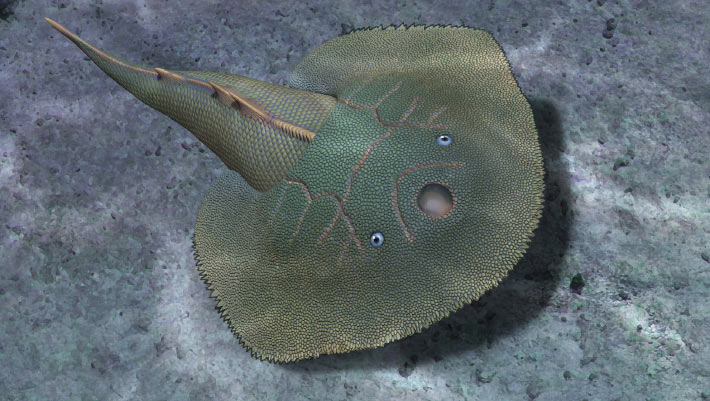
New Multi-Gilled Jawless Fish Discovered in 419-Million-Year-Old Rocks in China
Paleontologists have described Asioaspis brachiotus, a new genus and species of multi-gilled galeaspid fish that lived in what is now Yunnan Province, China, approximately 419 million years ago during the Early Devonian.
A new galeaspid fish from the Early Devonian
Asioaspis brachiotus belonged to Galeaspida, an extinct group of armored, jawless fish known from China and northern Vietnam.
Although galeaspids lacked jaws, they are considered more closely related to jawed vertebrates, including humans, than to living jawless fish such as lampreys and hagfish.
“Galeaspids have long played a central role in understanding the origin of key traits in gnathostomes, such as jaws, spiracles, and paired appendages, because they are more phylogenetically similar to jawed vertebrates than to extant jawless fishes,” said researchers Zhi-Kun Gai, Ph.D., of the Institute of Vertebrate Paleontology and Paleoanthropology at the Chinese Academy of Sciences, and colleagues.
“Although restricted to China and northern Vietnam, these armored jawless fishes exhibited remarkable morphological differentiation and taxonomic diversity during the Siluro-Devonian period, with 19 families, 74 genera, and 100 species described to date.”
Galeaspids are classified cladistically into two basic orders, Hanyangaspiles and Dayongaspiles, as well as three major orders: Eugaleaspiles, Polybranchiales, and Huanaspiles.
Fossils reveal a broad headshield and numerous gill pockets
The fossils of Asioaspis brachiotus were collected from the Xishancun Formation near Mandian Reservoir in Qujing City, Yunnan Province.
“The collection includes three nearly complete headshields and three incomplete headshields,” the paleontologists explained.
The oval headshield reached a maximum length of approximately 4.7 to 6 cm (about 2 inches). It had serrated edges, a coarse-grained surface, and a very wide rim on its underside.
The researchers identified at least 12 pairs of gill pockets, although an exact count was not possible because the fossils were incompletely preserved.
Based on these features, the team assigned the new species to Polybranchiales, a group of galeaspids characterized by multiple gill openings.
Asioaspis may bridge two galeaspid lifestyles
The earliest known members of Polybranchiales, including Platylomaspis, date back approximately 438.6 million years. However, the group became more diverse during the Early Devonian, when nine genera and 15 species appeared in the Xishancun Formation.
Asioaspis brachiotus combines characteristics of both primitive and more advanced relatives. The researchers’ phylogenetic analysis suggests that it occupied an intermediate position between them.
In some early galeaspids, the eyes and central openings were clustered near the top of the headshield. This arrangement may have suited a partially buried lifestyle in sand. In Asioaspis, however, the openings were more widely spaced.
The researchers argued that the fish could not have lived permanently half-buried because silt and mud would have entered its mouth and gill chambers. Instead, it probably lived on the seafloor surface, like most galeaspids.
“The midline dorsal opening and the paired orbital openings in Asioaspis brachiotus are not as tightly clustered near the top of the headshield as in Platylomaspis and Naningaspis,” the authors said. “Instead, they are widely separated and closer to the ventral margin, as in Pentathalaspidae, Duyunolepididae, and Polybranchipidae.”
“This shows that it is not possible for Asioaspis brachiotus to have lived a half-buried lifestyle, because sand, silt, and mud would have flowed into the oral and gill chambers,” they added.
“It probably lived a normal benthic lifestyle, like most galeaspids,” the researchers noted.
Considering its phylogenetic position, Asioaspis brachiotus may represent an evolutionary transition from a semi-endobenthic lifestyle to the epibenthic lifestyle seen in Polybranchiales.
Study of the new species
The discovery of Asioaspis brachiotus is reported in a paper published in the journal Asian Vertebrate Paleontology.
_____
Asioaspis, a new genus of polybranchial galeaspid fish (Galeaspida, stem-gnathostomes) from the Devonian of Yunnan Province, China. Vertebrata PalAsiatica 64 (2): 137–150. doi: 10.19615/j.cnki.2096-9899.260113.
Source: www.sci.news