


Cat Oxytocin Levels Are Linked to Owners’ Mood, Study Finds
A new study suggests that cats and their owners may share linked oxytocin levels, a hormonal pattern associated with social bonding. Cats with higher oxytocin were more likely to live with owners who reported less anger, confusion, depression and anxiety. The research was published in iScience.
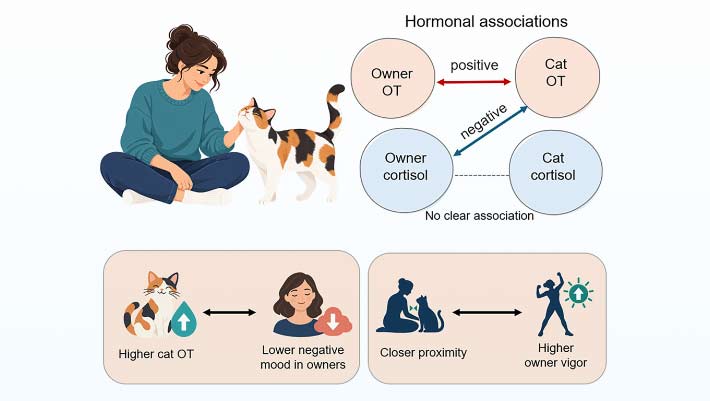
Cat and owner oxytocin levels were linked in a new study. Image credit: Takagi et al., doi: 10.1016/j.isci.2026.117934.
Oxytocin may help explain the human-cat bond
“Many cat owners are familiar with the sense of comfort and peace that they feel when their cat jumps on their lap for affection, starts petting them, and the cat starts purring contentedly,” says Dr. Saho Takagi, a researcher at Kyoto University and Azabu University.
“Our findings suggest that this emotion may be partially reflected in the hormonal bond between cat and owner, particularly through oxytocin, a hormone involved in the formation of parent-child bonds and social relationships.”
How the cat oxytocin study was conducted
The researchers collected urine from 19 cat owners and 29 cats over a one-month period. The humans and cats each provided up to three samples, which were tested for oxytocin, a hormone associated with social bonds, and cortisol, a marker of stress.
Because urine could not be collected from five cats, the hormone comparisons were conducted using 24 owner-cat pairs.
Owners with higher oxytocin levels were more likely to live with cats that also had higher oxytocin levels. Owners with higher cortisol levels were more likely to live with cats that had lower oxytocin levels.
There was little correlation between the cortisol levels of owners and cats. This differs from studies of dogs and their owners, in which cortisol levels were reported to change in tandem.
Cat hormones were linked to owners’ mood
The researchers also assessed the owners’ moods using a standard questionnaire. Cats with higher oxytocin levels were more likely to live with owners who reported feeling less angry, confused, depressed and anxious.
Owners with higher cortisol levels reported a more negative mood. The findings suggest that the human-cat relationship may revolve more around oxytocin-related processes than shared cortisol levels.
“The present findings provide preliminary evidence that owner and cat hormonal status are linked primarily through oxytocin-related processes, although evidence of an association between cortisol concentrations was limited,” the authors said.
Nearby cats were linked to greater owner vitality
To measure how much time each pair spent in close proximity, the researchers fitted the cats with small Bluetooth beacons. These tracked the signal strength between the cats and their owners’ smartphones.
Owners whose cats were nearby scored higher on the vitality scale.
In the original analysis, the length of time an owner had lived with a cat was associated with a more negative mood. However, that association disappeared after the researchers took into account owners who had multiple cats.
Cats’ responses to owners and strangers
In an exploratory test, cats with higher oxytocin levels were more likely to approach and enter a circle marked around their owner or an unfamiliar person.
Cats with higher cortisol levels tended to spend less time near strangers, although the results were not statistically clear.
Cats may be active social partners
The researchers suggest that the hormonal relationship between cats and humans may reflect the different histories of cat and dog domestication.
“Although the mood-enhancing effects of owning a cat may diminish over time, daily interaction and physical proximity with cats may help owners maintain a positive psychological state,” the authors said.
“This suggests that cats function not just as passive companions, but as active social partners who can participate in two-way physiological and emotional interactions with humans.”
_____
Takagi Saho et al. “Cats and humans exhibit correlated and affiliative physiological states.” iScience, published online October 13, 2026. doi: 10.1016/j.isci.2026.117934.
Source: www.sci.news