


Platypus-Like Jurassic Mammal Was the Size of a Chihuahua—and Hunted Salamanders
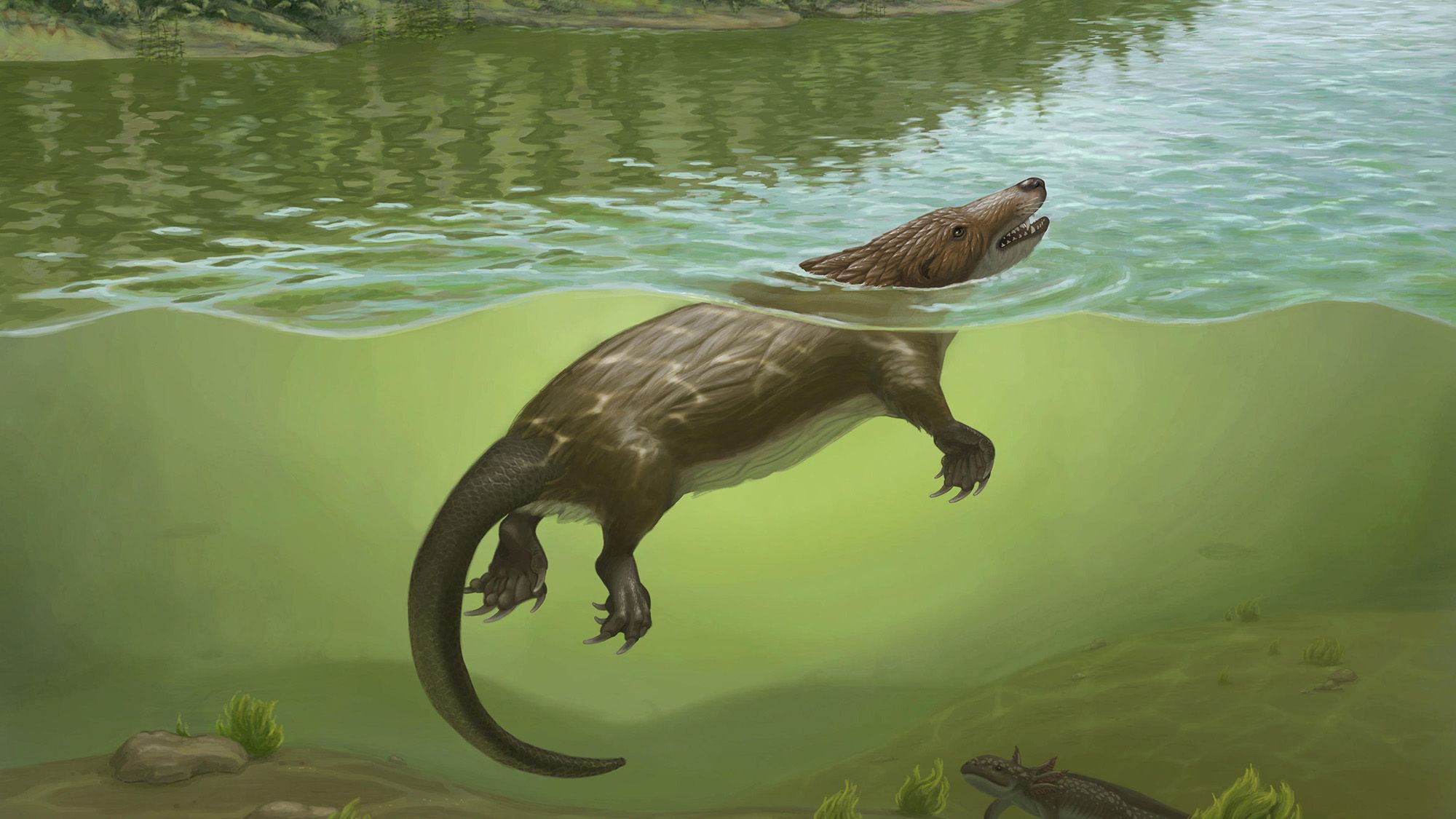
A newly discovered platypus-like creature was the largest known mammalian relative from the Jurassic Period, according to a new study. Despite its size by Jurassic mammal standards, Megacauda Sungei weighed only about as much as a Chihuahua: between 2.2 and 4.4 pounds (1 to 2 kilograms).
The semi-aquatic animal lived between 168 and 163 million years ago during the Middle Jurassic, in what is now China’s Inner Mongolia Autonomous Region. It likely hunted salamanders and other prey in freshwater lakes and rivers, making it one of the oldest known mammal-type animals adapted to a semi-aquatic lifestyle.
A Jurassic mammal with a broad, powerful tail
Researchers discovered the delicate fossil in 2016. The animal’s name, Megacauda Sungei, refers to its unusually large tail: megacauda means “big tail.” The findings were detailed in a study published in Nature.
The fossil shows a combination of features that resemble both modern platypuses and otters. It had a broad, flat tail suited to powerful swimming, along with short hind limbs and relatively long legs. These limbs may also have helped it swim and dig tunnels in riverbanks.
“It’s like a chimera,” study co-author Zhe-Xi Luo, a paleontologist at the University of Chicago, told Live Science. “The back half of this animal is platypus-like. The same goes for its limbs, which allow them to swim and dig tunnels in riverbanks.”
A predator with specialized teeth
Although its body and lifestyle were partly platypus-like, its teeth were very different from those of a modern platypus. M. Sungei had sturdy canines and shearing cheek teeth that could cut and chew meat.
Fragments of vertebrate bone found in what would have been the animal’s stomach, as well as in the surrounding fossil bed, suggest that it ate salamanders. The animal may also have hunted fish and invertebrates in nearby lakes and rivers.
“The teeth are definitely not platypus-like,” Luo said. “This is a predator with huge, very specialized canine teeth. So it’s partly like an otter and partly like a platypus.”
The fossil preserves clues about early mammal evolution
One of the fossil’s most significant features is its throat. Modern mammals, including humans, have a U-shaped arrangement of hyoid bones that supports the throat muscles used for swallowing chewed food. This structure also helps young mammals drink breast milk.
The fossil suggests that M. Sungei already had the anatomical equipment needed for suckling and swallowing. According to study co-author Thomas Martin, a paleontologist at the University of Bonn, these abilities may have evolved much earlier than previously thought.
“This is a very important evolutionary innovation,” Luo said. The ability to swallow chewed food and nurse young may have helped early mammals diversify into carnivores, insectivores, herbivores and omnivores that could exploit many different food sources.
The discovery suggests that suckling and specialized swallowing may have evolved at least 165 million years ago, in the common ancestor of docodonts and mammals. That was before marsupials such as kangaroos and placental mammals such as primates and bears diverged from one another.
“Now we can trace its history back to before the split between modern marsupials and modern eutherians,” Luo said. “It’s a mammal.”
Docodonts occupied many Jurassic habitats
Megacauda Sungei belonged to an extinct lineage called docodonts. These mammal relatives lived during the Jurassic Period, when dinosaurs dominated terrestrial ecosystems, and survived into the Cretaceous Period.
Docodonts adapted to a wide range of environments. Some were shrew-like tree dwellers, such as Microdocodon gracilis. Others, including Docofossor brachydactylus, were adapted for digging with shovel-like feet. Another species, Castrocauda lutrasimilis, lived a semi-aquatic lifestyle roughly 164 million years ago and has been described as a Jurassic “beaver.”
“Aquatic lifestyles appear to have occurred frequently in early mammal-like species,” Luo said.
Vertebrate paleontologist Sue Hand of the University of New South Wales, who was not involved in the study, said the fossil shows that docodonts were widespread during the dinosaur era.
“This highly detailed study adds to the growing body of evidence that mammals occupied a wide range of ecological niches long before the evolution of modern mammals,” Hand said.
Study reference
Li, Y., Li, P., Neander, A., Zhang, H., Zhou, C., Martin, T., and Luo, Z. (2026). “A Jurassic mammal swimmer with a modified mammalian pharynx.” Nature.
Source: www.livescience.com