


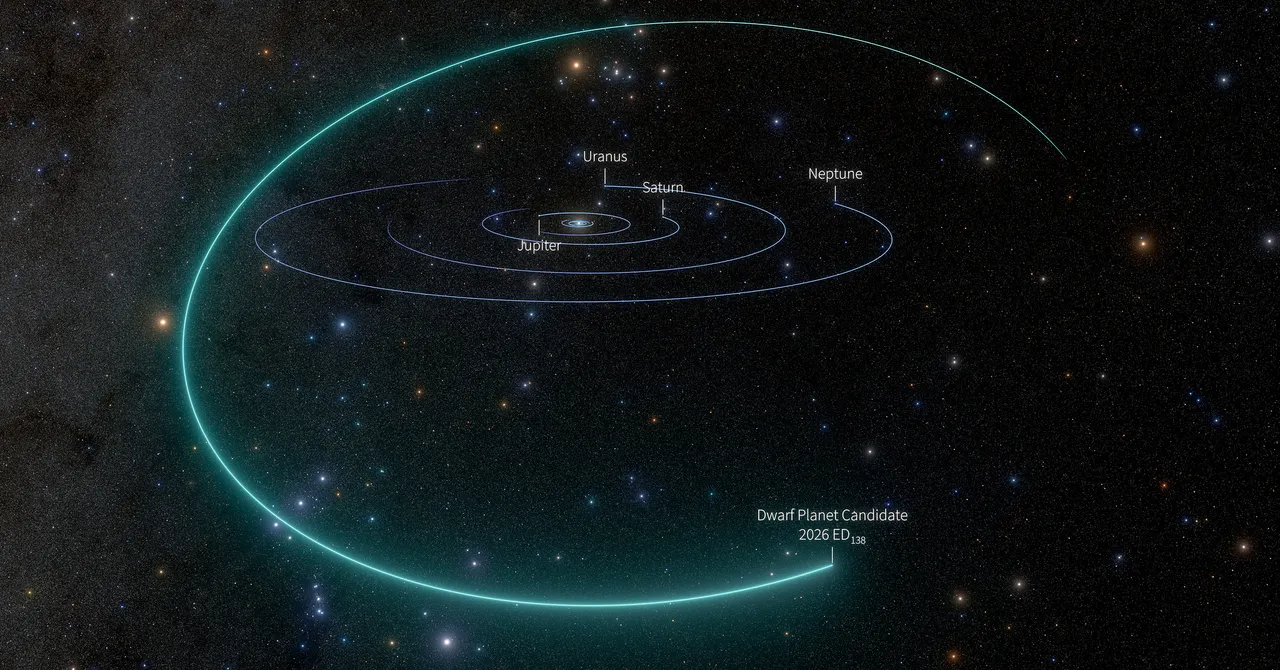
Astronomers have identified a distant trans-Neptunian object, designated ED138, that could eventually be recognized as a dwarf planet. Matthew Holman of the Harvard-Smithsonian Center for Astrophysics discovered the object while analyzing data collected by the Vera C. Rubin Observatory in 2026. Archival observations dating back to 2016 have helped researchers reconstruct ED138’s orbit, but its size and shape must be determined more precisely before its classification can be confirmed.
What distinguishes a planet from a dwarf planet?
Both planets and dwarf planets orbit the Sun and have enough gravity to become roughly spherical. The key difference is their orbital environment. A planet has cleared its orbit of other celestial bodies of comparable size, while a dwarf planet shares its region of the solar system with other objects.
This distinction led to Pluto’s reclassification in 2006. Pluto remains a rounded body orbiting the Sun, but it coexists with other objects in the distant solar system rather than dominating its orbital neighborhood.
How ED138 was discovered
Holman, a researcher at the Harvard-Smithsonian Center for Astrophysics and a member of the observatory’s operations team, identified ED138 on October 13 while examining data collected by Rubin in 2026. A more extensive search uncovered additional observations in archival records dating to 2016.
Together, these observations enabled the team to reconstruct ED138’s orbit over more than a decade. The long observational record is important because objects in the outer solar system can take many years to complete their orbits and are often difficult to detect.
Why the object remained hidden
Astronomers say ED138 was able to “hide” because it appears in a part of the night sky aligned opposite the Milky Way’s disk. The Milky Way usually appears as a thick band containing millions of stars. Its concentrated brightness can obscure much fainter objects, making them difficult to identify.
Rubin Observatory’s vast volume of data has made it possible to search for faint bodies even within this crowded field of light. That capability could help astronomers find more distant objects that have previously escaped detection.
Could ED138 become a dwarf planet?
ED138 is currently known only as a trans-Neptunian object. Astronomers have not yet confirmed that it is a dwarf planet because they need a more precise measurement of its size. That measurement will help determine whether the object’s gravity is strong enough to make it nearly spherical.
If ED138 meets the required criteria, it would join the five dwarf planets recognized by the International Astronomical Union: Ceres, Pluto, Haumea, Makemake and Eris.
Other possible dwarf planets
ED138 is not the only object awaiting possible classification. Astronomers have identified dozens of bodies in the outer solar system that may qualify based on their size and other characteristics. Well-known candidates include Gonggong, Quaoar, Sedna and Orcus, although experts acknowledge that the list could be even longer.
Confirming these classifications is difficult because the objects are so far away. Their size and mass are challenging to measure directly, and astronomers must determine whether their own gravity has shaped them into nearly spherical bodies.
For example, obtaining high-resolution images of Pluto required NASA’s New Horizons spacecraft to travel close to it. The journey lasted almost nine and a half years, from its launch in 2006 to its approach to Pluto in 2015. Three years later, New Horizons reached the more distant planetesimal Arrokoth.
A much larger solar system
The solar system is often depicted as the Sun surrounded by eight planets, but it is a far more expansive and populous structure. Alongside planets and moons, it contains dwarf planets, asteroids, comets and vast numbers of smaller bodies beyond Neptune.
The Kuiper belt spans about 50 astronomical units, while the scattered disks contain nearly 1,000 objects. Farther away lies the Oort cloud, which has never been directly observed and may extend to about 100,000 astronomical units from the Sun.
This story was originally published in the Spanish version of WIRED and translated from Spanish.
Source: www.wired.com