


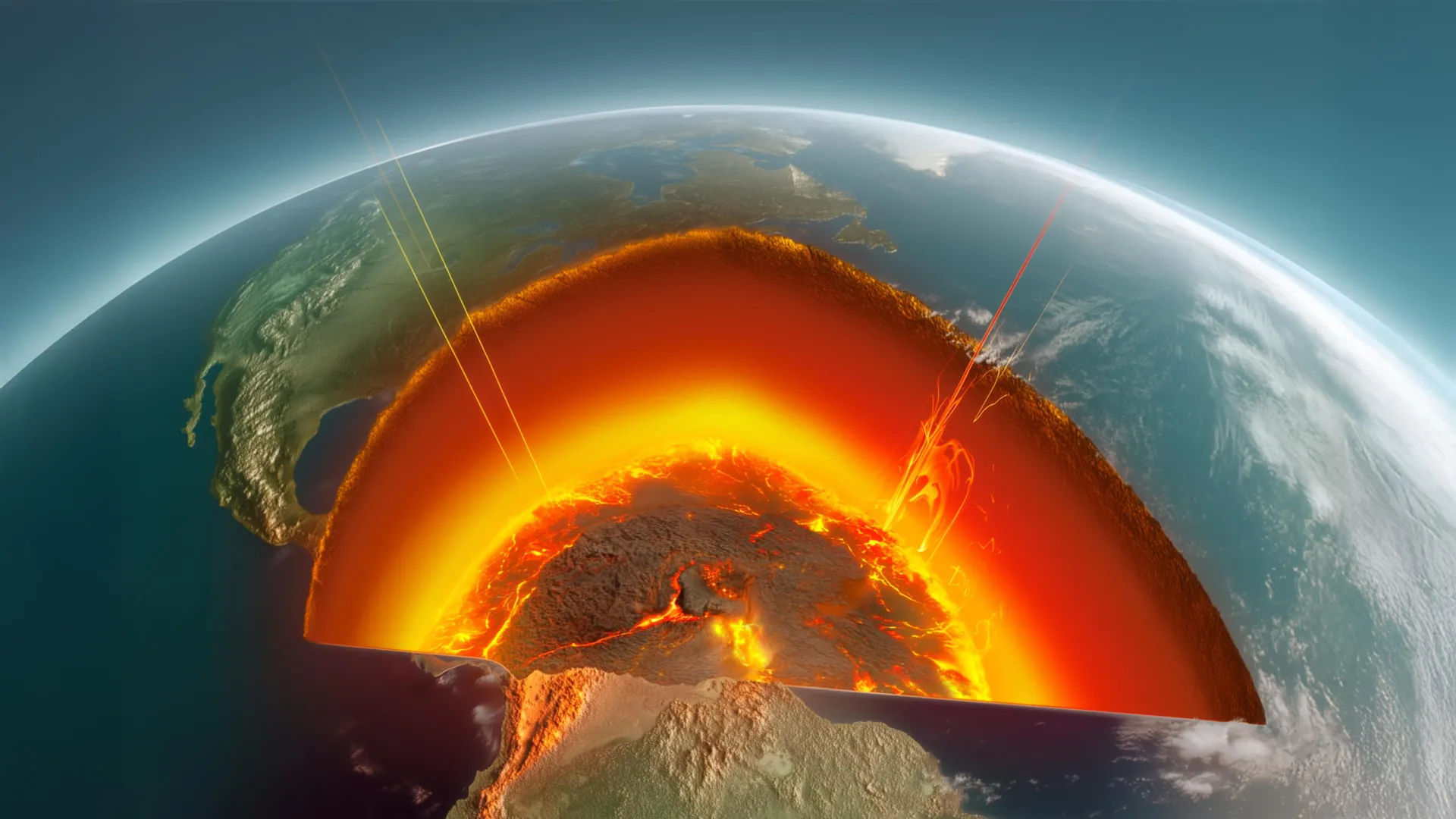
High-pressure experiments and computer simulations suggest that molten rock deep inside Earth can store far more oxygen than conventional chemical models predict. The finding, reported by researchers from the High Pressure Science and Technology Advanced Research Center (HPSTAR), Northwestern Institute of Technology and Vrije Universiteit Amsterdam in the National Science Review, raises the possibility that oxygen released by ancient volcanic activity helped influence the development of Earth’s oxygen-rich atmosphere.
Evidence that magma can hold “excess oxygen”
Oxygen is one of Earth’s most abundant elements, accounting for more than half of the atoms in the planet’s silicates. These minerals and molten materials, made primarily of silicon and oxygen along with other elements, form most of Earth’s mantle and crust.
Scientists have traditionally assumed that magma contains only the amount of oxygen required by the chemical composition and charge states of elements such as silicon, magnesium and iron. Water and carbon dioxide are treated differently: They can dissolve in magma and escape as gases when pressure falls. These substances are known as volatile components and play an important role in volcanic activity.
Oxygen, however, has generally not been considered an independent volatile component that magma can absorb and release. Whether molten silicate rocks could retain additional oxygen beyond their normal chemical composition had remained largely unexplored.
The research was led by Dr. Yanhao Lin and Dr. Ho-kwang Mao of HPSTAR, in collaboration with Professor Haiyang Niu of Northwestern Institute of Technology and Professor Wim van Westrenen of Vrije Universiteit Amsterdam.
Extreme pressure increases oxygen storage
To investigate the possibility, the researchers recreated conditions found deep inside Earth using equipment capable of producing extremely high pressures and temperatures. They heated a synthetic sample of mid-ocean ridge basalt, a volcanic rock commonly formed where tectonic plates move apart beneath the oceans.
The samples were subjected to pressures ranging from normal atmospheric pressure to 7 gigapascals and temperatures between 1,200 and 1,800 °C. Seven gigapascals is approximately 69,000 times the atmospheric pressure at Earth’s surface.
A special piston-cylinder and cube press maintained the conditions. The researchers also added platinum oxide (PtO2) to create an oxygen-rich environment and test how much additional oxygen the molten rock could absorb.
After each experiment, the team rapidly cooled the melt to form a glass that preserved key properties of the liquid. The researchers analyzed its elemental composition and measured the water and carbon dioxide it contained. They then calculated how much oxygen was needed to balance the other elements, in addition to the oxygen already present in the water and carbon dioxide.
They called the remaining amount “excess oxygen.”
At normal atmospheric pressure, the glass contained very little excess oxygen. At 7 gigapascals, however, excess oxygen accounted for more than 5% of the sample’s weight.
For comparison, experiments conducted at similar pressures and temperatures without platinum oxide produced excess oxygen concentrations of only 0.2 to 0.5 wt%.
The researchers also tested whether the additional oxygen had simply become trapped in tiny bubbles. Raman spectroscopy, which identifies materials by analyzing how they interact with light, found no trace of oxygen gas in the glass. This suggests that the excess oxygen had become part of the glass structure rather than collecting in bubbles.
The measured concentrations could even underestimate the magma’s true storage capacity. Some oxygen may have escaped as the molten sample cooled, meaning the original melt may have contained more.
Simulations reveal how the oxygen is incorporated
Professor Niu led theoretical computer simulations to examine the process at the atomic level. The team used a deep neural network (DNN) model designed to simulate atomic interactions with an accuracy approaching that of ab initio calculations, which describe atomic behavior using the fundamental principles of quantum mechanics.
The simulations showed that oxygen could dissolve into the melt until the system reached equilibrium, when the movement of oxygen into and out of the molten material was balanced.
The model contained only magnesium, silicon and oxygen, making it simpler than the basalt used in the experiments. Even so, it reproduced the same overall trend: The melt’s capacity to store excess oxygen increased with pressure.
The simulated concentrations were lower than those measured experimentally. The researchers attributed the difference to the model’s simplified chemistry compared with the more complex composition of natural basalt.
The calculations also showed that the behavior of oxygen atoms changed as more oxygen entered the melt. Their charges became more varied, and some oxygen atoms formed peroxide-like bonds with one another. These changes help explain how molten rock can accommodate more oxygen than traditional chemical models would predict.
The pressure-dependent behavior resembles that of water and carbon dioxide, which also become more soluble in magma as pressure increases. The researchers therefore propose that oxygen should be considered an independent component of silicate melts, rather than only as part of the chemical balance involving other elements.
Could ancient volcanism have affected atmospheric oxygen?
The finding raises questions about whether magma transported substantial amounts of oxygen from Earth’s interior to its surface.
The researchers propose a possible mechanism involving magma formed in oxidized regions of the mantle. Under the immense pressures found deep underground, this magma could absorb significant quantities of excess oxygen. As it rises, the surrounding pressure decreases, reducing the amount of oxygen the melt can retain.
Some of the oxygen could then be released and participate in reactions that increase the oxidation of the upper mantle, crust and, eventually, the atmosphere. Oxidation is a chemical process involving the transfer of electrons. In this case, oxygen carried by magma could increase the oxidizing capacity of surrounding materials and potentially affect the planet’s atmospheric oxygen balance.
This proposed mechanism may coincide with important events in Earth’s geological history. Between about 2.5 billion and 2 billion years ago, atmospheric oxygen concentrations rose substantially. That period also saw the formation of some of Earth’s largest large igneous provinces (LIPs), regions created by eruptions of exceptionally large volumes of magma.
The researchers suggest that oxygen released from these ancient volcanic systems may have contributed to changes in atmospheric composition.
Their preliminary calculations illustrate the potential scale of the process. If magma erupted during this period released excess oxygen equivalent to just 0.27% of its weight, the total amount could theoretically equal all the oxygen currently present in Earth’s atmosphere.
This estimate does not demonstrate that volcanism supplied that much atmospheric oxygen. Instead, it indicates that even a relatively small proportion of oxygen released from enormous volumes of magma could have significant planetary effects.
Implications for planetary evolution
The discovery could affect several areas of planetary science. It may change how researchers understand ancient magma oceans, vast bodies of molten rock thought to have existed early in the histories of Earth and other rocky planets.
It also points to a previously overlooked factor in volcanic degassing, the process through which gases and other volatile materials escape from magma and interact with an atmosphere. If magma can store and release oxygen independently of other chemical components, models of atmospheric development may need to include this process.
Understanding how oxygen moves between the interiors and atmospheres of rocky planets could also help scientists investigate how potentially habitable environments develop and persist over billions of years.
More research is needed to determine how much oxygen natural magma stores and how much ultimately reaches an atmosphere. For now, the findings suggest that some processes involved in creating Earth’s oxygen-rich environment may have taken place far below the planet’s surface.
Source: www.sciencedaily.com