


Hello Nature readers. Would you like to receive this science briefing free in your inbox every day? Sign up here.
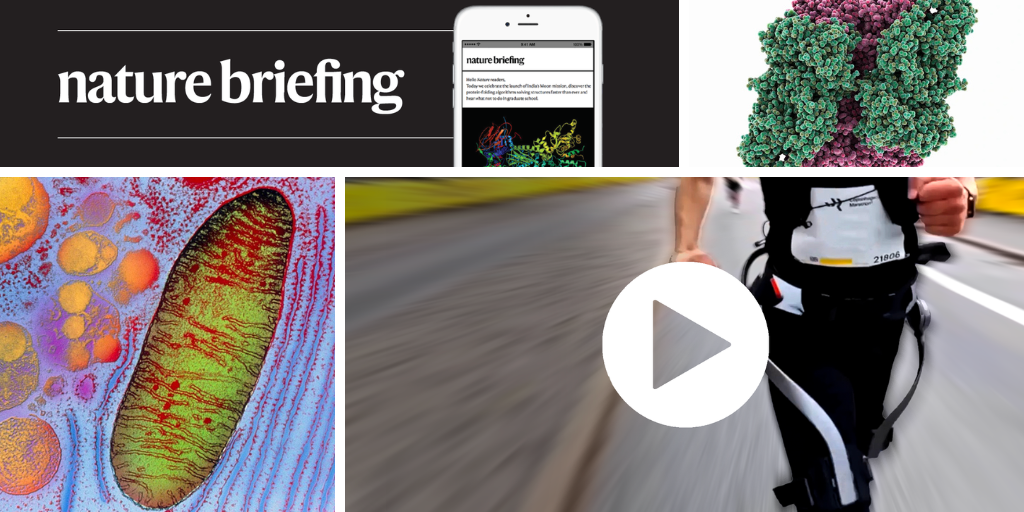
Microscopic image of mitochondria artificially colored green and red. The organelles were extracted from the patient’s leg muscles for retinal transplantation.
Credit: KR Porter/SPL
Scientists extracted mitochondria from a woman’s leg muscles and injected them into the vitreous humor of her eye in an experimental treatment for severe blindness. The procedure caused no inflammation or other reported side effects, but it had limited success in improving the eye’s response to light and did not restore the patient’s vision. Mitochondrial biologist Temurkhan Ayupov said the findings suggest that injecting a person’s own mitochondria into the eye is “relatively safe”.
Nature | 6 min read
Reference: Research Square preprint (not peer reviewed)
A scientific investigator reports that more than 50 studies on cellular aging may have used incorrect antibodies to identify important proteins. The finding comes two months after Sholto David, an independent molecular biologist in the United Kingdom, identified hundreds of studies containing similar errors. It also follows a discovery by David and another researcher, three months earlier, of problems with antibody-validation images in a catalog from Thermo Fisher Scientific, one of the world’s largest suppliers.
Nature | 8 min read
Science features and expert perspectives
Lightning does more than produce thunder: it also creates sound waves that could help scientists map hidden geological structures beneath the Earth’s surface. In a new study, researchers used distributed acoustic sensing to explore underground structures such as sinkholes.
The technique detects tiny deformations in standard fibre-optic cables. Disused cables extending more than four kilometres beneath a campus effectively served as more than 2,100 sensors. The researchers showed that existing underground infrastructure, combined with seismic energy from lightning, could eventually enable scientists to “continuously monitor the shallow subsurface”, geoscientists Nolan Ross and Tieyuan Zhu wrote.
Reference: Science Advances paper
Research on the US labour market suggests that automation has contributed significantly to rising inequality. Economist Daron Acemoglu warns that this trend could intensify as artificial intelligence becomes more widespread. Acemoglu has joined thousands of economists and AI researchers in signing a statement urging policymakers and technology leaders to steer AI towards complementing human workers rather than replacing them. “What is at stake is not just shared prosperity, but also our democratic institutions,” he wrote. “Society cannot maintain stability if large numbers of people are excluded from economic opportunity.”
Nature | 7 min read
Marine heatwaves and nutrient-rich agricultural pollution are creating an ecological paradox: wild kelp forests are disappearing while floating seaweed and microalgal blooms are expanding. The consequences include sargassum choking Atlantic coastlines, harmful sulfides released as seaweed decomposes and oxygen-depleted “dead zones” caused by algal blooms.
Local authorities are responding with offshore breakwaters and trawlers designed to keep seaweed away from coastlines, while conservation groups and researchers work to restore kelp forests around the world.
Technology that helps people walk, run and jump is moving rapidly from research laboratories to outdoor recreation. Robotic exoskeletons are very different from the giant machines depicted in science fiction, but continued advances could make wearable mobility technology part of everyday life sooner than expected.
Nature | 3 min video
A penguin swims along a river in El Gallineral Park in Santander, Colombia, on Friday. Can you find the penguin? When you are ready, view the answer.
Thank you for reading,
Flora Graham, Nature Briefing Editor-in-Chief
• Nature Briefing: Careers — expert insights, practical advice and award-winning journalism to help you improve your working life.
• Nature Briefing: Microbiology — the most abundant life forms on Earth, microorganisms, and their roles in human health, the environment and food systems.
• Nature Briefing: The Anthropocene — climate change, biodiversity, sustainability and geoengineering.
• Nature Briefing: AI and Robotics — 100% written by humans, of course.
• Nature Briefing: Cancer — a weekly newsletter created for cancer researchers and professionals.
• Nature Briefing: Translational Research — the latest developments in biotechnology, drug discovery and pharmaceuticals.
Source: www.nature.com