


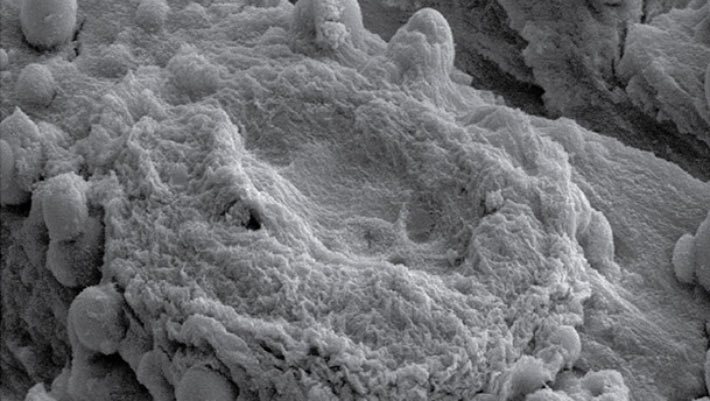
Fossilized hind-limb bones of Aratasaurus museunasionali, a coelurosaurian theropod that lived in what is now northeastern Brazil about 115 million years ago during the Early Cretaceous, contain structures interpreted as calcified red blood cells. A study led by Curtin University researchers identified heme-related chemical signatures within the structures, offering a molecular glimpse into the physiology of a long-extinct dinosaur.
“Our findings challenge the long-held assumption that certain biomolecules, such as hemoglobin, cannot survive for long periods of time,” said Curtin University’s Professor Kriti Grice, the study’s lead author.
“This opens up exciting new avenues in molecular paleontology, allowing us to investigate the evolution of blood, metabolism, and even activity levels in ancient animals.”
Structures inside fossil bone
Grice and her colleagues examined hind-limb bones of Aratasaurus museunasionali. The fossil was excavated at the Mina Pedra Blanca archaeological site in the Romualdo Formation, which is known for its large number of well-preserved specimens.
The paleontologists identified numerous small, oval structures inside the bone’s vascular canals, where blood vessels once ran. The structures measured approximately 23 micrometers in length and 20 micrometers in width on average.

Evidence of heme molecules
The researchers detected heme B, the molecule central to hemoglobin’s oxygen-carrying function, along with a chemically modified derivative known as 3,8-diethylheme B.
Additional imaging and spectroscopic analyses identified heme-related chemical signatures within the same structures. These findings reinforced the interpretation that the structures were calcified remains of red blood cells.
The scientists suggest that mineralization involving manganese oxide, particularly the mineral hausmannite, helped protect the cell structures and their organic contents from deterioration.
However, the discovery does not mean that intact blood or hemoglobin proteins survived for more than 100 million years.
“It’s amazing that we detected intact heme-derived molecules in 115-million-year-old red blood cells. This is a truly groundbreaking discovery,” Professor Grice said.
“This not only expands the known blood fossil record, but also provides a direct molecular window into the physiology of long-extinct animals, potentially allowing us to better understand animals and the world they lived in.”
The study was published in Proceedings of the National Academy of Sciences.
Heme signature of calcified red blood cells in blood vessels of a 115-million-year-old dinosaur bone
Critie Grice et al. 2026. PNAS 123 (46): e2614248123. doi: 10.1073/pnas.2614248123
Source: www.sci.news