


Sixty-five years after plans for a NASA human-spaceflight center took shape in Houston, Johnson Space Center remains a central part of the United States’ crewed space program. From Project Mercury and Apollo to the Space Shuttle, the International Space Station and Artemis, the center has supported astronauts, mission control and the development of spacecraft, training facilities and human-health systems.
From Houston’s selection to Johnson Space Center
Today, Johnson Space Center is NASA’s center of excellence for human spaceflight. It is home to the agency’s astronaut corps, mission control center and teams supporting some of humanity’s most significant achievements in space.
Houston is also home to NASA’s Low Earth Orbit program, which includes International Space Station operations, commercial partnerships and future destinations in low Earth orbit. For missions beyond low Earth orbit, Johnson hosts the Lunar Base Program and the Orion Program. NASA’s Human Health and Performance Directorate and Human Research Program work to protect crew health and performance as missions move farther from Earth.
The center’s history began on May 25, 1961, when President John F. Kennedy addressed a joint session of Congress. He pledged that the nation would land a man on the Moon and return him safely to Earth by the end of the 2010s.
NASA’s Space Task Group, which was responsible for the nation’s human-spaceflight program, was already developing Project Mercury to send astronauts into Earth orbit. The addition of a crewed lunar-landing program soon made the group’s facilities at NASA’s Langley Research Center in Hampton, Virginia, inadequate.
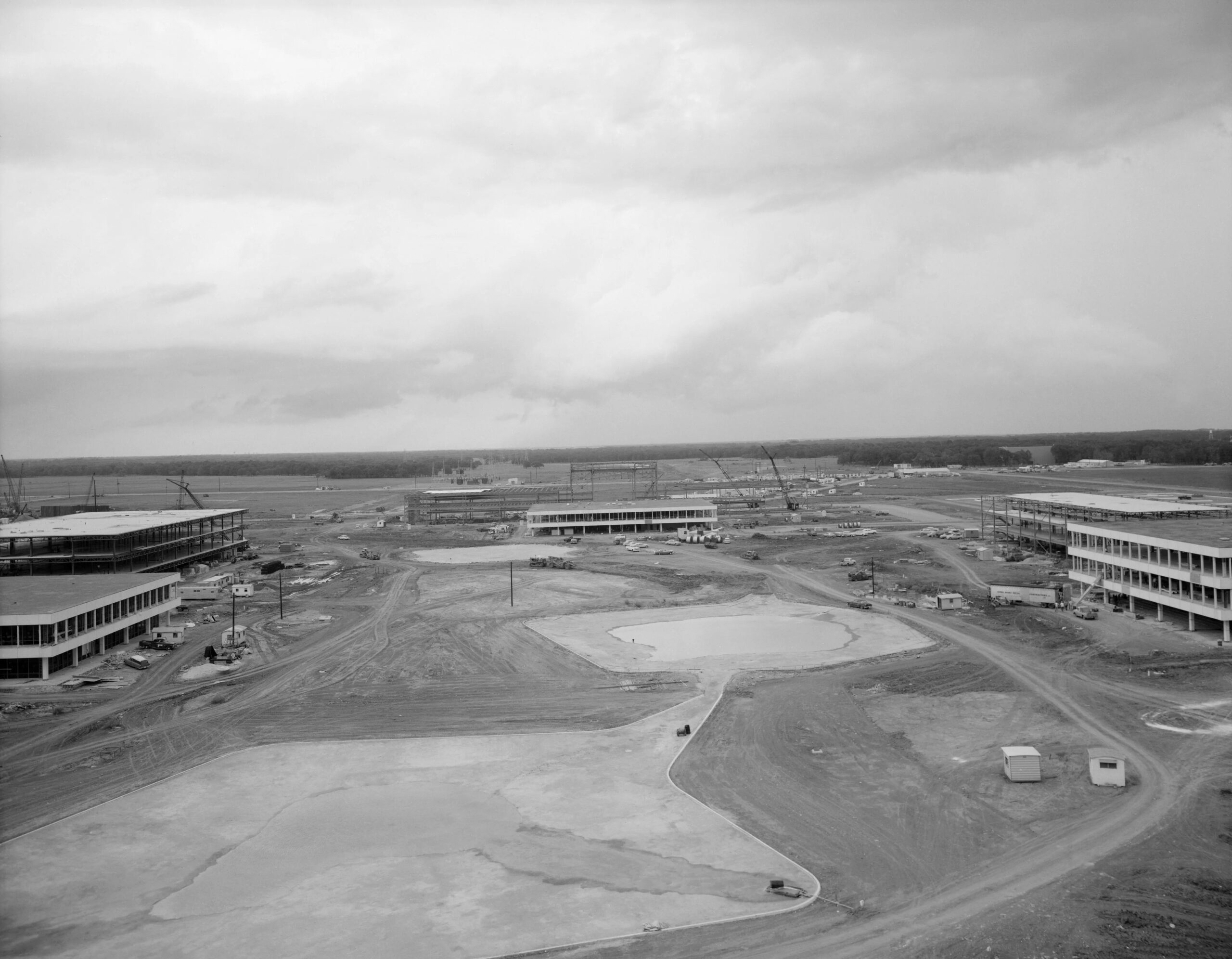
NASA concluded that human spaceflight required a dedicated field center. After evaluating sites across the country, the agency announced on September 19, 1961, that it had selected Houston, Texas, for a new manned spacecraft center. The center was established on November 1, 1961, and construction began in 1962. In 1973, it officially became NASA’s Lyndon B. Johnson Space Center, honoring President Johnson, a strong supporter of the U.S. space program from its founding.
Building the center
The Manned Spacecraft Center officially opened on November 1, 1961. While construction continued at the Clear Lake site, employees worked from 13 leased buildings in southeast Houston. The design phase lasted six months, construction of the first building took 18 months, and the first employees moved to the new site at the end of 1963.
Over the following decades, the number of buildings grew to support new spaceflight programs.
Project management building
Construction of the nine-story project management building began on December 5, 1962, and was completed on March 15, 1964. Robert Gilles, the center’s first director, moved into an office on the top floor—then known as Building 2—on March 5, 1964.
The building exchanged numbers with the Public Relations Building, originally known as Building 1, on June 30, 1974.
Neutral-buoyancy training
NASA began using neutral buoyancy for extravehicular-activity training during the Gemini XII mission in 1966. In 1967, workers installed an above-ground circular pool known as the Immersion Facility for astronaut training in support of Apollo and pre-Shuttle extravehicular-activity activities.
As the Space Shuttle’s payload bay grew larger, extravehicular-activity training moved in 1980 to the Zero Gravity Training Facility, where astronauts trained in near-zero-gravity conditions. The facility supported all Shuttle extravehicular-activity training until 1997, when the Neutral Buoyancy Laboratory at the Sonny Carter Training Center began supporting both Shuttle and Space Station training. It also provided a site for testing future spacesuits and lunar operations.
Lunar Receiving Laboratory
To prevent possible lunar microbial back-contamination, NASA designed the Lunar Receiving Laboratory in Building 37. Construction began in August 1966, and the first employees moved into offices in June 1967.
The Apollo 11, 12 and 14 astronauts completed three-week post-flight quarantines in the laboratory. Scientists from several laboratories also studied the lunar samples there.
After the Apollo missions, the life sciences department and laboratories moved into the building and remained there until 2017, when they moved elsewhere. Following the demolition of Building 37, Moon Receipt Park is scheduled to open in 2026 to commemorate the site’s history.
Spacecraft Mockup Facility
Construction of Building 9 began in December 1965 and was completed in March 1967. The building originally housed a technical-services facility. In April 1969, workers modified part of it to create a mock lunar scene and install a mock-up of the lunar module used by the Apollo 11 astronauts.
To support the Space Shuttle program, workers completed an addition in September 1974 for mock-up and integration laboratories. Astronauts on all 135 Shuttle missions used the mock-ups for training.
Additions to the building’s northwest side began in 1986 and were completed in 1988. The building hosted mock-ups for Space Station Freedom and later the International Space Station, and it was renamed the Spacecraft Mockup Facility.
The facility currently houses training mock-ups and commercial mock-ups for NASA’s Orion spacecraft, along with the Active Response Gravity Offload System, known as ARGOS.
Mission simulation and training
Construction of Building 5, the mission simulation and training facility, was completed in April 1965. It began supporting missions with Gemini IV in June 1965.
The building originally contained the Gemini spacecraft simulator and the Gemini conversion and docking simulator. Apollo simulators, including command-module and lunar-module simulators, began arriving in December 1965.
From 1967 to 1978, astronauts used the immersion facility for extravehicular-activity training. In the early 1970s, Building 5 also housed a high-fidelity trainer and simulator for Skylab components. All nine Skylab astronauts used it for mission training.
In the late 1970s, the facility underwent extensive renovations for the Space Shuttle program, including the addition of fixed-base and motion-based simulators. Completed in 1991, the Space Station Training Facility Addendum supported training for the first Space Station Freedom crews and current International Space Station crews. It also includes Orion and Starliner simulators.
Mission Control
Construction of Building 30, home of the mission control center, began in June 1963 and was completed in November 1964. Technicians installed real-time computers in April 1964, and the first employees moved into the building two months later.
The center originally contained two mission operations control rooms to support Gemini and Apollo missions and simulations. By January 1965, it was monitoring the unmanned Gemini 2 and crewed Gemini 3 missions in flight-tracking mode.
In June 1965, Houston took full control of Gemini IV. It has controlled every NASA crewed spaceflight mission since then.
The mission control center received major computer-system upgrades in the mid-1970s to support future Space Shuttle flights. On April 4, 2011, the building was renamed the Christopher C. Kraft Jr. Mission Control Center in honor of the man who developed concepts still used in human-spaceflight control.
The mission control center continues to provide round-the-clock support for the International Space Station and NASA’s Artemis missions to return humans to the Moon.
Source: www.nasa.gov