


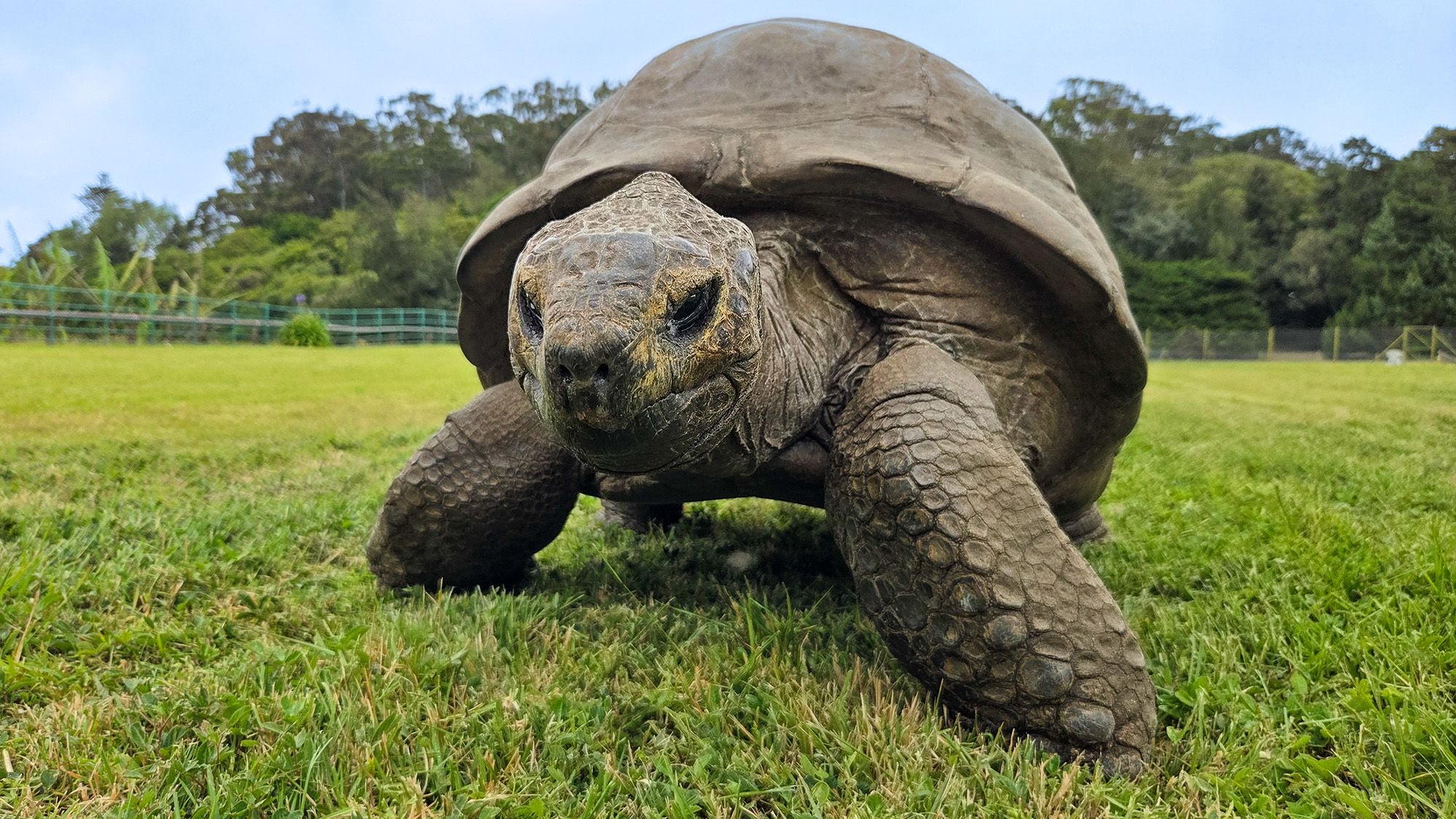
Jonathan the Giant Tortoise Is 194. Scientists May Have Found Clues to His Extraordinary Longevity
Jonathan, a giant tortoise living on the remote South Atlantic island of St. Helena, is the world’s oldest known land animal. At 194 years old, he has survived far beyond the typical lifespan expected for an Aldabra giant tortoise (Aldabrachelys gigantea).
Now, researchers have identified distinctive genetic and epigenetic traits that may help explain how Jonathan has lived for so long. The findings point to genes involved in mitochondrial function, DNA repair and other biological pathways associated with aging.
What Jonathan’s genes reveal about aging
The study examined Jonathan’s genome and epigenetic markers—chemical tags attached to DNA that help control which genes are switched on and how strongly they are expressed.
Researchers found that Jonathan carried 287 genetic variants in genes previously linked to aging-related pathways. These included genes involved in DNA repair and telomeres, protective structures at the ends of chromosomes that tend to shorten as organisms age.
The research also revealed unusual patterns in Jonathan’s DNA methylation. DNA methylation occurs when chemical compounds called methyl groups attach to DNA. Scientists can use these patterns as a biological indicator of age.
Jonathan’s mitochondrial genes stood out
In older tortoises, DNA methylation patterns generally became more disorganized over time. Scientists refer to this phenomenon as methylation entropy.
Jonathan showed this age-related disorganization across many genes. However, genes associated with mitochondrial function—particularly genes that help activate mitochondria—had a more organized methylation pattern.
Mitochondria produce the energy cells need to function, repair themselves and limit additional damage to DNA. The researchers suggest that maintaining a more stable epigenetic pattern in mitochondrial genes may help Jonathan preserve cellular function over an exceptionally long lifespan.
“Keeping the entropy of these mitochondrial genes low, or maintaining pristine mitochondria, likely contributes to longevity,” study co-author Stephen Clark said.
Researchers had to collect Jonathan’s DNA from his cheek
Nearly a decade ago, researchers asked Joe Hollins, the veterinarian responsible for Jonathan’s care, to collect biological samples from the tortoise. Authorities on St. Helena prohibited blood collection because of concerns that the procedure could expose Jonathan to infection.
Instead, Hollins collected a sample from Jonathan’s cheek. The first sample caused problems when researchers tried to sequence it: computer crashes eventually helped reveal that the DNA came from bacteria in Jonathan’s mouth rather than from Jonathan’s own cells.
After obtaining permission to collect another sample, the team used a slightly different cheek-scraping technique. This time, the DNA belonged to Jonathan.
Because the cheek-tissue DNA was more fragmented than a blood sample, the researchers used a reference genome from a 36-year-old Aldabra tortoise named Tank to fill in missing sections. They also compared Jonathan’s DNA with that of Lonesome George, a Galápagos tortoise who was thought to be more than 100 years old when he died in 2012.
Could Jonathan’s DNA help explain human longevity?
The aging-related pathways identified in Jonathan are also relevant to human aging. This suggests that some biological features of aging may be shared across different species.
However, the researchers emphasized that the study does not prove that Jonathan’s mitochondrial genes caused his extraordinary lifespan. No experiments were performed to establish a direct cause-and-effect relationship.
“Some organs are more susceptible to various diseases of old age than others because mutations accumulate over time,” biology professor Vincent Lynch, who was not involved in the study, told Live Science. “We ideally want to know what the mutations are in specific tissues.”
Lynch also questioned whether entropy is the most useful way to describe age-related DNA methylation, since methylation patterns can be unpredictable. Still, he agreed that the identified genes could provide valuable data for future longevity research.
Jonathan may be an exceptional outlier
More research is needed to determine whether the mitochondrial genes identified in the study contribute to unusually long lives in other Aldabra tortoises, other animals or humans—or whether Jonathan is simply an extraordinary individual.
“Maybe Jonathan is good at growing old,” Lynch said.
Researchers may learn more after Jonathan’s death, when they can collect DNA from additional tissues and build a more complete genetic profile.
Read the study: Epigenetic insights into the ultralong lifespan of Jonathan, the world’s oldest land animal.
Source: www.livescience.com