


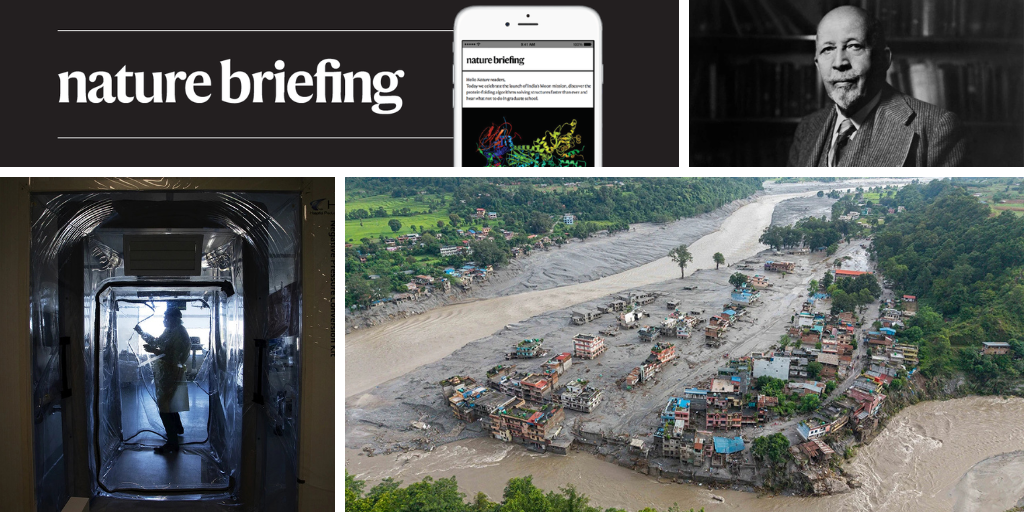
This briefing covers a dwarf reed snake’s unusual cartwheel-like escape, evidence that mechanical stimulation of bones may slow ageing in mice, and changes in Antarctic ocean water that could affect global circulation. It also examines rising mountain-disaster risks, preparedness for diseases with unfamiliar symptoms, government metascience departments and the history of scientific arguments about race.
Hello Nature readers. Would you like to receive this briefing free in your inbox every day? Sign up here.
Dwarf reed snakes begin a quick escape by lunging forward and throwing their bodies over their heads, in a movement similar to a human forward flip. (Yosuke Kojima, Ibuki Fukuyama)
A snake that escapes by cartwheeling
When threatened, the dwarf reed snake (Pseudorabdion Ronceps) can make a rapid, cartwheel-like escape. Researchers have found that the animal controls its movement by keeping its head at roughly the same height and facing in the same direction. This rotation allows the snake to move around four times faster than it can by gliding.
Such conspicuous movements are unusual for a snake. “It’s good to be surprised every now and then by the strange behavior of snakes,” says herpetologist Frank Verbrink.
New York Times | 3 minute read (Free registration required)
Reference: Current Biology paper
What bones may reveal about ageing
Mechanical loads placed on the skeleton during physical activity can cause irritation. Research in mice suggests that bones may also release proteins that slow ageing. The researchers gently squeezed a mouse’s leg to simulate the mechanical forces associated with exercise. They found that force-sensing cells in bone, called bone cells, secreted molecules that rejuvenated immune cells and reprogrammed cells in other organs to a younger state.
Mice that underwent this simulated exercise regimen lived about three months longer on average than mice that did not.
Reference: Cell Metabolism paper
Antarctica’s changing freshwater engine
Since 2016, the water layer around Antarctica that has a major influence on the world’s oceans has changed, with unknown consequences for the global climate. As sea-ice melt decreases year by year, Antarctic Intermediate Water (AAIW) is becoming saltier and more concentrated, and is settling somewhat deeper in the ocean.
The change could alter how surface water circulates into the deep ocean. “The Antarctic region is the freshwater engine for the world’s oceans,” says Vishakudatta Gayen, a hydrodynamicist and study co-author.
Reference: Nature Climate Change paper
This week’s infographic

Source: MC Matthew et al., Landslides 21, 2307–2326 (2024); D. Schneider et al., Earth Surface Processes and Landforms 36, 1948–1966 (2011); Y. Chong et al., Landslides 22, 989–1001 (2025); JA Co et al., Landslides 15, 393–407 (2018); A. Cave et al., The Cryosphere 15, 1751–1785 (2021); Alaska Volcano Observatory Annual Report (https://avo.alaska.edu)
The deadly avalanches and floods that struck Nepal’s Rasuwa district in August are an urgent wake-up call, according to a group of mountain-disaster experts. “The unprecedented scale of the damage shows that current approaches to assessing and managing these risks are failing,” they say. “And as global warming accelerates, we can expect to see more disasters of this magnitude.” (Nature | 14 minute read)
Features and perspectives
As dangerous diseases evolve, they can develop new symptoms that evade systems designed to detect outbreaks. “Unless clinicians recognize that unusual symptoms need investigation, even the most advanced tracking systems will not be able to keep up,” argue infectious-disease expert Serge Toenen-Woliec and virologist Laurent Bellec.
They outline a “symptom preparedness” approach that would help clinicians act on the intuition that they are dealing with something unusual.
Nature | 10 minute read
Metascientist Jen Gold, co-founder of the UK Government’s Metascience Department, offers advice on building a department that studies how research is funded, conducted and evaluated, with the aim of adding value to national funding agencies.
Gold says that working in small teams is essential, as is efficient time management. A data infrastructure for sharing the unit’s results with external researchers is also important. “The barriers to improved science funding are often systemic,” Gold wrote. The success of other government metascience departments “depends on getting these elements right.”
Nature | 5 minute read
In his new book End of the Race, humanities scholar Jeffrey Galt Harpham chronicles attempts to use science to justify racism in the 19th century, as well as the scientific backlash against those efforts. “Ultimately, distrust of the concept of biological race manifested itself as a triumph of scientific self-correction,” journalist David Silverberg wrote in a review of the book.
Nature | 8 minute read
On Friday, a leaf penguinson was flying around a rock formation in Jordan’s Wadi Rum. Did you find the penguin? When you’re ready, this is the answer.
Thank you for reading,
Flora Graham, Nature Briefing Editor-in-Chief
Contributed by Jacob Smith
• Nature Briefing: Careers — insights, advice and award-winning journalism to help you optimize your work life.
• Nature Briefing: Microbiology — the most abundant life forms on Earth, microorganisms — and the role they play in health, the environment and our food system.
• Nature Briefing: The Anthropocene — climate change, biodiversity, sustainability and geoengineering.
• Nature Briefing: AI and Robotics — 100% written by humans, of course.
• Nature Briefing: Cancer — a weekly newsletter written with cancer researchers in mind.
• Nature Briefing: Translational research — covering biotechnology, drug discovery and pharmaceuticals.
Source: www.nature.com