


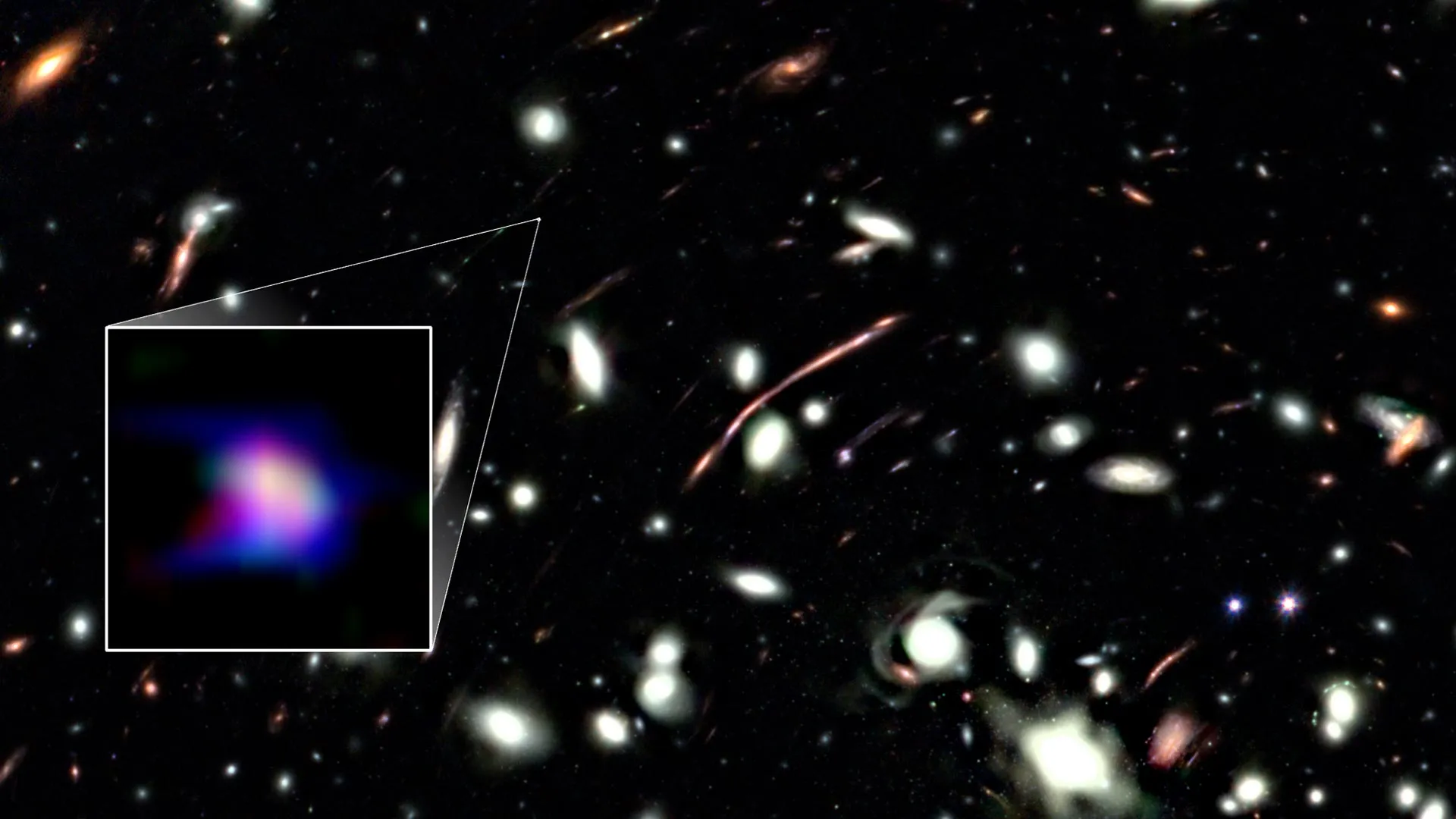
Astronomers using the James Webb Space Telescope have identified an extremely primitive galaxy that existed about 13 billion years ago, when the universe was only 800 million years old. Known as LAP1-B, the galaxy contains about 240 times less oxygen than the Sun and may preserve chemical evidence from the universe’s first stars. Its properties could also clarify how some of the oldest and faintest galaxies near the Milky Way formed.
Webb finds a chemically primitive galaxy
An international research team led by Associate Professor Kimihiko Nakajima of Kanazawa University studied LAP1-B with Webb and a natural magnification effect called gravitational lensing. The galaxy’s light was magnified about 100 times by a massive foreground galaxy cluster, making the otherwise tiny, faint object accessible to detailed observation.
Previous observations indicated that LAP1-B contains about 240 times less oxygen than the Sun. The new measurements make it the most chemically primitive star-forming galaxy ever discovered.
Its unusual chemical composition, intense ionizing radiation and dominant dark matter halo suggest that LAP1-B could be the long-sought progenitor of an ancient galaxy observed today near the Milky Way. The finding offers a rare opportunity to study the early stages of galaxy formation and the first spread of the chemical elements needed for planets and life.
Searching for the universe’s first elements
Immediately after the Big Bang, the universe consisted almost entirely of light elements such as hydrogen and helium. Heavier elements, including carbon and oxygen, had not yet formed. Those elements were later produced by nuclear reactions inside the universe’s first stars.
These first-generation stars, known as Population III stars, formed from almost pure cosmic gas with virtually no heavy elements. Their emergence ended the “Cosmic Dark Ages” and began the universe’s chemical transformation.
When early massive stars exploded, they released newly created elements into their surroundings. Over successive generations, that material accumulated in galaxies and eventually became the raw material for rocky planets and life.
Astronomers have searched for direct evidence of this critical period for decades. Early galaxies, however, were generally so small, faint and distant that measuring their chemical composition was thought to be nearly impossible.
Launched in 2021, the James Webb Space Telescope is the largest and most powerful infrared space telescope ever built. Its sensitivity allows astronomers to study some of the faintest and most distant objects in the observable universe.
Gravitational lensing magnifies an ancient galaxy
LAP1-B is normally extremely difficult to observe. The massive galaxy cluster in the foreground magnified its light by a factor of 100, acting as a natural telescope.
Gravitational lensing occurs when the gravity of a massive object bends and magnifies light from more distant objects behind it. Galaxy clusters can therefore serve as giant “natural magnifiers,” extending Webb’s already powerful observational capabilities.
The researchers used spectroscopy to observe LAP1-B for more than 30 hours. This technique separates light into individual wavelengths, much as a prism separates visible light into a rainbow. The resulting characteristic “barcodes of light” reveal which elements are present, their relative abundances, the object’s distance and how it is moving through space.
The observations measured a redshift of 6.625 ± 0.001 for LAP1-B, corresponding to a time when the universe was about 800 million years old.
A record-low oxygen abundance
The measurements showed that the oxygen abundance in LAP1-B’s gas is only 0.42% of the Sun’s value, or approximately one 240th of the solar abundance. That makes LAP1-B the most chemically primitive star-forming galaxy identified so far.
Oxygen abundance is determined by comparing the number of oxygen atoms with the number of hydrogen atoms and is expressed as (O/H). Because hydrogen has been present since the earliest moments of the universe, it provides a useful reference for measuring how chemically evolved a galaxy is.
As successive generations of stars form, evolve and die, they enrich their surroundings with heavier elements. Galaxies with extremely low oxygen abundances therefore offer a rare view of conditions approaching those in which the first galaxies formed.
“We were immediately excited by the extreme oxygen deprivation revealed in the data,” said Associate Professor Nakajima, who led the research team. “The discovery of a galaxy in such a pristine state is surprising; it is a chemical signature that clearly indicates that a primordial galaxy was captured moments after its formation.”
Possible chemical fingerprints of the first stars
LAP1-B’s unusually low oxygen content is not its only distinctive feature. Despite its overall scarcity of heavy elements, the galaxy contains a disproportionately large amount of carbon compared with oxygen.
This chemical fingerprint agrees with theoretical predictions for material expelled by stars that originally formed from gas containing no heavy elements.
The researchers also detected extremely high-energy ionizing radiation capable of stripping electrons from atoms. The radiation is inconsistent with what would be expected from chemically enriched stellar populations or actively feeding black holes. Instead, it matches theoretical predictions for a population of stars containing exceptionally small amounts of heavy elements.
Together, these observations provide evidence that LAP1-B may preserve the chemical legacy of the universe’s first generation of stars.
Much of what astronomers know about these early stars has come from studying the chemical compositions of ancient stars that still exist nearby. Webb now allows scientists to examine gas in primordial galaxies that existed more than 8 billion years before the formation of our solar system.
“Usually we act like ‘space archaeologists’ looking at old stars in our neighborhood and trying to infer the past. But now we can analyze gas directly from the original scene 13 billion years ago,” Nakajima said. “We are witnessing the moment when galaxies first inherited the chemical building blocks created by the universe’s first stars.”
A tiny galaxy dominated by dark matter
LAP1-B also has an exceptionally small stellar mass. Because the researchers could not detect the continuous glow produced by its stars, they estimated that the combined stellar mass is less than 3,300 times the mass of the Sun.
However, the motion of gas within the galaxy indicates that its total gravitational mass is greater than the combined mass of its stars and gas. This suggests that LAP1-B is embedded in a halo dominated by invisible dark matter.
Dark matter does not emit light and accounts for about 85% of all matter in the universe. Its composition remains unknown, but its presence can be inferred from its gravitational effects on visible matter.
The combination of an exceptionally small stellar mass, a dominant dark matter halo and an extremely primitive chemical composition makes LAP1-B a good match for the ancestor of the predicted ultrafaint dwarf galaxies, or UFDs, found near the Milky Way today.
A possible link to the Milky Way’s cosmic fossils
Ultrafaint dwarf galaxies are among the smallest and faintest galaxies known. They contain relatively few stars, many of which formed more than 12 billion years ago, and they have undergone little chemical evolution.
These ancient systems are sometimes called “cosmic fossils” because they preserve evidence of conditions that existed during the universe’s formation. Astronomers have long suspected that such galaxies descended from some of the earliest galaxies, but direct evidence of their ancestry has been difficult to obtain.
LAP1-B provides a rare view of what one of these ancient galaxies may have looked like in its infancy. The researchers describe it as a “fossil in the making” that links the early stages of galaxy formation with ancient dwarf galaxies that still exist in the modern universe.
“UFDs are not only the faintest galaxies; they are composed of old stars that are more than 12 billion years old and are often described as ‘cosmic fossils,’” explained research team member Professor Masami Ouchi of the National Astronomical Observatory of Japan and the University of Tokyo. “Astronomers had suspected that it was the remnant of one of the oldest galaxies in the universe because it lacked heavy elements, but until LAP1-B was discovered, astronomers had no idea of the direct connection.”
Ouchi added, “It’s a big surprise that LAP1-B looks exactly like its ‘ancestor’ that we had only imagined in theory. This helps solve the mystery of why these space fossils have survived to this day in their current form.”
Tracing the origins of life’s ingredients
The discovery provides a new way to investigate the origins of heavy elements and reconstruct how the universe’s earliest structures developed. By studying galaxies with extremely low chemical abundances, researchers can examine the transformation of a universe dominated by hydrogen and helium into one capable of supporting planets and life.
The team plans to continue using the James Webb Space Telescope to search for even more primitive objects, with the ultimate goal of identifying the first galaxies that formed after the Big Bang.
“We hope that this discovery will be a historic step in understanding how the elements that make up our own bodies were first created and accumulated throughout the universe,” Nakajima said.
Source: www.sciencedaily.com