


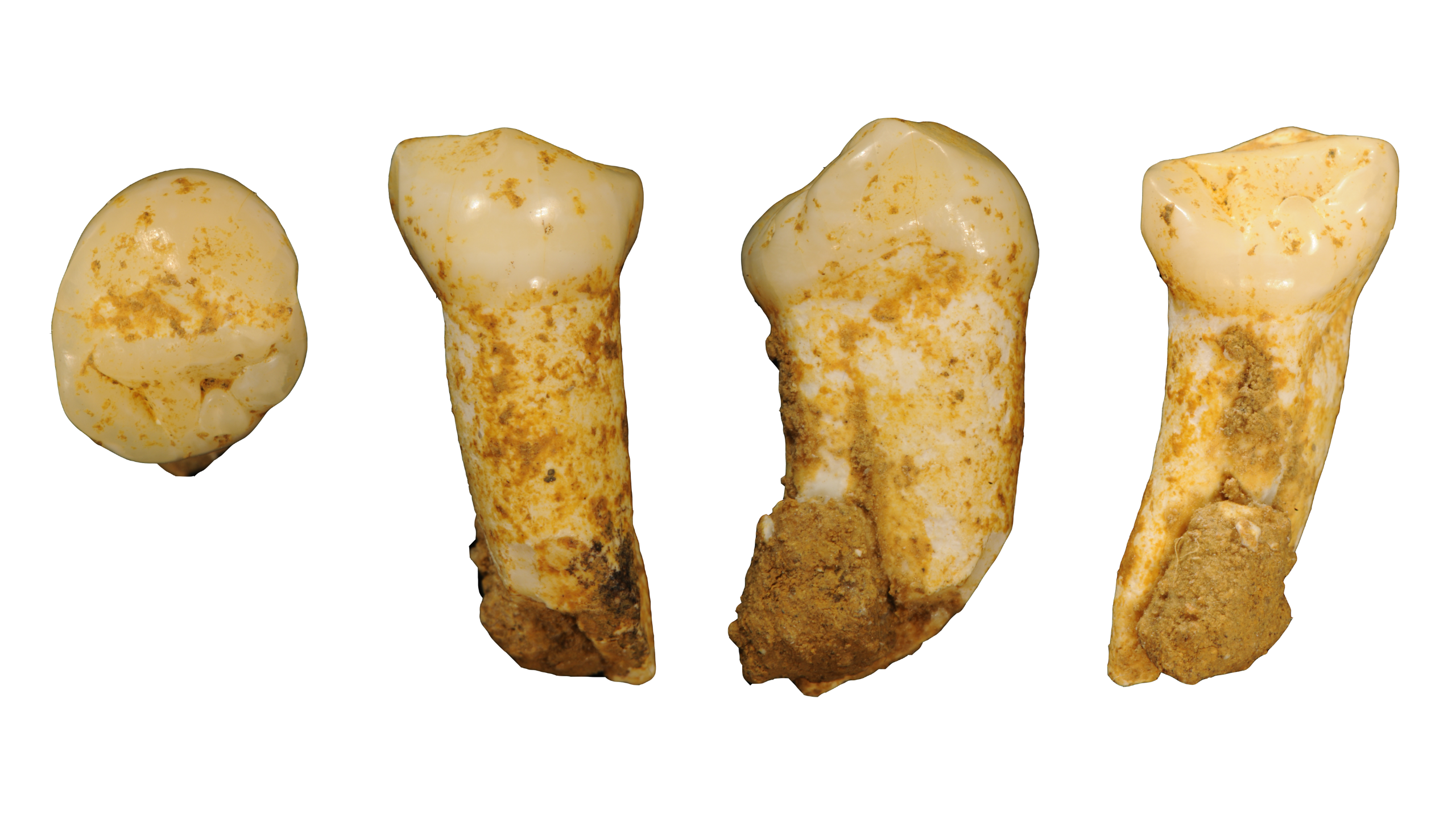
Archaeologists have discovered four teeth dating to roughly 100,000 years ago in two caves in southern China. Protein analysis suggests that two teeth resemble those of Denisovans, while the other two have an unusual combination of physical and molecular characteristics that may represent a previously unknown lineage of archaic humans. Researchers caution, however, that the evidence is not yet sufficient to establish a new human group.
Teeth from two southern Chinese caves
The study, published Wednesday, November 25, in the journal Nature, examines four isolated teeth found at Longchuan Cave and Chuanshan Cave in the Guangxi Zhuang Autonomous Region.
Using uranium-series dating, researchers estimated that the two teeth from Longchuan Cave—a molar and a premolar, the tooth between a canine and a molar—are approximately 104,500 to 42,600 years old. The two premolars from Chuanshan Cave are at least 100,800 years old.
Denisovans, an extinct human group that lived across Asia, were first identified in 2010 through DNA recovered from a tiny finger bone found in a Siberian cave. Since then, researchers have found Denisovan fossils at sites across Asia, along with evidence that Denisovans, Neanderthals and modern humans interbred when they encountered one another.
The Longchuan Cave teeth closely resemble previously identified Denisovan teeth, and proteins extracted from their enamel also match proteins from Denisovan remains found elsewhere in China. This suggests that Denisovan-related people lived in southern China during the late Pleistocene, which lasted from about 129,000 to 11,700 years ago.
An unusual combination of traits
The Chuanshan Cave teeth, which researchers think may have belonged to the same individual, were markedly different from the Longchuan specimens. Their shape did not match any established East Asian Homo form particularly well.
The teeth had complex root systems typical of Homo erectus, but their crowns also showed characteristics more consistent with Homo sapiens, including a more symmetrical shape. Researchers extracted proteins from one Longchuan tooth and one Chuanshan premolar and found that both came from chromosomally male individuals.
Although the proteins from the Longchuan tooth matched Denisovan material, some protein variants in the Chuanshan tooth have so far been identified only in Homo erectus, a possible ancestral form of Homo, and distantly related ancient humans including Neanderthals and modern humans.
“Protein analysis shows that the Chuanshan people form a sister group to the common ancestor of Neanderthals, Denisovans and Homo sapiens,” the researchers wrote. They added that “at least two non-sapiens Homo populations may have existed in the subtropics of southern China during the mid-to-late Pleistocene.”
Evidence for a new human lineage?
Because so few Chinese fossils from around 100,000 years ago have been analyzed, it remains unclear what the morphology and protein data from the Chuanshan teeth mean for the evolution of humanity.
The researchers said the Chuanshan proteome contains ancestral variation linking it with Homo erectus and an ancestral form of Homo that existed before the arrival of Homo sapiens. These unusual proteins could indicate that the teeth belonged to a previously unknown branch of the human family tree, but the team said more fossil and molecular evidence is needed.
“It is not clear whether they are our cousins.”
Qiaomei Fu, director of the Institute of Ancient DNA at the Institute of Vertebrate Paleontology and Paleoanthropology
Fu told Live Science by email that it is too early to describe the fossils as a new human group. “We can tentatively call it the Kawashan East Group, but we need more fossil and molecular evidence to determine its affinity with other archaic Homo,” she said. “It’s not clear whether they are our cousins or not.”
Alternative explanations remain possible
John Hawks, an anthropologist at the University of Wisconsin-Madison who was not involved in the study, said the Chuanshan proteome was “very interesting.” However, he questioned whether it should be characterized as belonging to an “unknown Homo.”
Because paleoproteomic analysis is still a relatively new technology, it is not yet clear whether the protein variants are specific to Homo erectus, Denisovans or another group. Hawks said the Chuanshan tooth could even represent a Neanderthal or an individual with unusual characteristics rather than an entirely new human population.
Comparisons are also limited because researchers have not yet found other Denisovan premolars of the type discovered at Chuanshan Cave.
“I think there’s a lot to learn by putting together a more complete analysis,” Hawks said, adding that a comprehensive study of all the teeth together is more informative than comparisons with a single additional specimen.

More discoveries may follow
Ten years of excavations in caves across Guangxi have revealed fossils from a wide variety of Pleistocene mammals, including close relatives of ancient humans. The researchers said the ongoing work could accelerate discoveries about the region’s human past.
“There have been some new discoveries from this area and we are analyzing them,” Fu said.
Reference: Xing, S., Rao, H., Xie, G., Bai, F., Ge, J., Bennett, E. A., Wu, Z., Shao, Q., Li, X., Viola, B., Sun, Q., Zhou, K., Li, Z., Jiangzuo, Q., Zhao, Y., Liu, F., Liu, Y., Feng, X., Lin, Q. and Fu, Q. (2026). “The Denisovans of the Middle-Late Pleistocene and unresolved Homo in southern China.” Nature.
Source: www.livescience.com