


In today’s context, the term “weapons” often evokes images of advanced tools such as firearms, knives, and missiles. However, archaeological studies reveal that weapons have existed for hundreds of thousands of years, and early humans utilized quite different forms from today’s cutting-edge technology.
So, what is recognized as the oldest weapon?
A weapon is generally defined as an object intended to inflict harm on another living creature. According to Ben Fitzhugh, a professor of anthropology at the University of Washington in Seattle, this encompasses items used in personal conflicts between hominins—those who include modern humans and their direct ancestors like Homo sapiens.
Subscribe to Our Newsletter
(Image credit: Marilyn Perkins / Future)
Join our weekly Life’s Little Mysteries newsletter to get the latest insights before they’re published.
Nonetheless, archaeologists do not automatically categorize every harmful object as a weapon. Context and intent are pivotal. Rolf Warming, founding director of the Society for Combat Archaeology and a PhD candidate in archaeology at Stockholm University, pointed out that an excavator may search for evidences such as butchered animal bones or artifacts like sharp bone tools that might indicate hunting activities. Additionally, an analysis of the materials used and any wear marks present can help deduce the object’s purpose.
According to Warming, archaeologists typically recognize three significant artifacts as candidates for the earliest evidence of weapons in the archaeological record: the Clacton spear, the Schöningen spear, and the Kathu Pan 1 spear tip.
Clacton Spear
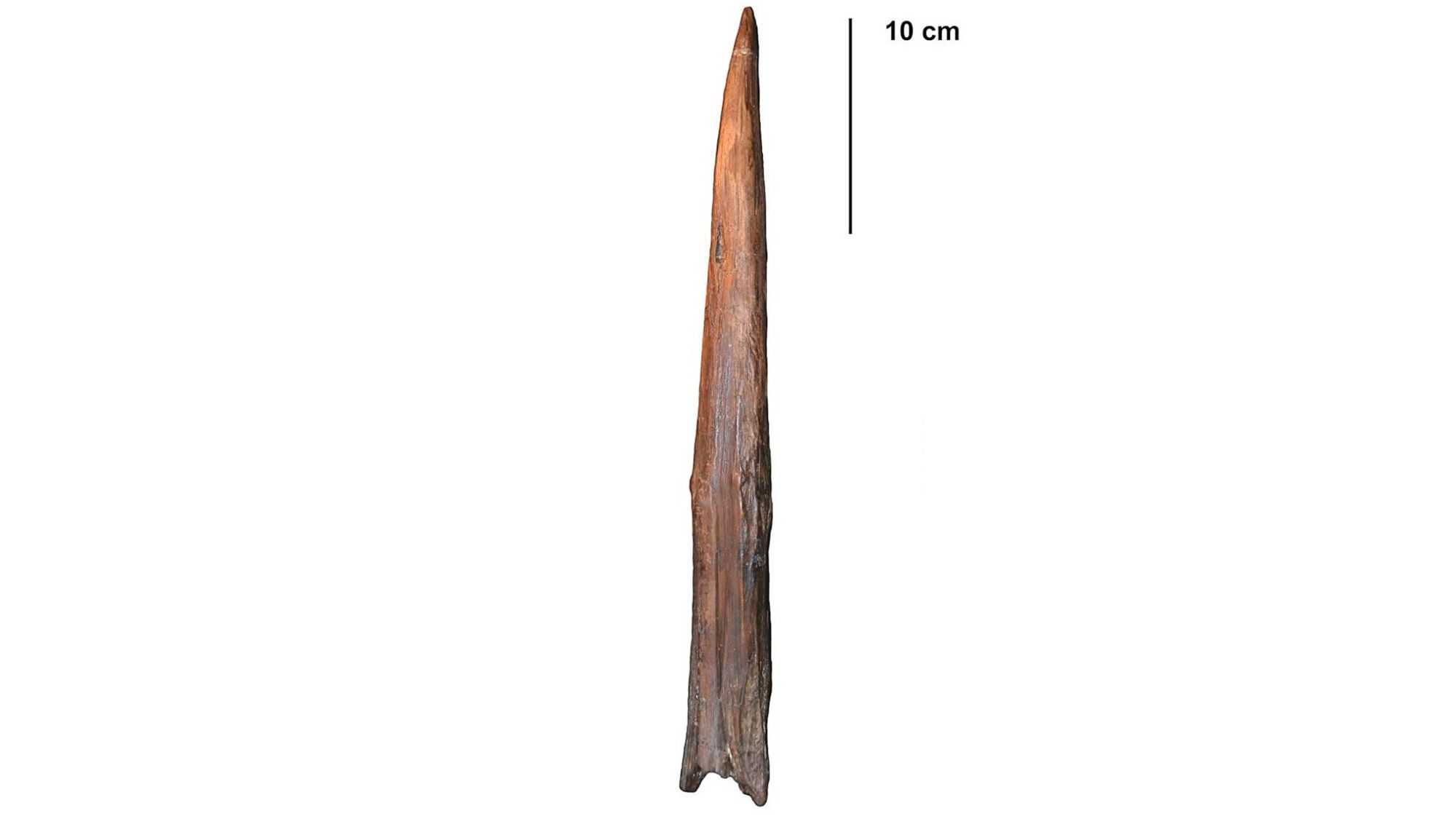
Experts estimate that the Clacton Spear is over 400,000 years old. With an exposed length of 15 inches (37 cm), the tip was broken off the shaft, possibly due to accidental damage during its crafting or used in hunting or for a ritualistic purpose. Crafted from yew wood, one end was sharpened using a tool, and no other broken ends were found.
The Clacton Spear was discovered in 1911 in Clacton-on-Sea, Essex, England, and it is currently preserved at the Natural History Museum in London, where it is displayed as the oldest existing wooden spear fragment.
Archaeologists believe it may have been crafted by either Homo heidelbergensis or Neanderthals, both of whom predate Homo sapiens. Evidence indicates that spears were already in existence before our species emerged, as the earliest known Homo sapiens fossil dates back approximately 300,000 years. The Clacton Spear’s design, dimensions, and wood type—all suggest it was indeed a thrusting weapon, indicating a sophisticated collective hunting strategy.
Schöningen Spears and Throwing Sticks

Different views of the Schöningen throwing stick, a candidate for one of the world’s oldest weapons.
(Image credit: Photo by Volker Minkus)
Since 1992, archaeologists have excavated 20 to 25 wooden weapons from the site in Schöningen, Germany, including complete and fragmented spears and throwing sticks. These artifacts, predominantly made from spruce and pine wood, are now regarded as some of the oldest perfectly preserved wooden weapons worldwide, with their dating ranging from 200,000 to 300,000 years. These relics are believed to have originated from H. heidelbergensis, a human species that existed approximately 700,000 to 200,000 years ago across Europe, parts of Africa, and possibly even in present-day China. More recent research indicates that these spears could likely have been made by Neanderthals, as a 2025 survey suggests.
Experts assert that these spears, averaging slightly over 6.6 feet (2 meters) in length, were utilized as both thrusting and throwing weapons, effectively targeting large game animals like horses. Short throwing sticks, regarded as projectile weapons, typically measure around 26 inches (65 centimeters).
According to Fitzhugh, “The Schöningen weapons were discovered alongside evidence of slaughtered horses, indicating they were strategically sharpened, hardened, and blackened with fire, showcasing advanced craftsmanship.”
Warming noted that the artifacts from Schöningen imply a distinct material comprehension and varied hunting strategies that depended on the proximity of the target.
Kathu Pan 1 Spear Point
Handled spear points, which include stone tips attached to some form of shaft, have surfaced more frequently in the archaeological record from approximately 200,000 to 300,000 years ago throughout Africa and Eurasia, especially associated with Neanderthals and Homo sapiens.
One spear point, excavated from the Katupang site in South Africa, dates back 500,000 years and exhibits signs of wear along the edges; its shape suggests it was a handled spear, likely utilized as a spear ambush weapon. Some researchers question this interpretation due to the absence of wooden shafts being uncovered, highlighting a lack of contextual evidence linking these items directly to weaponry.
Are There Even Older Weapons?
While these artifacts might represent some of the earliest weapons documented, there are likely older examples that have not survived the test of time.
Moreover, early hominins likely utilized materials such as wood, sinew, and fibers, as well as glue. Warming highlighted that such organic materials tend to degrade or break down over time.
Exploring these ancient weapons gives valuable insights into humanity’s past. Weapons are not merely tools of destruction; they serve as vital indicators of how our ancestors combined materials, harnessed creativity, shared knowledge, and collaborated in groups.
When evaluating the contenders for the title of the world’s oldest weapon, Warming asserts, “Clacton is the most reliable choice.”
Challenge your knowledge of historical weaponry with our World Weapons Quiz!
Topics
Source: www.livescience.com