


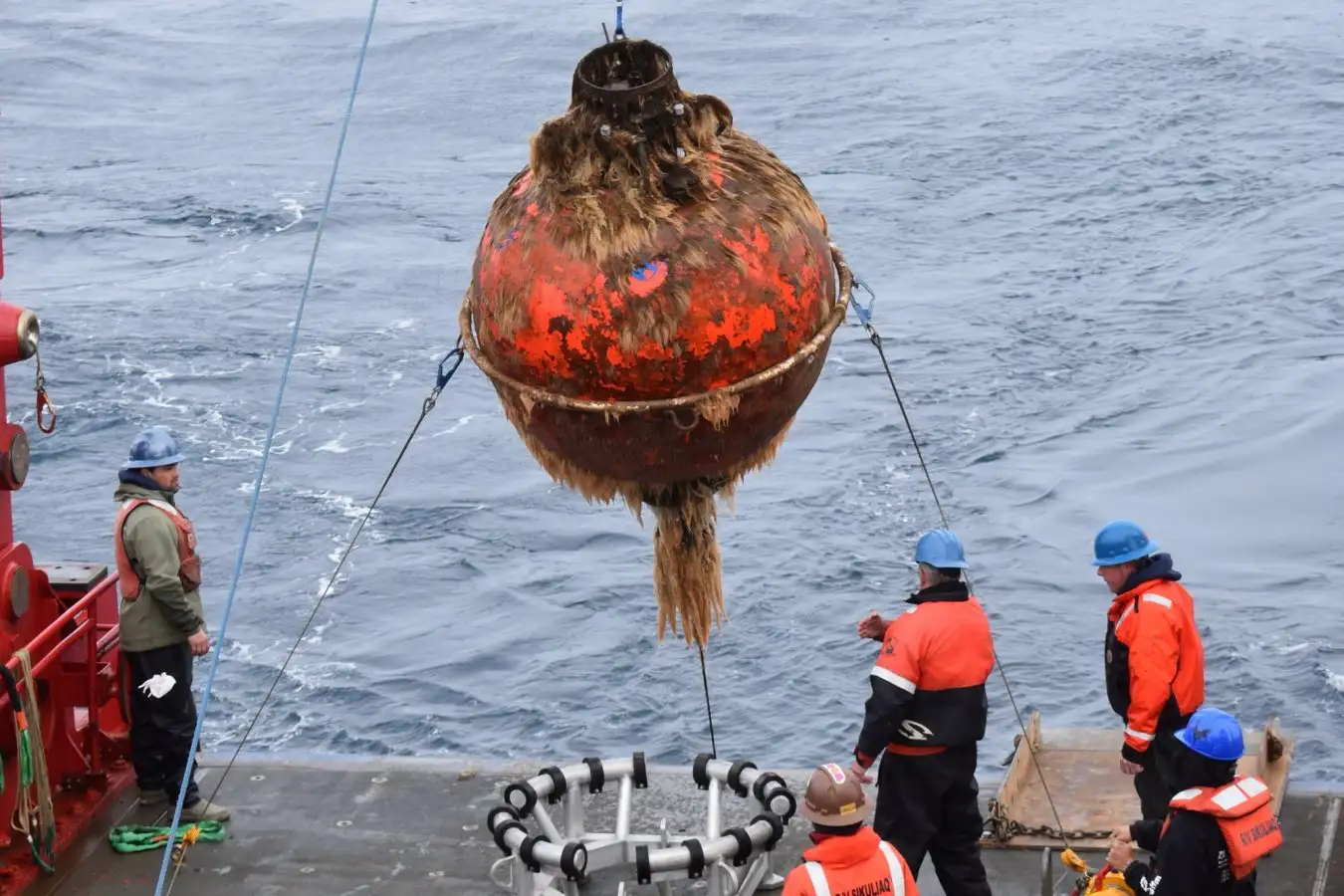

One of the Ocean Observatories Initiative’s moored spheres being pulled out of the sea.
Rebecca Travis / Woods Hole Oceanographic Institution
During winter 2013-2014, a significant shift in the jet stream led to the emergence of a warm water mass, dubbed the “blob,” which spanned over 1500 kilometers in the North Pacific Ocean. This remarkable phenomenon has profound impacts on oceanic conditions. learn more
Floating instruments anchored to the ocean floor off Alaska, Washington, and Oregon served as early warning systems, alerting scientists and the fishing industry to water temperatures increasing by up to 4 degrees Celsius above normal.
These instruments are part of the Ocean Observing Initiative (OOI), which includes five crucial moorings along the U.S. West Coast. In 2023, the National Science Foundation (NSF) announced $220 million in funding for OOI, highlighting its role in monitoring “Earth’s vital organs.” However, recent funding cuts from the Trump administration led to plans for removing most of these arrays from the water. Read more here
Between 2015 and 2016, sensors on the OOI mooring wire detected the blob’s persistence as water temperatures surged due to the El Niño effects exacerbated by global warming. This event continued to reappear in 2019, raising concerns over potential increases in toxic algae blooms that negatively impact the fishing industry, including a $60 million loss in California’s Dungeness crab fishery.Discover more.
The removal of OOI moorings threatens the accuracy of weather predictions, including precipitation patterns associated with ongoing drought conditions in the western U.S. Moreover, it could hinder efforts to monitor the Atlantic Meridional Circulation (AMOC), essential for maintaining Europe’s mild climate and understanding El Niño’s ramifications.
“We’re flying blind, resulting in higher costs for us,” states John Abraham, a professor at the University of St. Thomas in Minnesota.
While OOI costs $56 million annually, U.S. commercial fisheries that leverage OOI data generate billions per year. The financial repercussions of weather disasters average $183 billion annually, a figure the U.S. government ceased tracking in 2025.Learn more about the costs.
Without OOI, fleets will lack critical insights into fishing areas less affected by the potential strongest El Niño event on record, predicted by some models. This situation will also affect oyster, clam, and shellfish farms that cannot adequately prepare for climatic impacts that El Niño may impose, resulting in unseen damages to marine ecosystems. OOI has previously warned about the emergence of low-oxygen “dead zones,” posing significant threats to marine life.
“Removing OOI would occur at the worst possible moment,” warns Hilary Palewski of Boston University, Massachusetts.
As satellites cannot penetrate the ocean surface, underwater floats, gliders, and tethered vessels are crucial for understanding the dynamics of the Earth’s oceans, which cover 70% of the planet. These instruments primarily monitor temperature, salinity, and flow, but OOI moorings also capture vital parameters such as pH and CO2, enriching our understanding of ocean biology and chemistry in remote locations where water mass movements are critical to climate feedback.
The loss of such sensors will impact global regions, mainly linked to the decrease in AMOC observations. The OOI array in the Irminger Sea, positioned east of Greenland, is part of the OSNAP project—a network monitoring the flow of warm saltwater from the tropics to the North Atlantic, where it cools and sinks, driving AMOC. Should this system collapse, Europe could face severe winter conditions, and essential agricultural monsoon patterns in Africa and Asia could become disrupted.
“OSNAP has revealed that most actual capsize incidents occur east of Greenland, making the Irminger Sea critical for understanding capsize variability,” affirms Femke de Jong at the Royal Netherlands Marine Institute.
Palewski warns that dismantling OOI will create a data gap, complicating our understanding of AMOC, even if a replacement system is developed.
Scientists are apprehensive that dismantling OOI may signal a broader decline in U.S. ocean research funding, putting critical projects such as OSNAP and the Argo network—which comprises about 4,000 floats traversing global oceans—at risk. HALF of these floats are provided by the United States.
In a statement to New Scientist, the NSF expressed that OOI’s removal is aimed at “prioritizing support for evolving scientific priorities.” However, the future will largely depend on the current administration’s agenda, as articulated by Gretchen Goldman of the Union of Concerned Scientists, who describes this move as an “attack on science.” The administration also plans to cut thousands of research grants and reduce NSF’s budget by 55% by 2027.
This week, proposed regulations could eliminate peer review processes for research grant applications, enabling political appointees to influence federally funded research outcomes, while also prohibiting international cooperation and studies on gender and diversity.
Edward Dever, a professor at Oregon State University overseeing the OOI array off Washington and Oregon, argues that dismantling OOI and changing grant regulations reflect significant shifts aimed at “weakening peer review and politicizing NSF-funded science.”
A recent study found that dismantling even 20% of the Global Ocean Observing System, including the OOI array and Argo floats, would raise errors in estimating ocean heating rates by 33 percent. “It would be like forecasting the unemployment rate at 3%, but with a range of 2% to 4%,” explained Abraham, who is part of the research team.
“This is a deliberate attempt to obstruct scientific observation of our oceans,” he laments about OOI’s dismantling. “If we don’t measure something, how can we identify a problem?”
Topics:
Source: www.newscientist.com