


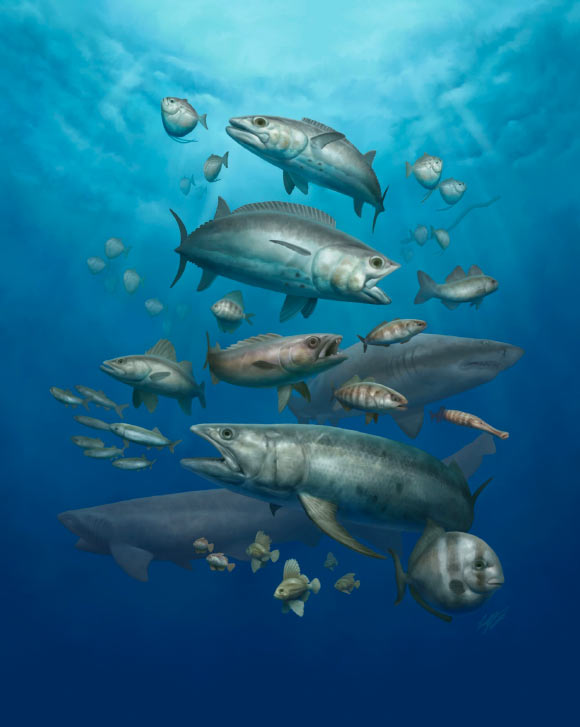
Approximately 66 million years ago, the end-Cretaceous extinction event significantly reshaped Earth’s biodiversity. However, the extent of its impact on marine fish has been a topic of debate due to gaps in the fossil record. A new study by paleontologists reveals a collection of marine fish fossils from the 62.2 million-year-old Quraya 3 site in Egypt’s Eastern Desert, shedding light on this evolutionary transition. The findings include the oldest known fossil skeletons of horse mackerel, moonfish, pipefish (relatives of seahorses), and sportfish.
Marine fish from the early Paleocene site of Qreiya 3 in Egypt’s Eastern Desert. Image credit: Ian Beilatry.
“The fossil record is limited, especially with a 10 million-year gap,” remarked study lead author Sanaa El-Sayed, a doctoral candidate at the University of Michigan.
“We know that asteroid impacts affected the marine ecosystem, but it’s unclear how modern fish came to inhabit our oceans afterward.”
“It’s remarkable that this site is helping us address questions regarding the timing, location, and existence of modern fish just a few million years after the dinosaurs vanished.”
At the Quraya 3 site, El-Sayed and her team uncovered fossils of 21 fish species spanning nine orders.
“Most of these species are percomorphs, a dominant group in today’s oceans, yet relatively rare during the dinosaur era,” said co-author Professor Matt Friedman, director and curator of the University of Michigan Museum of Paleontology.
“This discovery also strengthens the hypothesis that the end-Cretaceous mass extinction, caused by an asteroid impact, led to the demise of specific fish types, paving the way for the emergence of distinctly modern fish groups.”
The fossil-poor segment of the record, both before and after the mass extinction, is referred to as the Patterson Gap, named after the paleontologist who studied it extensively.
This gap obscures our understanding of how fish were influenced by the extinction event.
“This gap raises two critical questions,” Professor Friedman stated.
“First, did the fish species we assume went extinct at the end of the Cretaceous actually survive into the Paleogene? Were they simply overlooked due to sparse records?”
“Secondly, when did the more modern fish groups emerge?”
“This gap signifies an extensive period in which our knowledge is still lacking, frustratingly coinciding with one of Earth’s most intriguing historical periods.”
“Here, we have an exceptional deposit that opens new avenues of research during this pivotal time.”
“While there are numerous preserved skeletons, none of the species once believed to be extinct were present.”
“Our findings imply that their absence is not merely a result of an incomplete record but rather that they likely faced extinction during the end-Cretaceous catastrophe.”
Simultaneously, this site offers direct evidence that several modern fish groups were established quite early.
The researchers also pondered the implications of their findings concerning the broader fossil record following the end-Cretaceous mass extinction.
By comparing their results with data from other fossil deposits, they noted that most percomorphs emerging shortly after extinction events primarily inhabited the tropics.
Fewer percomorphs appeared in higher latitudes initially.
It wasn’t until well after their extinction that percomorphs became widespread.
“There seems to be a geographic trend in how these modern faunas emerged,” Friedman commented.
“They likely developed in tropical regions before spreading to higher latitudes as the climate evolved, and these groups dispersed.”
“As we enhance our fossil record, our findings will be rigorously tested.”
For more details, visit the full study published in this week’s edition of Scientific Progress.
_____
Sanaa El-Sayed et al. 2026. The rise of modern marine fishes captured in Lagerstätte during the early Paleocene. Scientific Progress 12(23); doi: 10.1126/sciadv.aec8978
Source: www.sci.news