


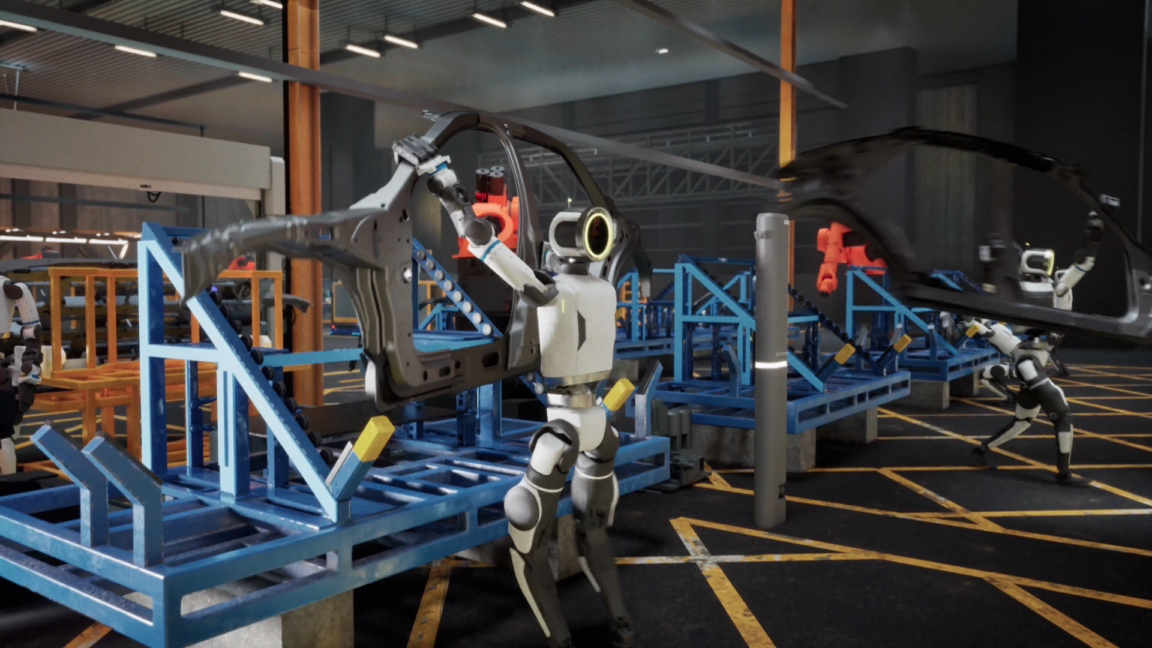
Metaplant America is rapidly becoming the most automated automobile factory in the United States. This cutting-edge facility utilizes over 850 robots for tasks such as unloading auto parts, punching steel components, assembling car frames, and installing car doors, as reported by IEEE Spectrum. Additionally, more than 300 automated guided vehicles (AGVs) are employed to transport auto parts throughout the plant, optimizing workflow and reducing the need for human intervention.
The facility also hosts Spot, Boston Dynamics’ renowned four-legged robot. It is tasked with conducting “appearance quality inspections” in the welding shop. During a July 2026 visit, a reporter from Atlanta Journal Constitution observed Spot using a sensor embedded in its nose to detect potential defects.
Two Boston Dynamics Spot robots inspect the bodyshell of a Hyundai Ioniq 5 at Hyundai Motor Group’s Metaplant outside of Savannah, Georgia.
Credit: Jonathan Gitlin
In 2028, Atlas, Hyundai’s humanoid robots, will be introduced at Metaplant America for sorting and organizing auto parts. However, Gerald Roach, the general manager, assured the AJC that these robots will not replace the human workforce, as tasks involving the delicate handling of components like hoses, wires, carpets, and trim panels still require the human touch.
Hyundai has committed to hiring 8,100 full-time employees at Metaplant America by 2031 as part of an economic development agreement with Georgia. Local and state leaders have provided around $2.1 billion in incentives to attract automakers to Georgia. By the end of 2025, Hyundai facilities are projected to employ over 3,800 workers.
Labor unions in both South Korea and the U.S. continue to urge automakers to take stronger initiatives amidst increasing automation. Recently, the United Auto Workers criticized General Motors for adding 50 new robotic arms at its flagship electric vehicle plant in Detroit after recently laying off over 1,300 workers, which they labeled a temporary measure.
During the UAW Constitutional Convention in June 2026, UAW President Sean Fein also highlighted concerns over the “threat of humanoid robotics and mass automation”, signaling potential risks to job security and worker compensation. The upcoming years will determine if humanoid robots can indeed prove to be more cost-effective than specialized industrial robots and human labor.
Source: arstechnica.com