


Close Menu
HitechubHitechub
    What's Hot
    Science

    How Plants Altered Magma Chemistry: Insights from Sciworthy

    Science

    Common Tooth Brushing Mistakes: Are You Doing It Wrong? Learn the Correct Technique!

    Science

    Why Restoring Pluto’s Planet Status Isn’t as Simple as It Seems

    Important Pages:
    • About Us
    • Privacy Policy
    • Terms & Conditions
    Facebook X (Twitter) Instagram Pinterest
    Facebook X (Twitter) Instagram
    HitechubHitechub
    Friday, June 12
    • Technology
      1. AI
      2. Gadgets
      3. View All

      This is the most popular CEO in the world

      Sectors in which “Chat-GPT” is most often used

      AI Pioneer Expresses Concern About Potential for AI to Surpass Humanity

      Artificial intelligence has begun to “swallow” professions

      What’s new in Android 14

      Europeans have about 700 million old mobile phones in their drawers

      Here’s how you can tell if your phone is being tapped

      “Sneaker X” – computer case in the shape of a sneaker

      Russian Gamers Unite to Prevent Nuclear War: Join the Fight Online

      Challenges of Space Travel: Why Journeying to Space is So Difficult

      NASA Astronaut Casts Historic Vote from Space

      Discover the Future of Comfort: What If You Could Wear a Chair?

    • Science
      1. Space
      2. Wheels
      3. View All

      Galaxies in the universe are growing more slowly than they should

      “Espace” presented the new lander “Apex 1.0”

      The largest asteroid sample ever collected has arrived on Earth

      (VIDEO) Incredible flight of the Parker Solar Probe

      Toyota wants to make a new generation battery with a range of up to 1,200 km

      Meet Toyota’s lunar “baby” that could make exploring the Moon easier

      Microlino – Is this the perfect city car?

      Alfa Romeo 4C gets an electric successor

      Mastering Beer Brewing Techniques: Insights from Beer Foam Analysis

      Discovery of Supernova Remnant Near Milky Way’s Central Black Hole: Astronomers Uncover New Cosmic Insights

      Discover the Hidden Intestinal Condition That Generates Alcohol in the Abdomen

      Link Between E-Cigarette Use After Quitting Smoking and Lung Cancer Risk

    HitechubHitechub
    Home » Revolutionary Nuclear Clock: A New Era in Accurate Timekeeping
    Science

    Revolutionary Nuclear Clock: A New Era in Accurate Timekeeping

    Share Facebook Twitter Pinterest WhatsApp
    Share
    Facebook Twitter LinkedIn Pinterest WhatsApp

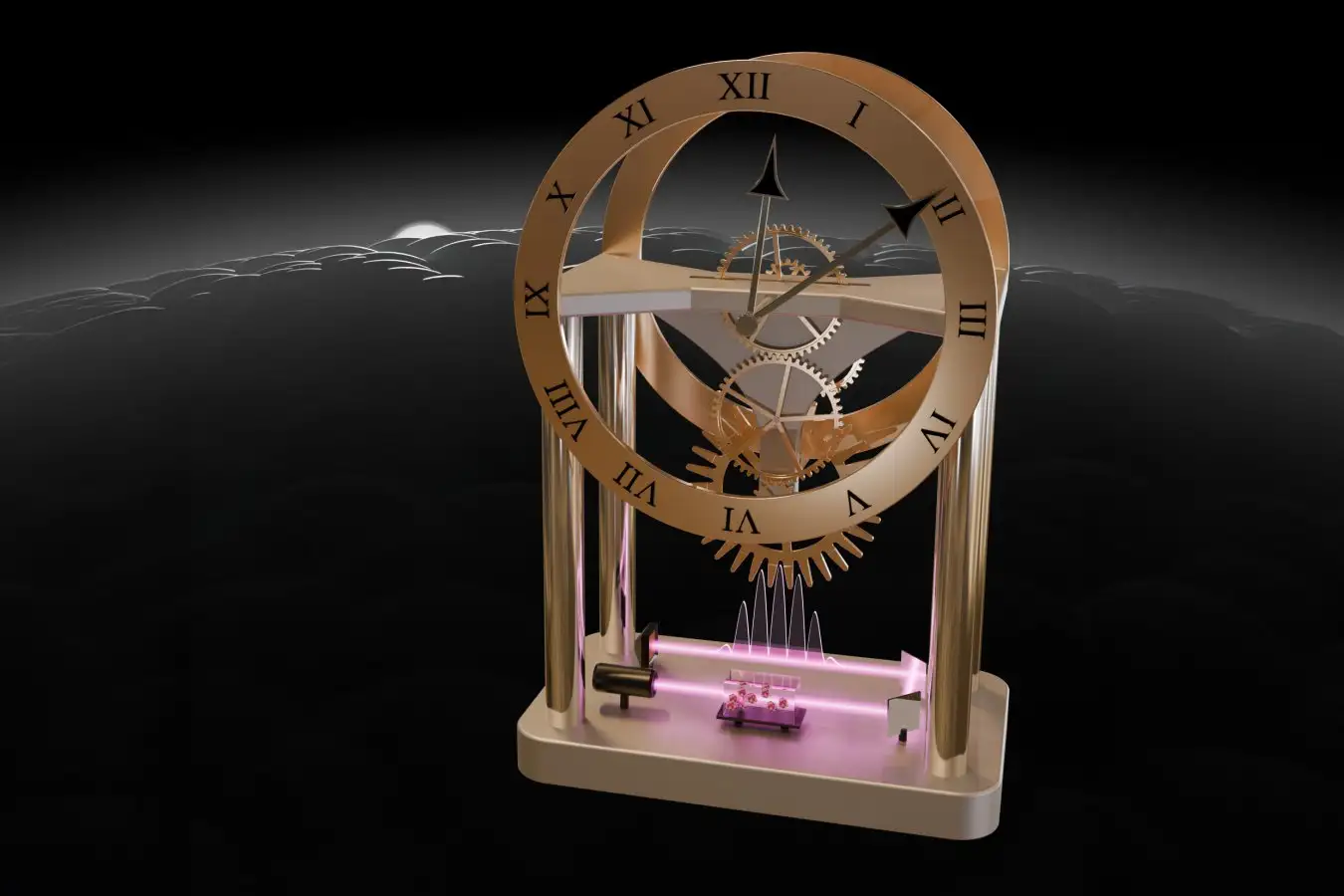
    Innovative Concept of a Nuclear Clock

    Credit: Oliver Diekmann, Vienna University of Technology

    Researchers have successfully created the world’s first operational nuclear clock, harnessing the vibrations of atomic nuclei for precise time measurement. This breakthrough, two decades in the making, could revolutionize accurate timekeeping and open avenues for groundbreaking physics experiments.

    Current state-of-the-art atomic clocks utilize electrons to keep time, relying on their movements between various energy levels or orbitals around an atom’s nucleus. By exciting electrons with specific frequencies of light, researchers can measure time much like the classic ticking of a grandfather clock.

    These atomic clocks employ laser technology tuned to electron-exciting nuclear frequencies to stimulate atom collections. Deviations from the correct frequency lead to fewer electrons jumping between energy levels, prompting the system to adjust the frequency for maximum accuracy. Such atomic clocks can maintain an error margin of just seconds over a billion years.

    Nuclear clocks might eventually surpass this accuracy due to their reliance on the more stable energy transitions of atomic nuclei. These nuclei have higher energy requirements for excitation, suggesting they could function accurately over vast timescales far exceeding the universe’s age.

    Nonetheless, the development of effective nuclear clocks has faced challenges since the majority of atomic nuclei need more energy for excitation than the most powerful lasers can provide. Fortunately, radioactive thorium stands out as a prime candidate for nuclear clocks, requiring relatively lower energy for excitation.

    Recent developments by Torsten Schumm and his team at Vienna University of Technology have yielded a thorium-based clock that hints at potential in identifying dark matter particles. “This achievement sums up over 15 to 20 years of research,” Schumm notes. “It’s remarkable to see dreams come to fruition for many researchers.”

    While prior attempts demonstrated that thorium’s nuclear frequencies could be excited with appropriate lasers, they lacked a reliable tuning mechanism. As Harry Morgan from the University of Manchester puts it, “If there’s ever been a moment of breakthrough, this is it.”

    The newly developed clock works by embedding thorium within a calcium fluoride crystal and illuminating it with an ultraviolet laser. This laser functions as the clock’s hands, oscillating between two frequencies around thorium’s nuclear frequency. If both frequencies are equally absorbed by thorium, the laser is correctly tuned; discrepancies prompt adjustments.

    Though current nuclear clocks lack the precision of the best atomic clocks, losing tens of seconds every billion years, Schumm’s team believes this prototype demonstrates potential for improvement.

    Team members are encouraged by the surprising performance of this prototype, as Ekkehard Peik from the German National Metrology Institute comments, “What impressed me most was the system’s ability to run continuously for 24 hours without user intervention, something no other optical clock has managed this quickly.”

    Despite the current limitations, nuclear clocks offer advantages over atomic clocks. The atomic nucleus is shielded from the chaotic electromagnetic environments of surrounding electrons, allowing for measurements of physical influences sensitive to very precise transitions. This unique feature makes them potentially more accurate for fundamental physics measurements.

    Additionally, nuclear clocks can operate at room temperature without the need for extreme cooling or vacuum conditions common in atomic clocks. “This simplicity is groundbreaking,” Schumm adds.

    This characteristic may pave the way for these clocks to be miniaturized for diverse applications, like satellite experiments testing the theory of relativity. “Current capabilities are below the state-of-the-art, but we anticipate significant advancements shortly,” asserts Eric Hudson from UCLA.

    By leveraging the high-energy transitions of thorium nuclei, the team was able to investigate potential dark matter particles. If dark matter behaves like an electromagnetic force permeating the universe, it should subtly modify nuclear energy transitions, affecting the clock’s operating frequency due to thorium’s elevated nuclear characteristics. As Schumm explains, “It’s akin to measuring length variations in a metal when temperature changes impact its dimensions.”

    Topic:

    Source: www.newscientist.com

    Share. Facebook Twitter Pinterest LinkedIn WhatsApp
    Previous ArticleMastering Small Talk: Tips to Shine in Conversations with Strangers
    Next Article Unlock Faster Cryptocurrency Mining with Energy-Efficient Quantum Computers

    Related Posts

    Science

    Mastering Beer Brewing Techniques: Insights from Beer Foam Analysis

    Science

    Discovery of Supernova Remnant Near Milky Way’s Central Black Hole: Astronomers Uncover New Cosmic Insights

    Science

    Discover the Hidden Intestinal Condition That Generates Alcohol in the Abdomen

    Science

    Link Between E-Cigarette Use After Quitting Smoking and Lung Cancer Risk

    Science

    How New World Cup Ball Design Changes Could Impact Close Games

    Science

    Unlock Faster Cryptocurrency Mining with Energy-Efficient Quantum Computers

    Science

    Mastering Small Talk: Tips to Shine in Conversations with Strangers

    Science

    Exploring the Ship of Theseus Paradox: Key Insights from its Wiki Page

    Add A Comment
    Leave A Reply Cancel Reply

    Stay In Touch
    • Facebook
    • Twitter
    • Instagram
    • Pinterest
    Top Picks
    Technology

    Driverless taxi in Japan

    Honda, GM and Cruise together are developing an autonomous driverless taxi project to be used in Japan.

    The most powerful supercomputer in Europe

    Empowering Girls: Launching Africa’s First Private Space Satellite

    How Parenthood Can Impact Your Love Life: Keeping the Spark Alive After Babies

    How Quantum Computers Enhance the Spookiness of Horror Video Games

    Most Popular
    AI

    The first factory for humanoid robots opens in the United States

    Science

    Rethinking Consciousness: Here’s Why We Need a Fresh Perspective

    Categories
    • AI (13)
    • Gadgets (10)
    • Science (214)
    • Space (9)
    • Technology (37)
    • Wheels (9)
    Our Picks
    AI

    AI Pioneer Expresses Concern About Potential for AI to Surpass Humanity

    Science

    NASA Unveils Three Unmanned Moon Exploration Missions in 2023 to Support Lunar Base Construction

    © 2026 Hitechub.
    • Home
    • About Us
    • Privacy Policy
    • Terms & Conditions

    Type above and press Enter to search. Press Esc to cancel.

    We are using cookies to give you the best experience on our website.

    You can find out more about which cookies we are using or switch them off in .

    Ad Blocker Enabled!
    Ad Blocker Enabled!
    Our website is made possible by displaying online advertisements to our visitors. Please support us by disabling your Ad Blocker.
    Go to mobile version
    Hitechub
    Powered by  GDPR Cookie Compliance
    Privacy Overview

    This website uses cookies so that we can provide you with the best user experience possible. Cookie information is stored in your browser and performs functions such as recognising you when you return to our website and helping our team to understand which sections of the website you find most interesting and useful.

    Strictly Necessary Cookies

    Strictly Necessary Cookie should be enabled at all times so that we can save your preferences for cookie settings.