


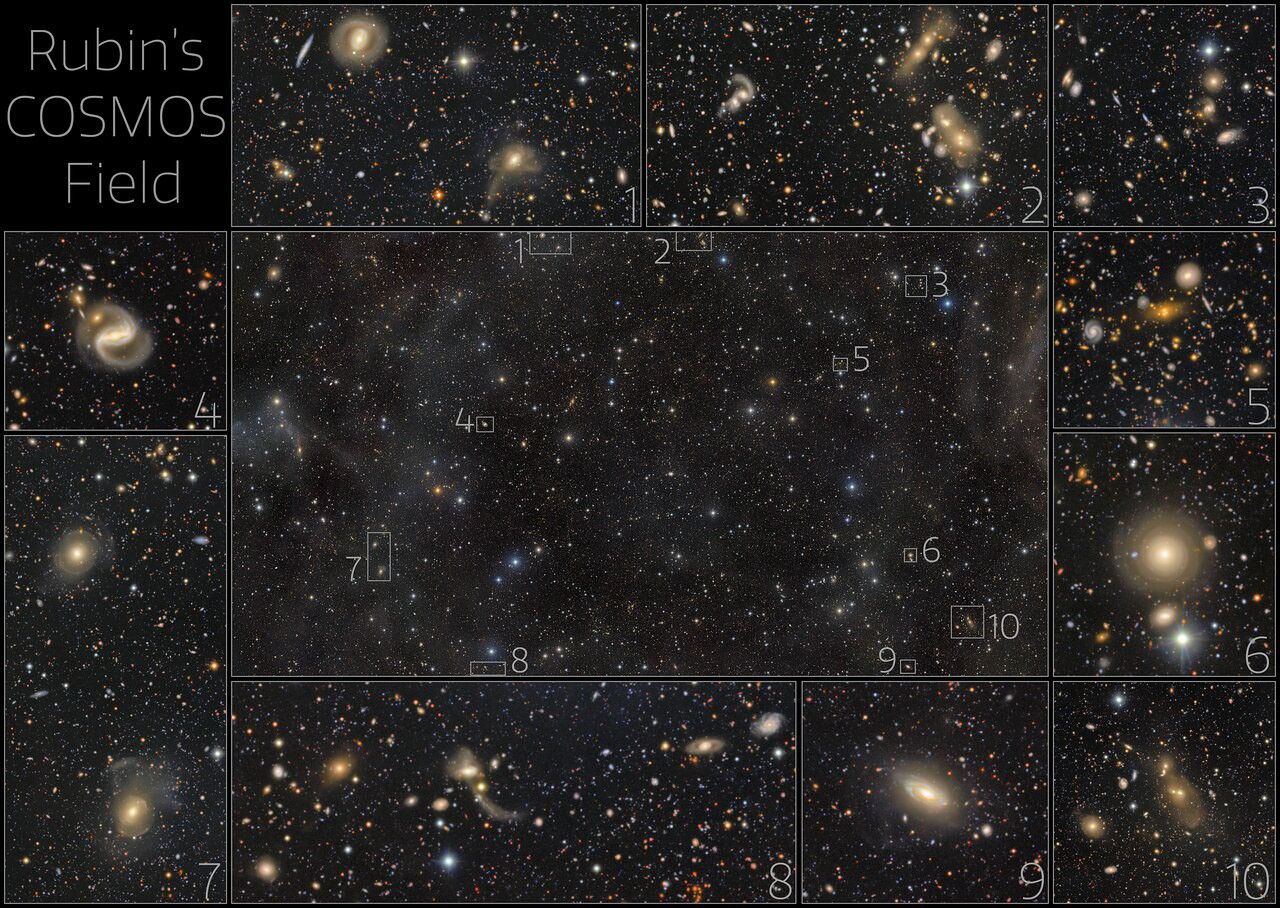
Explanation: The central panel of this remarkable image from the NSF-DOE Vera C. Rubin Observatory in Chile reveals more than half a million galaxies. It shows the COSMOS field, a region of the night sky several times larger than the full moon. First studied in detail by the Hubble Space Telescope, the COSMOS field has also been observed by the James Webb Space Telescope and other major observatories. Because it contains relatively few bright stars from our own galaxy, the field provides an exceptionally clear view of distant galaxies beyond the Milky Way. The outer panels, numbered 1 through 10, feature zoomed-in views of the corresponding regions marked in the central image. Together, they showcase the astonishing diversity of galaxy shapes, sizes, and structures across the universe. Some of these galaxies are so distant that their light has traveled for billions of years before reaching Earth. As part of its ten-year Legacy Survey of Space and Time, the Vera C. Rubin Observatory will revisit the COSMOS field every couple of days. These repeated observations will create a dynamic time-lapse view of the COSMOS field, revealing how the universe and the changing night sky evolve over time.
Tomorrow’s picture: What’s next?
Source: science.nasa.gov