


Venus’ Mysterious UV Absorber May Require Highly Efficient Molecules or High Concentrations
A new study has placed strict limits on the unknown substance responsible for Venus’ dark ultraviolet markings. The mysterious UV absorber must either absorb sunlight exceptionally efficiently, exist in unusually high concentrations, or both.
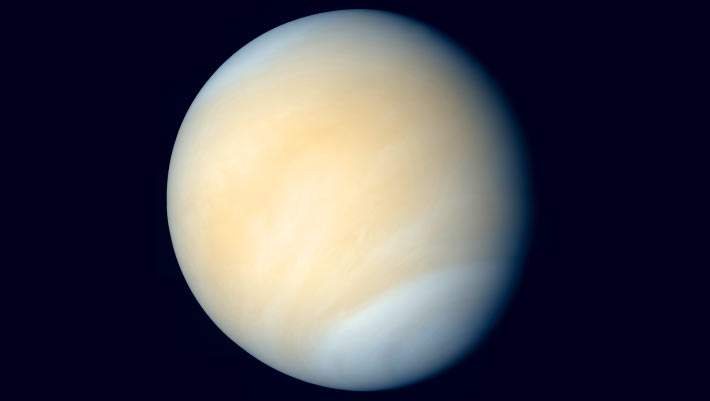
Actual color Venus processed from Mariner 10 images. Image credit: Matthias Malmar / NASA.
At visible wavelengths, Venus appears pale yellow and relatively featureless. However, astronomers have observed high-contrast markings in the planet’s ultraviolet (UV) atmosphere since the 1920s.
These dark UV features follow the approximately four-day superrotation of Venus’ upper cloud layer and change substantially over time and across the planet’s atmosphere.
The chemical identity of the UV absorber remains unknown because none of the proposed candidates fully explains all of the available observations.
In a new study, Dr. Jan Spacek of the Foundation for Applied Molecular Evolution and colleagues calculated how strongly the liquid inside Venus’ cloud droplets would need to absorb light to reproduce the planet’s observed ultraviolet and blue cloud reflectance.
“Our model effectively asks what would happen if we could collect that cloud material into a cuvette and put it into a spectrometer in the laboratory,” Dr. Spacek said.
“This is important because light absorption in bulk liquids can be linked to the concentration of light-absorbing substances dissolved in the solution.”
The researchers combined spacecraft and telescope observations of Venus with a radiative-transfer model that accounts for multiple scattering by cloud droplets and atmospheric molecules.
They converted the astronomical observations into a measurement commonly used in laboratory ultraviolet-visible spectroscopy: the absorption coefficient of the bulk cloud liquid.
“The brightness observed from space cannot be directly compared with bulk-liquid absorption measured in the laboratory because particles in Venus’ clouds scatter sunlight very efficiently,” said Dr. Yeon-Ju Lee of the Korea Institute of Basic Science.
“By including scattering and absorption by both cloud particles and the atmosphere, our model estimates how strongly the cloud droplets themselves must absorb light.”
Across the modeled wavelength range of 365 to 455 nm, the estimated absorption coefficient reaches approximately 1,278 cm-1 at 375 nm.
This result indicates that Venus’ unknown UV absorber must be extremely efficient at absorbing light, present at very high concentrations, or both.
Highly absorbing conjugated organic molecules could meet these requirements. In this context, “organic” refers to carbon-based compounds and does not imply a biological origin.
For molecules with light-absorption strengths similar to efficient porphyrinoid pigments, concentrations of roughly 10 grams per liter would be necessary.
The authors stress that they are not identifying chlorophyll, heme, or any specific biological pigment as the Venusian absorber. These substances are used only as familiar examples of highly efficient light-absorbing molecules.
The shape of Venus’ absorption spectrum provides an additional constraint.
When simple organic compounds are exposed to concentrated sulfuric acid, they can form a black, chemically complex, tar-like mixture.
Such mixtures generally absorb light across a broad portion of the visible spectrum, causing them to appear brown or black. That behavior does not match the sharp decline in absorption estimated between 365 and 455 nm for Venus’ clouds.
“If the observed optical absorption is caused by conjugated organic molecules, the relatively sharp absorption profile is consistent with a chemically defined absorber that resists conversion into the tar-like mixture typically produced when organics dissolve in concentrated sulfuric acid,” Spacek said.
“Paradoxically, by placing additional constraints on the unknown absorber, we may have made the mystery even more intriguing,” said Dr. Janusz Petkowski of Wrocław University of Science and Technology.
“This model imposes severe constraints on any proposed absorber,” said Dr. Paul Rimmer of the University of Cambridge.
“Many of the proposed inorganic candidates would need to be present at extremely high concentrations to produce the required level of absorption.”
The study was published in the journal Astrobiology.
_____
Jan Spacek et al. A model for UV-blue absorption in the bulk liquid of Venusian cloud aerosols is consistent with efficient organic absorbers at high concentrations. Astrobiology, published online August 25, 2026. doi: 10.1177/15311074261477502
Source: www.sci.news