


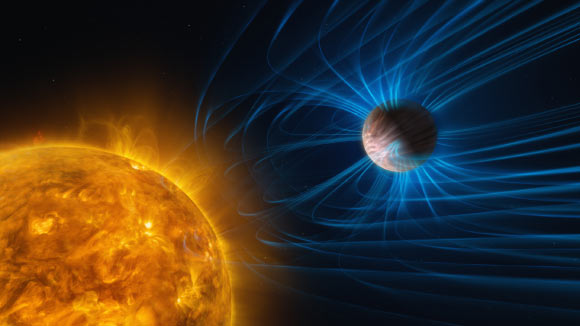
Astronomers have unveiled groundbreaking evidence that magnetic fields influence the weather on exoplanets, particularly by examining the violent winds in the atmospheres of seven superhot Jupiters.
Illustration of the magnetic activity of a superhot Jupiter. Credit: ESO / M. Kornmesser / L. Calçada.
The Earth’s magnetic field plays a crucial role in the atmosphere, influencing conditions that support life. Similarly, magnetic fields are present on other planets in our solar system, including Jupiter and Saturn.
However, for the past 15 years, researchers have struggled to directly measure the strength of an exoplanet’s magnetic field.
“This landmark discovery opens new avenues in exoplanet research,” stated Dr. Julia Seidel, an astronomer at the Lagrangian Laboratory at the Côte d’Azur Observatory.
“It marks the first occasion we can compare magnetic environments of different worlds, a vital step toward understanding which planets can sustain water and potentially harbor life.”
The researchers analyzed wind speeds from seven tidally locked superhot Jupiters orbiting various stars.
Wind speeds ranged from around 7,200 km/h to over 25,000 km/h, in stark contrast to Jupiter’s fastest winds, which reach approximately 1,500 km/h.
Utilizing data from the ESPRESSO instrument on the ESO’s Very Large Telescope and a similar device on the Gemini North telescope, they uncovered an intriguing pattern: hotter planets exhibited slower wind speeds.
“This is counterintuitive; generally, higher temperatures should accelerate winds,” explained Professor Vivienne Parmentier from the Lagrangian Laboratory.
“Something must be inhibiting the wind speeds of these hotter bodies.”
Scientists suggest that the most plausible explanation is the presence of a planet-wide magnetic field that acts as a brake, limiting the motion of charged particles within the atmosphere.
From their findings, the authors were able to estimate the magnetic field strength of each planet studied.
Their intensity was found to be similar to those in our solar system, approximately four times stronger than Saturn’s field and about half that of Jupiter’s.
Such potent magnetic fields can impact more than just winds on distant exoplanets.
“Here on Earth, we enjoy the stunning displays of the Northern and Southern Lights, where solar particles collide with our magnetic fields,” noted ESO astronomer Dr. Viviana Prinos.
“Auroras driven by magnetic forces on these exoplanets could be even more spectacular.”
For more details, view the full study published in Nature Astronomy.
_____
JV Seidel et al. The magnetic field strength of a hot giant exoplanet matches that of our solar system. Nat Astron published online June 2, 2026. doi: 10.1038/s41550-026-02870-1
Source: www.sci.news