


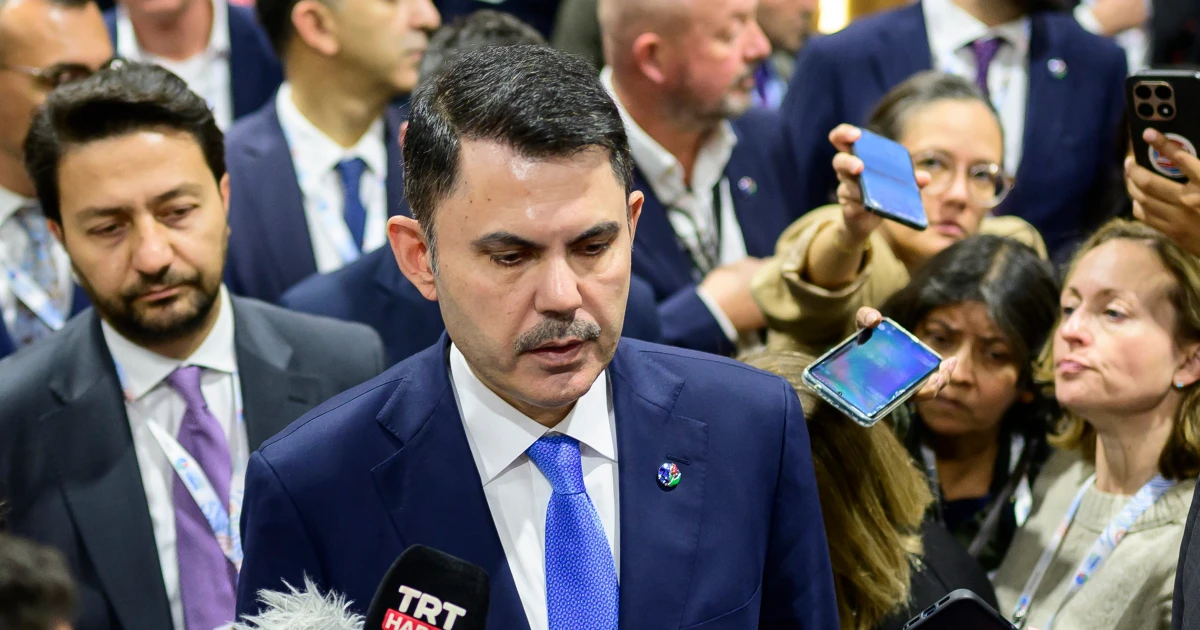
Climate talks in Antalya, Turkey, collapsed on Sunday after the European Union and several other countries rejected a proposed agreement that did not mention phasing out fossil fuels. Representatives of 196 countries and the European Union had struggled to agree on new climate commitments and how to implement earlier promises, extending COP31 beyond its scheduled end and making it the longest COP meeting in history.
Negotiations end without an agreement
COP31 President Murat Krum said on Sunday, two days after the meeting was scheduled to conclude, that negotiators would not produce a new draft climate agreement after the fourth version was rejected.
“There’s nothing to do. We did everything we could,” he said. “We do not perform new text work in an environment where there is no consensus.”
COP31 negotiators’ chair Chris Bowen told reporters that the discussions had reached a “red line that cannot be crossed.”
“The circumstances leading into this COP were some of the most complex and challenging geopolitical environments in living memory,” said Bowen, the Australian minister. “In past COPs, like the last two, where people wanted to mention certain words but didn’t understand, this time it became a line that couldn’t be crossed,” he added.
Fossil fuels become the central dispute
The latest draft, released on Sunday, outlined measures for countries to accelerate climate action. However, the 12-page document omitted a key demand from the EU and other countries: reducing reliance on fossil fuels.
Irish Minister Darragh O’Brien, representing the EU in Antalya, said the bloc was “strongly opposed” to the agreement and called it “greenwashing.”
“These decisions fall far short of the level of ambition needed to tackle climate change. It would be unconscionable to have a climate change agreement that does not mention fossil fuels,” O’Brien said.
Panama also rejected the agreement, saying it did not go far enough.
“Science doesn’t negotiate,” he said. “The Earth cannot continue to wait.”
British mission spokeswoman Kate Hughes said the situation “requires greater ambition” and described the draft as the “lowest common denominator.”
“What we have in front of us is not commensurate with the urgency of the overshoot, the scale of the climate crisis, and the impacts already being felt by the most vulnerable people and communities around the world,” she told the conference.
The Marshall Islands, a low-lying Pacific nation facing an existential threat from rising sea levels, also rejected the deal.
Talks extend beyond the scheduled end
All countries had to approve the document for it to pass. The talks became the longest in COP history, surpassing the delay during negotiations at COP25 in Madrid.
The summit began on November 9. The first draft was circulated a week later and mentioned “fossil fuels” six times. The second draft, released on Thursday, removed all references, angering many countries.
The meeting officially ended on Friday without an agreement. Member states continued talks in an effort to find a solution, but the fourth draft published on Sunday still did not mention fossil fuels.
Countries including Saudi Arabia, Russia and India resisted including the term, citing concerns that phasing out fossil fuels, which are central to their economies, could create fiscal risks.
The United States, one of the largest greenhouse-gas emitters, was officially absent from the conference after withdrawing from a series of international climate commitments under President Donald Trump.
Warnings over the 1.5-degree target
The latest draft began with a “full recall of the UAE agreement,” referring to COP28 in the United Arab Emirates, where countries first agreed to “de-transition” from fossil fuels in their energy systems.
The draft also acknowledged that the goal established in the 2015 Paris Agreement of limiting global temperature rise to below 1.5 degrees Celsius will not be met.
If warming exceeds 1.5 degrees Celsius, the effects of climate change, including heatwaves and other extreme weather events, are expected to increase significantly.
If the negotiations break down, Krum could convene a follow-up meeting or postpone a decision until next year’s conference, which will be hosted by Ethiopia.
The last time negotiations broke down was at COP6 in The Hague, Netherlands, in 2000.
Source: www.nbcnews.com