


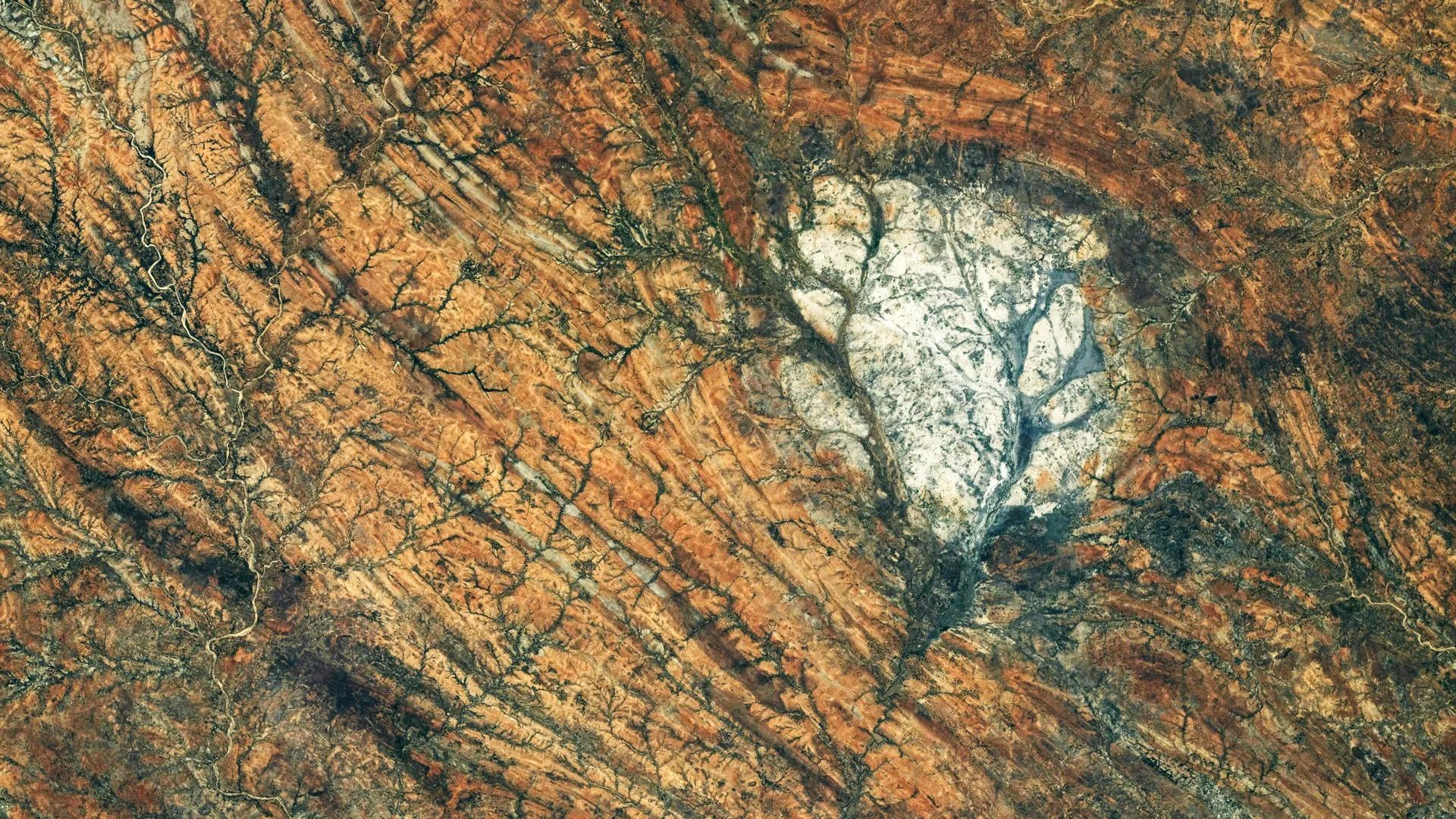
Moon-Like Rock Formation in Madagascar Photographed From Space
Ancient formations of bright plagioclase, a common rock-forming mineral on the Moon, stand out among the highly deformed rocks of southern Madagascar.
A bright and unusual rock formation in southern Madagascar has a surprising connection to the Moon. Seen from space, the formation stands out against the surrounding arid landscape. Although anorthosite may seem rare on Earth, similar rock covers much of the Moon’s surface.
Anorthosite is an igneous rock that makes up much of the Moon’s bright, reflective highlands. These lighter regions are visible to the naked eye when the Moon is viewed from Earth.
Anorthosite is also found in several regions on Earth, including eastern Canada, Scandinavia, southern India, and Madagascar. In southern Madagascar, one particularly impressive deposit forms a nearly circular feature that is easily distinguishable from the surrounding terrain.
NASA astronauts photograph Madagascar’s ancient anorthosite
On August 28, 2026, astronauts aboard the International Space Station photographed the Salilia Key Anorthosite Massif, a large rocky body exposed at Earth’s surface.
Anorthosite is classified as an intrusive igneous rock, meaning it forms when molten material cools and solidifies below Earth’s surface. Because this cooling process takes place underground, the minerals have time to grow into relatively large crystals.
A geological survey indicates that the formations of Salilia Key originated during the late Precambrian period, at least 600 million years ago. The area of exposed rock is currently approximately 100 square kilometers (40 square miles).
While the formation itself is remarkable, the surrounding landscape tells an equally fascinating story. Nearby rocks preserve evidence of the enormous forces that reshaped the region hundreds of millions of years ago.
How ancient continents reshaped southern Madagascar
The Salilia Key Massif lies within what geologists call ductile shear zones. In these regions, rocks undergo severe deformation as powerful geological forces act on them deep within Earth’s crust.
At sufficiently high temperatures and pressures, solid rocks can gradually bend, stretch, and change structure rather than simply breaking apart. This process can also alter the rock’s mineralogy and texture, a phenomenon known as metamorphism.
Studies of the area have identified long, nearly parallel geological features running from north to south. These patterns record the intense deformation that affected the rocks surrounding Salilia Key.
Scientists believe that much of this change occurred when ancient landmasses collided during the formation of Gondwana, a vast supercontinent that ultimately included parts of modern-day Africa, India, Madagascar, Australia, and Antarctica.
As these continental fragments came together, enormous pressure and heat reshaped large portions of Earth’s crust.
Some researchers have identified a second anorthosite massif approximately 60 kilometers (40 miles) north of Salilia Key within the same shear zone. The formation may once have been connected to Salilia Key, according to this interpretation.
The original rock bodies may have been stretched and separated by tectonic movements. The resulting structure is known as boudinage, a geological process in which relatively strong layers or bodies of rock are drawn into separate segments as the surrounding material deforms.
If this explanation is correct, the two geological formations preserve evidence of the tremendous forces involved in assembling one of Earth’s ancient supercontinents.
What Madagascar’s anorthosite reveals about the Moon
The scientific importance of anorthosite extends far beyond Earth’s geological history. Similar rocks provide an important opportunity to investigate how the Moon formed and evolved.
The Moon’s anorthosite-rich highlands are more than 4 billion years old. Scientists believe these rocks formed early in lunar history, when a vast ocean of lava covered much of the young Moon.
As this magma ocean gradually cooled, certain minerals crystallized and accumulated near the surface, helping form the Moon’s early outer shell. The anorthosite produced by this process is the main component of the bright lunar highlands still visible today.
Apollo astronauts brought samples of the Moon’s anorthosite back to Earth, providing researchers with valuable material for studying the Moon’s distant past. However, similar geological formations on Earth are especially useful for comparison because the amount of lunar rock available for research is limited.
One particularly close match occurs in the Beartooth Mountains of Montana, where anorthosite deposits have a composition very similar to their lunar counterparts.
By studying these terrestrial rocks, scientists can investigate the geological processes involved in anorthosite’s formation and evolution. This research can help them interpret much older material collected from the Moon.
The Saririaki formation provides another striking example of the geological similarities between Earth and its closest celestial body. Its bright exterior and dramatic environment reveal how hundreds of millions of years of tectonic activity transformed ancient rocks into a unique landscape visible from orbit.
Details of the NASA astronaut photograph
Astronaut photograph ISS075-E-85249 was taken by the Expedition 75 crew aboard the International Space Station on August 28, 2026. The astronauts used a Nikon Z9 digital camera equipped with a 400 mm focal-length lens.
The image was provided by the ISS Crew Earth Observation Facility and the Earth Science and Remote Sensing Unit at NASA’s Johnson Space Center. It was cropped and adjusted to improve contrast and remove lens artifacts.
Source: www.sciencedaily.com