


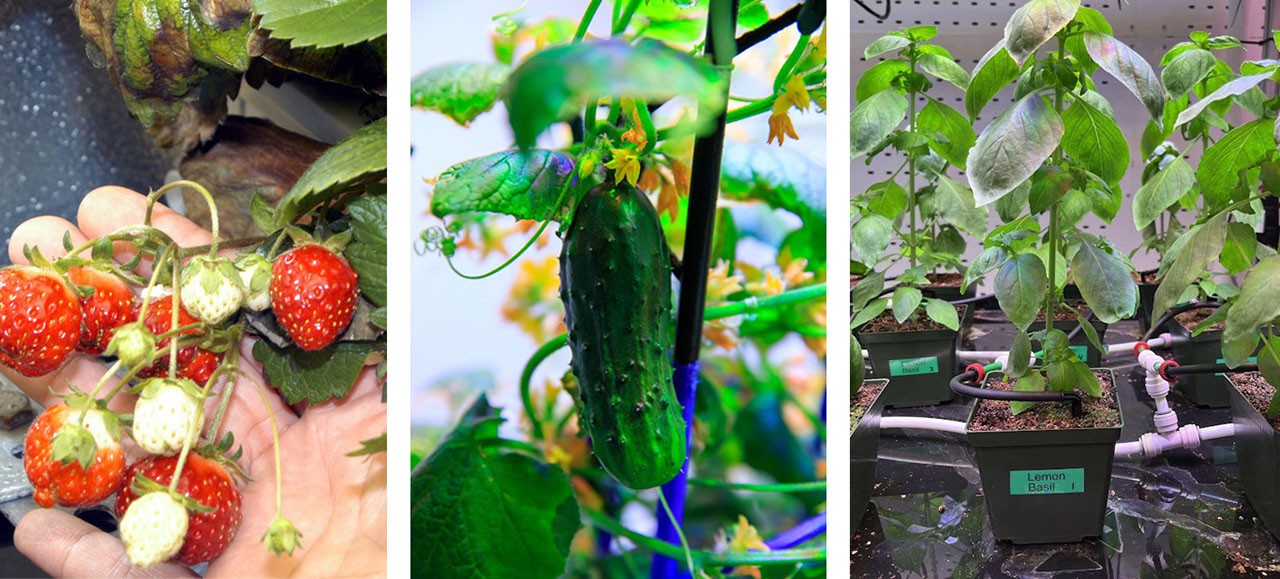
As NASA prepares for future missions to the Moon and Mars, researchers are studying crops that could provide astronauts with fresh food, nutrition and variety far from Earth. Recent work has highlighted strawberries, cucumbers and lemon basil as promising candidates, while a new NASA study is scheduled to launch to the International Space Station aboard a prototype growth chamber designed to inform crop-production systems for future lunar habitats and Mars missions.
Growing food beyond Earth
Space crops could do more than supplement astronauts’ diets. Plants can absorb carbon dioxide, produce oxygen and help recycle water—functions that will become increasingly important as crewed missions travel farther from Earth.
Research on Earth is advancing alongside experiments in orbit. NASA’s Biophysical Sciences Division is preparing to send a study to the International Space Station, where a first-of-its-kind prototype growth chamber will provide data for developing systems capable of growing crops in future Moon and Mars habitats.
Strawberries offer a sweet option
Strawberries are among the few sweet fruits being considered for spaceflight. They are nutritious and aromatic, and their flowers can self-pollinate.
Researchers at NASA’s Kennedy Space Center in Florida are growing strawberries in a flight growth chamber to assess their potential as space crops. NASA partners at the Australian Research Council Space Plant Center of Excellence are also contributing to research on growing strawberries in space.
Researchers from NASA, the University of Melbourne and the University of Western Australia recently compared wild strawberries with Deliz, NASA’s leading strawberry candidate, under simulated space conditions.
According to the study, published in Life Sciences in Space Research in September, the two types produced markedly different fruit. Deliz produced large red berries, while the wild strawberries produced small yellow berries because of a recessive genetic mutation.
Appearance was not the only consideration. When grown from seed, the wild strawberries produced twice as many buds, flowers and fruits as Deliz. However, they also produced too many runners, which would take up valuable space aboard a spacecraft. As a result, Deliz remained NASA’s preferred strawberry candidate.
Cucumbers could broaden space menus
Many crops have been grown in space, but none so far has belonged to the gourd family. Cucumbers could be among the first.
Before cucumbers can be grown and eaten in space, they must undergo extensive testing. NASA-funded researchers recently evaluated cucumber growth, yield and nutritional characteristics under spaceflight conditions.
The researchers found that the plants showed signs of leaf enlargement while continuing to produce edible fruit, according to a study published in HortScience in August.
Adding crops such as cucumbers could give astronauts more dietary variety and support their mental health. Greater plant diversity could also improve the chances of successfully growing food during long-duration missions.
Lemon basil could add flavor
Herbs could help make space meals more appealing by adding fresh flavor and variety to otherwise repetitive menus.
Lemon basil, an edible herb with a citrus aroma and taste, is advancing through testing at NASA’s Kennedy Space Center. Researchers report that it passed a preliminary round of space-crop testing and successfully underwent seed sterilization, a process required before launch to remove microorganisms from the seeds.
The next steps include evaluating how lemon basil grows in plant pillows, which can house plants inside the International Space Station.
Menu fatigue can become a problem for astronauts. Fresh herbs such as lemon basil could help turn packaged meals into more varied and satisfying dishes while supporting human health and performance in space.
Source: science.nasa.gov