


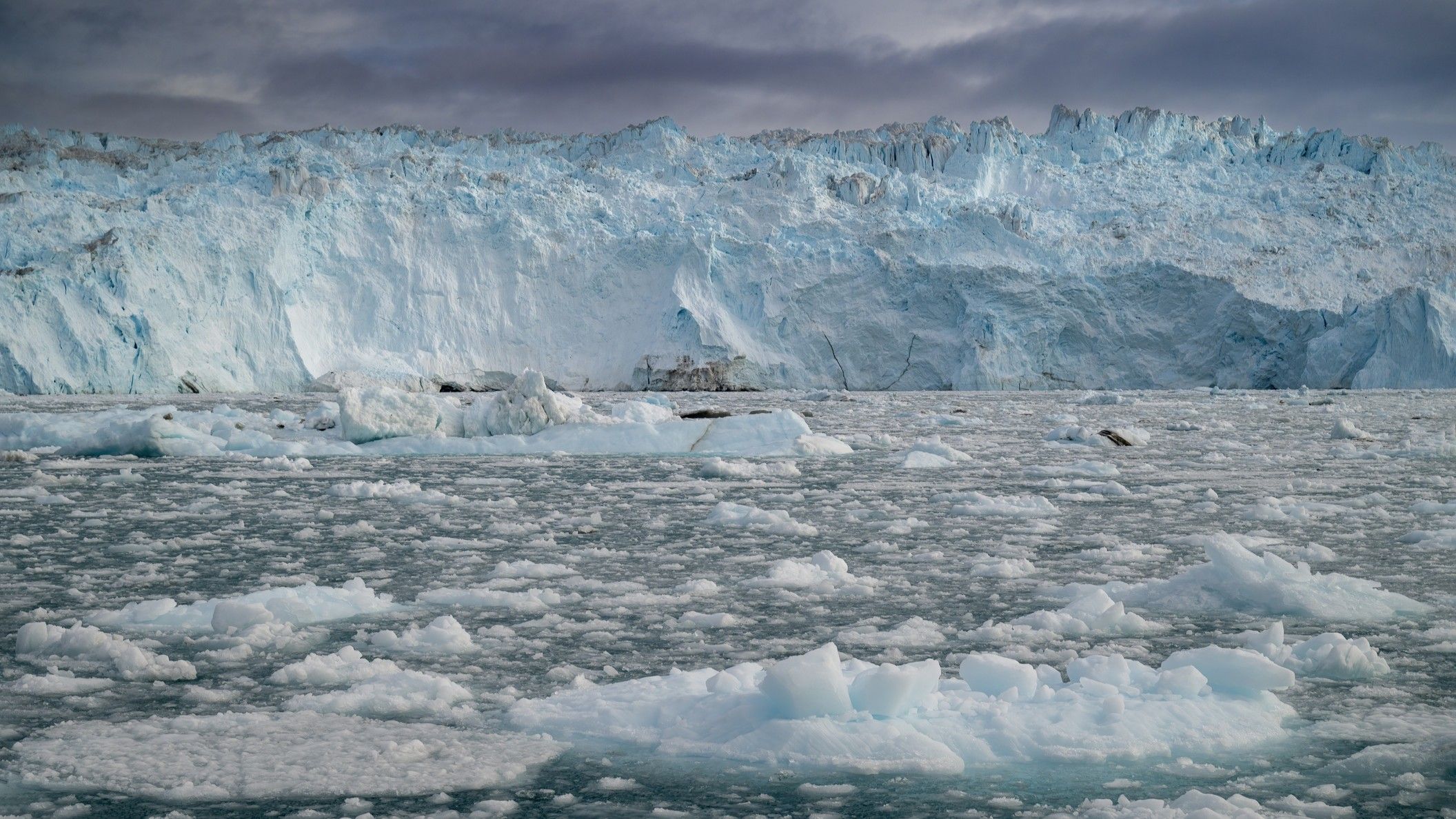
Runoff from Greenland’s rapidly melting ice sheet poses a significant risk to the Atlantic currents that regulate Earth’s climate, experts warn. However, recent studies indicate that the influx of freshwater may not lead to a complete and irreversible disruption of these critical oceanic currents, contradicting earlier predictions.
By 2100, the snowmelt in Greenland could contribute to a 10% to 20% decrease in the strength of the Atlantic Meridional Overturning Circulation (AMOC), further destabilizing this vital ocean current system. Scientists have already noted that the AMOC is a crucial driver behind global climate patterns.
Research has shown that the AMOC’s role is to transport warm water from tropical regions to the Northern Hemisphere while sending cold water back south toward Antarctica. The current state is the weakest in over a millennium. The melting of Arctic ice and rising ocean temperatures further exacerbate this situation, with models predicting a continuing decline in AMOC strength over the next few decades, potentially triggering severe weather in northwestern Europe, additional sea-level rise along the U.S. East Coast, and increased drought conditions near the equator.
The AMOC circulates through the Atlantic Ocean, transporting warm water north at the surface and cold water south at the seabed.
(Image credit: NASA/Goddard Space Flight Center Scientific Visualization Studio)
A new study suggests that if greenhouse gas emissions continue unabated, Greenland’s ice sheet could lead to a staggering 40% reduction in AMOC strength by 2300, beyond current climate model predictions. This highlights the significant impact of increased freshwater from Greenland on ocean currents, which many existing climate models fail to adequately incorporate.
“By 2100, we will witness notable changes, but the most significant impacts will unfold later,” stated Jost von Hardenberg, a professor at Politecnico di Turin’s Department of Environmental, Land, and Infrastructure Engineering, in an interview with Live Science.
Snowmelt from the Arctic and Greenland decelerates the AMOC by hindering the formation of deep currents in the North Atlantic, critical for maintaining the southward flow of ocean currents. This process is disrupted as fresh water influx and rising temperatures dilute and warm the surface waters.
While Arctic meltwater is frequently included in climate predictions, the runoff from Greenland has often been overlooked, as it may not exert as destructive an influence in the short term, according to von Hardenberg.
Get the world’s most fascinating discoveries delivered straight to your inbox.
“To accurately model the impacts of Greenland’s melting, a dynamic model tailored to the Greenland ice sheet is essential,” said von Hardenberg. “While it would be beneficial to develop such a model, it demands substantial resources.”
The Community Ice Sheet Model version 2 (CESM2) stands out as one of the few simulations that account for the Greenland Ice Sheet. In this study, von Hardenberg and his colleagues leveraged a global climate model called EC-Earth3, initially excluding the Greenland ice sheet, before incorporating CESM2 to evaluate its effects on the AMOC over the coming centuries. This allowed researchers to compare the weakening of the AMOC with and without the influence of Greenland’s ice, highlighting the sheet’s crucial role in AMOC dynamics.
Results were published on June 19 in the journal Scientific Progress, indicating that the Greenland ice sheet will significantly impact Atlantic currents, especially post-2100.
“It is only after that point that Greenland’s melting may accelerate dramatically,” von Hardenberg noted. “Extending our simulations to 2300 A.D. would showcase when the snowmelt becomes notably pronounced.”
Contrary to some findings, other studies suggest an irreversible collapse of the AMOC due to climate change; however, this model showcased a potential for recovery in circulation when snowmelt was curtailed or greenhouse gas emissions were reduced. The simulations indicated similar outcomes with and without Greenland, revealing a partial recovery upon cessation of meltwater input and complete recovery when emissions were halted.
The model’s recuperative capabilities suggest that the AMOC may be more resilient than previously believed, remaining stable rather than abruptly collapsing, according to von Hardenberg. “This aligns with significant weakening but not total cessation,” he explained.
These findings underscore the critical need to incorporate the Greenland ice sheet in climate models, a priority for von Hardenberg and his team in future iterations of the EC-Earth3 model.
“Incorporating this factor greatly reduces uncertainty in future climate simulations,” said von Hardenberg. “A broader range of models that includes this component will better inform us on the potential decrease of AMOC under various climate scenarios.”
Experts concur that factoring in Greenland’s ice sheet can enhance the reliability of AMOC projections.
“What makes this study particularly compelling is its direct examination of a process often linked to significant uncertainty in future AMOC assessments,” stated Jonathan Baker, a senior climate scientist at the Met Office, who was not involved in the research.
These findings align with earlier research, indicating that Greenland’s snowmelt further exacerbates the weakening of the AMOC. However, Baker highlighted that since this study utilized a singular model, the possibility of collapse remains uncertain. “Conducting similar experiments across a broader spectrum of models will be crucial for assessing the robustness of the findings,” he added.
Nicolas Foucal, an assistant professor at the University of Georgia’s Skidaway Oceanographic Institute, who was not involved in the study, expressed confidence in the results. “This finding resonates with other modeling data indicating that only massive amounts of freshwater would induce irreversible AMOC changes, far surpassing what Greenland can supply,” he remarked.
Conversely, a third expert noted that the model adopted in the research may inaccurately depict AMOC resilience compared to other models. This requires further replication in diverse models to ensure unbiased outcomes.
“While the experiment is intriguing, the findings should not be regarded as representative for all model analyses,” stated Sibren Drijfhout, a professor of physical oceanography at the University of Southampton in the UK, in an email to Live Science.
Research into the influence of the Greenland ice sheet on AMOC dynamics remains a high priority for von Hardenberg. “It would be enlightening to further explore these dynamics in the future,” he concluded.
Source: www.livescience.com