


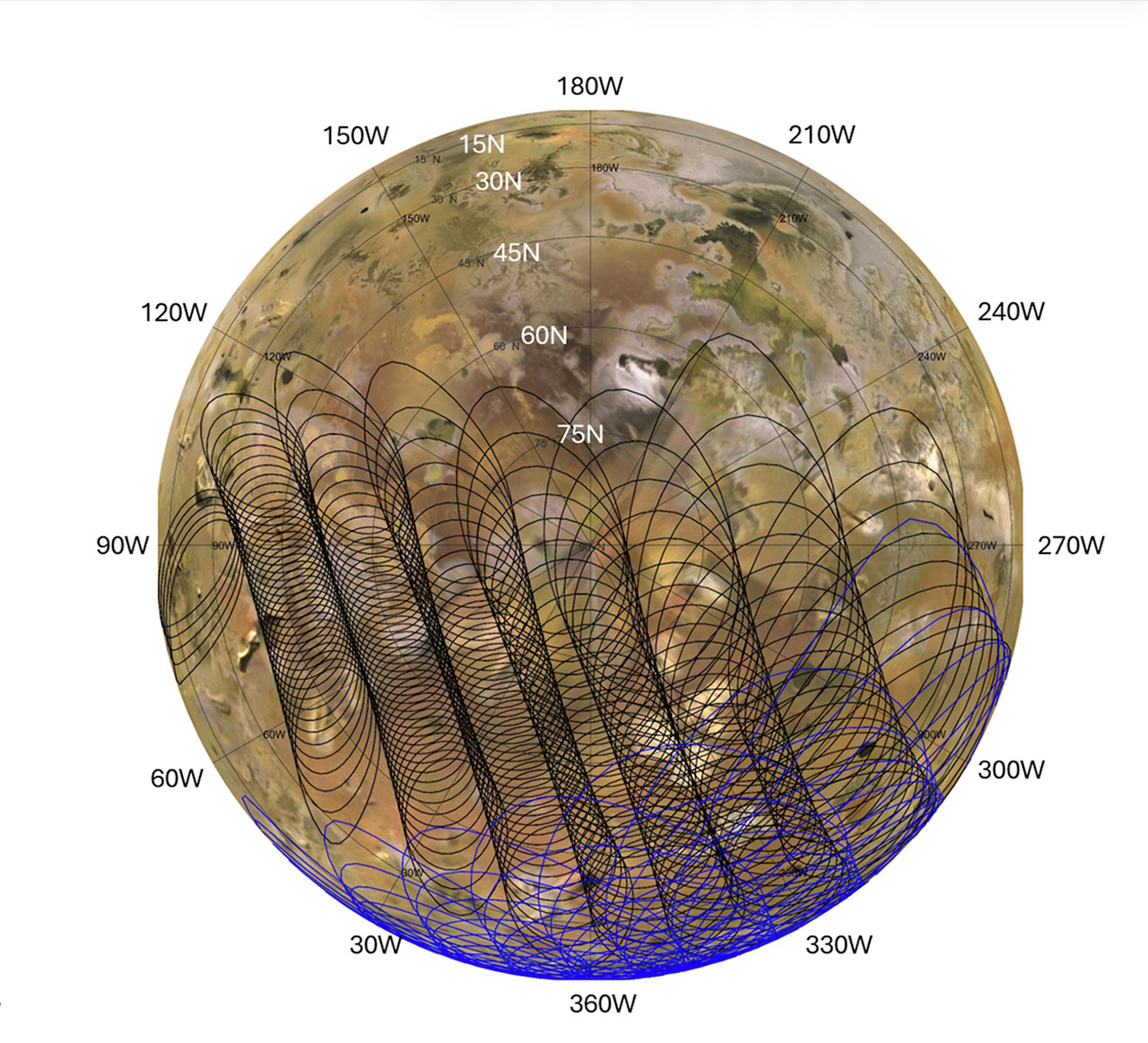
This detailed illustration depicts the regions of Jupiter’s moon Io that were sampled by the Microwave Radiometer (MWR) instrument on NASA’s Juno spacecraft during two critical flybys. The black overlapping lines indicate the footprint of the Chikagi 57th satellite on December 30, 2023, focusing predominantly on the Northern Hemisphere. Meanwhile, the blue line represents near Jupiter 58 on February 3, 2024, highlighting the moon’s mid-latitudes and equatorial regions.
Both flybys mapped the side of Io that is perpetually facing Jupiter. The extensive overlapping patterns are created as the spacecraft rotates at two revolutions per minute while approaching the moon at an approximate distance of 930 miles (1,500 kilometers).
NASA’s Jet Propulsion Laboratory, a division of the California Institute of Technology in Pasadena, California, is leading the Juno mission under the direction of principal investigator Scott Bolton from the Southwest Research Institute in San Antonio. Juno is an integral part of NASA’s New Frontiers program, managed at NASA’s Marshall Space Flight Center in Huntsville, Alabama, under the auspices of the NASA Science Mission Directorate in Washington. The MWR instrument was developed by JPL, while Lockheed Martin Space in Denver is responsible for building and operating the spacecraft.
For further insights and comprehensive information about the Juno mission, visit: NASA Juno Mission and Mission Juno.
Source: science.nasa.gov